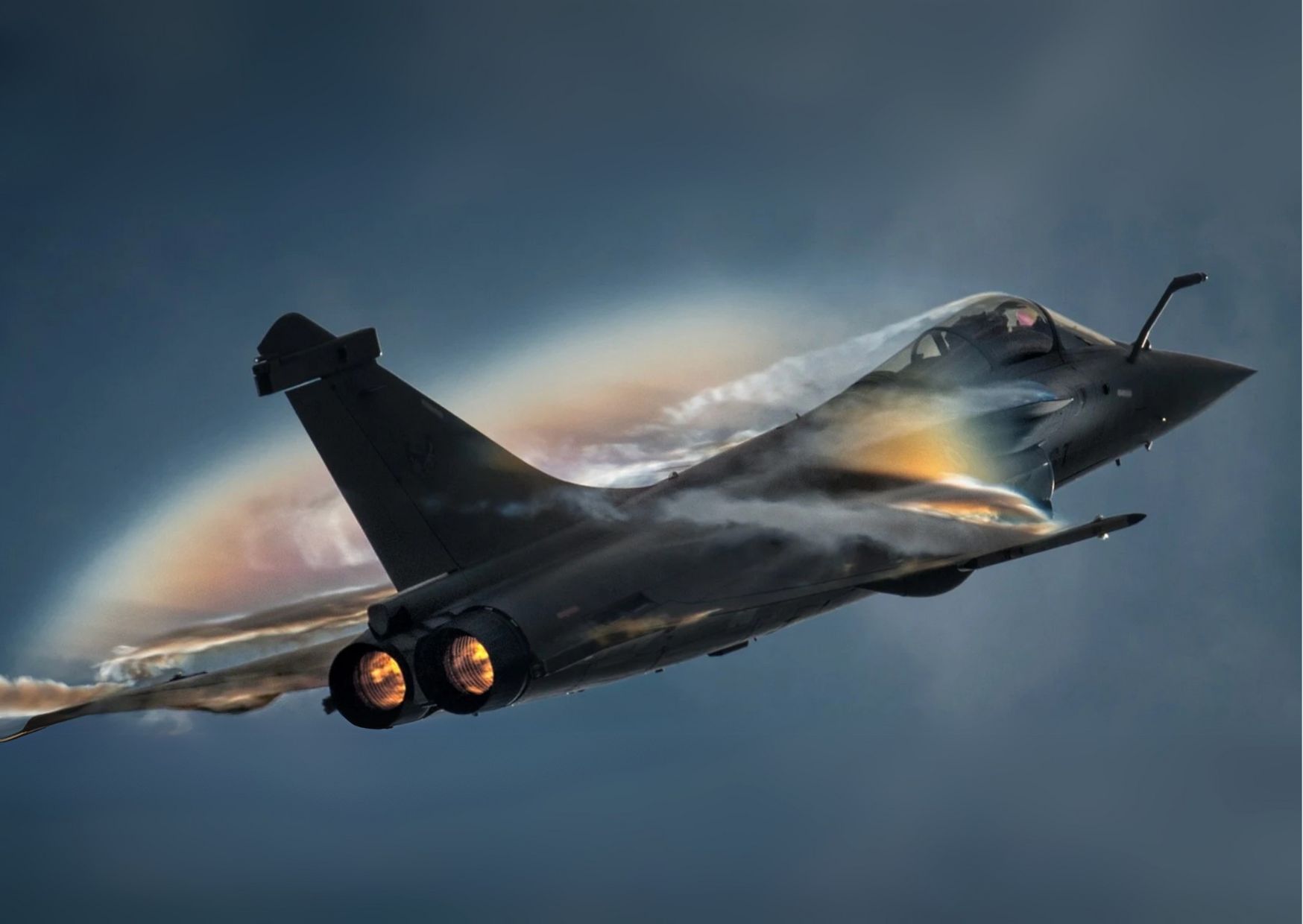
Three French-built aircraft arriving on the tarmac in Sumatra may appear, at first glance, to be a routine arms delivery. In reality, they represent something far more consequential: a visible sign that Europe’s long-neglected defence industry is stirring back to life.
For decades, Europe’s arms manufacturers have struggled under the weight of political hesitation, underinvestment, and an unspoken assumption that American power would always fill the gaps. That illusion has now collapsed. Russia’s war in Ukraine, mounting instability in the Middle East, and growing tensions in the Indo-Pacific have forced European governments to confront a hard truth: credible power requires credible industry. The Rafale’s arrival in Indonesia is one of the clearest expressions yet of that recalibration.
Indonesia’s deal with France, which ultimately covers 42 Rafale jets at a reported cost of around $8 billion, is not merely a procurement choice. It is a vote of confidence in Europe’s ability to design, produce and export cutting-edge military capability without American oversight or Chinese dependence. In an era of fractured alliances and transactional diplomacy, that matters enormously.
The Rafale itself embodies Europe’s quiet resurgence. A 4.5-generation multirole fighter, it boasts advanced radar, electronic warfare systems and weapons integration that place it among the most capable aircraft of its class. Unlike many European programmes of the past, it is not a paper concept or an endlessly delayed multinational compromise. It is operational, battle-tested, and increasingly in demand.
For Indonesia, the aircraft marks a decisive break from an ageing and fragmented fleet of Cold War-era jets. For France — and Europe more broadly — it signals that the continent’s defence industry is once again capable of competing on the world stage. The Rafale’s export success, now spanning India, Egypt, Greece, Croatia, the UAE and Indonesia, would have been unthinkable twenty years ago, when European defence ambition was being steadily hollowed out.
That hollowing out was not accidental. After the Cold War, Europe chose comfort over capability. Defence budgets were slashed, industrial capacity was allowed to atrophy, and strategic responsibility was outsourced to Washington. The consequences are now painfully clear. European arsenals are depleted, production lines are stretched, and the continent is scrambling to relearn skills it once took for granted.
Yet there are signs that the tide is finally turning. France has led the charge, not only with Rafale exports but with sustained investment in naval platforms, submarines, missile systems and aerospace engineering. Indonesia’s parallel purchases of French frigates and submarines underline how European firms are once again offering complete, sovereign defence ecosystems rather than isolated products.
Crucially, Europe’s renewed relevance is not confined to its immediate neighbourhood. Indonesia’s decision to buy Rafales reflects a broader shift among non-aligned states seeking reliable partners who offer advanced technology without political coercion. Unlike Washington, Paris does not attach sweeping strategic conditions. Unlike Beijing, it does not seek to entangle buyers in dependency. In a volatile world, that balance has become attractive.
There is also a strategic message embedded in the deal. As power competition intensifies in the Indo-Pacific, Europe is no longer content to be a bystander. France, with territories and military assets in the region, has been explicit about its Indo-Pacific ambitions. Supplying Indonesia with frontline combat aircraft reinforces that presence, while reminding allies and adversaries alike that Europe retains agency.
Of course, challenges remain. Europe’s defence revival is uneven and fragile. Production rates are still too slow, coordination between states remains imperfect, and political will can evaporate with a change of government. Integrating new platforms such as the Rafale into foreign air forces is complex and costly, demanding sustained training, maintenance and doctrinal adaptation.
Yet momentum matters. Indonesia’s Rafale delivery is not an isolated transaction but part of a growing pattern: Europe is rediscovering that industrial strength is inseparable from strategic autonomy. Every aircraft delivered, every ship launched, every production line restarted strengthens that realisation.
Further Rafale deliveries are expected later this year, with Indonesia planning to phase the jets into active service as its air force undergoes modernisation. As they do, Europe’s defence manufacturers will be watching closely. Success in Indonesia will not only bolster French influence in Asia; it will reinforce the argument that Europe’s defence industry, neglected for too long, is once again indispensable.
The Rafale’s arrival, then, is more than a milestone for Jakarta. It is a reminder that Europe, when it chooses to act, still knows how to build power — and sell it.
NATO’s ‘Eastern Sentry’ begins as French Rafales arrive in Poland