

 ByDefencematters.eu Correspondents
Ukraine’s latest strikes on Russian logistics infrastructure in the south appear designed to do more than cause local damage. They point to a broader effort to complicate the transport and supply systems that sustain Russian operations in occupied Crimea and on the southern front. Fresh reporting on 9 April indicated that Ukrainian drones hit the Krymskaya oil-dispatch node in Krasnodar Krai, while Ukraine’s military intelligence agency said it had also disabled the last remaining Russian rail ferry operating in the Kerch Strait. Taken together, these developments suggest a deliberate campaign against the connective points of Russia’s rear logistics rather than against isolated targets alone.
The strike in Krasnodar Krai is important because the target was not simply a storage site, but a distribution point within a wider pipeline and export network. According to a report by Kyiv Post, the Krymskaya linear production and dispatch station is a major oil artery feeding the Novorossiysk export hub. Earlier Reuters reporting had already identified Ukrainian attacks on oil pumping infrastructure in the same region, underlining that such facilities have become recurring targets in Ukraine’s campaign against Russian energy logistics. These sites matter because they route crude onwards to export terminals and refineries, meaning that even a temporary disruption can have effects beyond the immediate strike zone.
That wider context is important. The Novorossiysk area, which Krymskaya helps supply, has already come under pressure in recent days. Reuters reported on 7 April that loadings at Russia’s Sheskharis terminal in the Black Sea port of Novorossiysk were suspended after a drone attack and fire. Reuters described Sheskharis as Russia’s main oil outlet on the Black Sea, typically loading around 700,000 barrels per day. If a dispatch station such as Krymskaya is also degraded, the cumulative effect is not merely local damage but additional strain on a network already under repeated attack.
The military significance of this should be stated carefully. A strike on a pumping or dispatch station does not by itself sever Russia’s supply lines to the front. Russia retains multiple energy routes, and the extent of damage is often unclear in the first hours after an attack. Even so, repeated strikes on infrastructure of this type force Russia to devote more resources to air defence, emergency response and repair work, while reducing the efficiency and resilience of systems that depend on uninterrupted throughput. Reuters made that broader point in its 8 April overview, “Ukraine renews attacks on Russian energy sites – what has been hit?”, which set the latest incidents within a wider pattern of Ukrainian pressure on Russian fuel and export infrastructure.
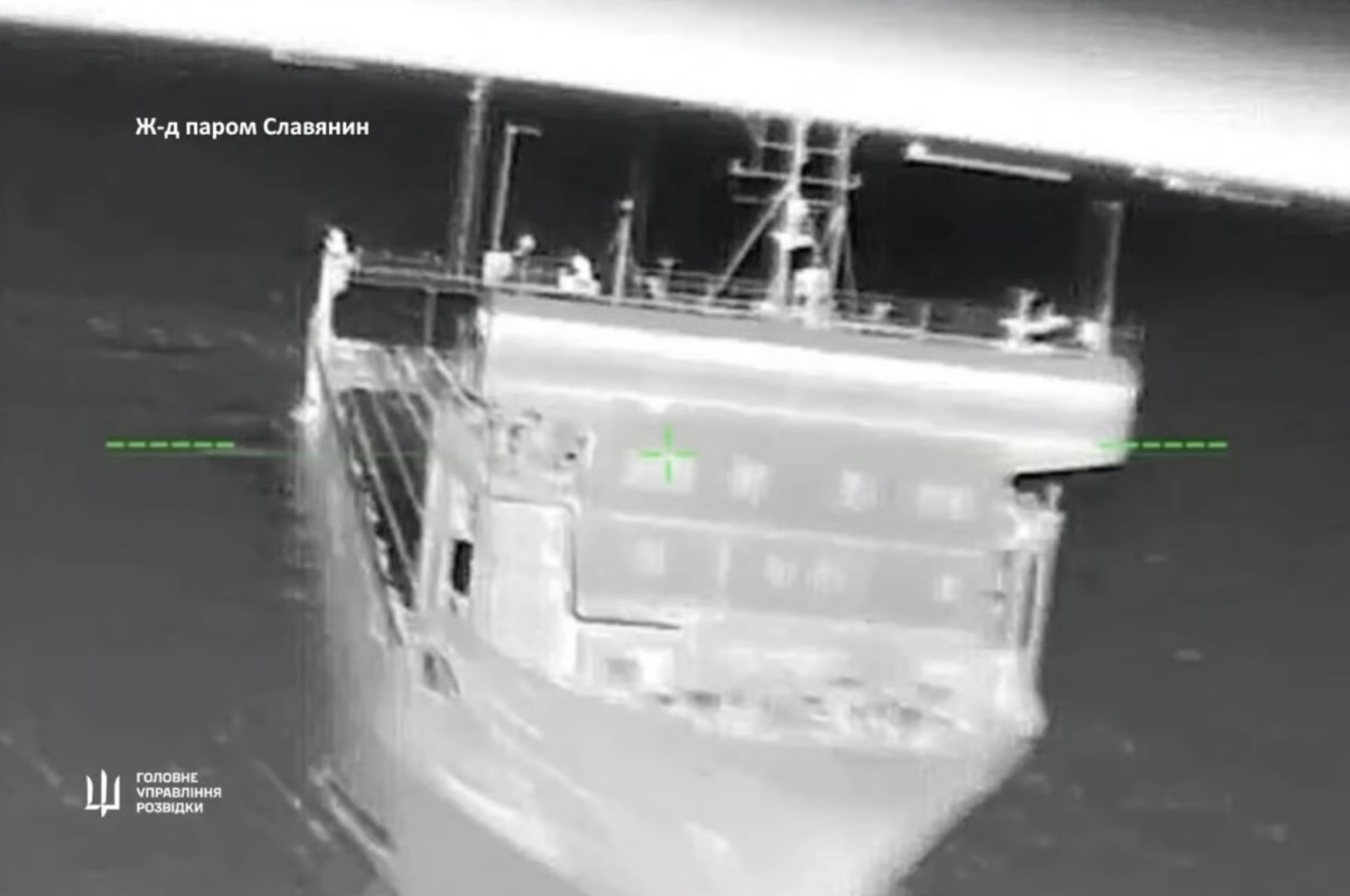
The second development is more directly tied to military supply into Crimea. On 8 April, Ukraine’s Defence Intelligence Directorate published a statement saying its forces had neutralised the Slavyanin, described as the last Russian rail ferry operating in the Kerch Strait. In its official statement, the GUR said the ferry had been used to move rail wagons carrying fuel, weapons, military equipment and ammunition to occupied Crimea.
How serious is that loss? It is significant, but it should not be exaggerated. The principal rail route into Crimea remains the Kerch bridge, not the ferry. As long as the bridge continues to operate, Russia can still move the bulk of its rail traffic into the peninsula. The ferry therefore cannot be described as the main artery of Crimean resupply. However, it was a valuable fallback asset. Its importance lay in redundancy: it provided Russia with an additional means of transferring rail cargo, including potentially sensitive military consignments, across the strait. Once that option is removed, Russian logistics into Crimea become more concentrated and therefore more exposed.
That point becomes sharper if anything happens to the bridge itself. The Kerch crossing has already been damaged in earlier attacks during the war, and it remains one of the most politically and militarily sensitive structures in the theatre. In any future scenario in which the bridge’s capacity is disrupted, even temporarily, the absence of a functioning rail ferry would become far more consequential. In practical terms, there is no equivalent alternative rail route into Crimea from the east. That means the ferry’s loss may not be critical today, but it reduces Russian flexibility in any future contingency.
Taken together, the strikes in Krasnodar Krai and the Kerch Strait reflect a coherent Ukrainian approach. A pumping station, an export terminal and a rail ferry serve different purposes, but all belong to the same wider logistical architecture that supports Russian military power in the south. None of these attacks on its own is likely to collapse Russian supply into Crimea or the front. Their value lies in attrition: narrowing options, increasing pressure, reducing redundancy and forcing Russia to rely more heavily on a smaller number of critical routes. That is not a decisive break in Russian logistics, but it is a meaningful tightening of pressure on one of the most vulnerable elements of Moscow’s war effort.




Is the bridge really in use – I have seen various statements that bridge is severely damaged and not usually by HGV and rail for any significant goods transport. Only used by private vehicles (and only after severe controls leading to long delays)…