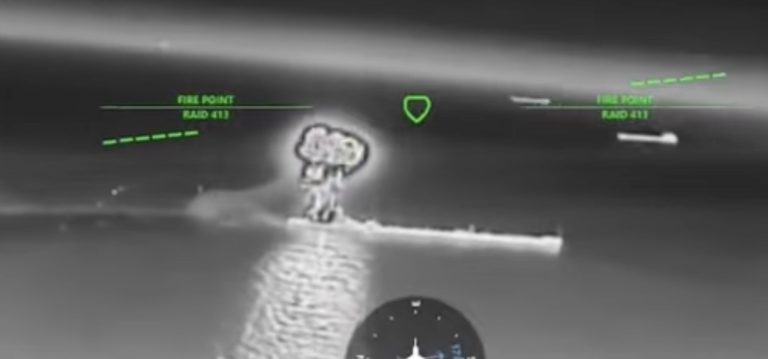
The United States has carried out fresh military strikes in southern Iran, targeting missile launch sites and boats which it said were attempting to lay mines near the Strait of Hormuz. US Central Command said the operation was conducted in self-defence and was intended to protect American forces from threats posed by Iranian units.
The strikes reportedly took place near Bandar Abbas, a major port city and naval base on Iran’s southern coast. Iranian state media reported explosions in the area, while Tehran accused Washington of violating a ceasefire that has been in place for nearly seven weeks. The Islamic Revolutionary Guard Corps also claimed it had downed a US drone and fired at another drone and a fighter jet that it said had entered Iranian airspace, although the timing and circumstances have not been independently confirmed.
The latest escalation comes while diplomatic efforts continue. Iranian officials were in Qatar for talks involving a possible ceasefire extension, arrangements for reopening the Strait of Hormuz and a framework for further negotiations on Iran’s nuclear programme. The discussions appear to be focused on an interim understanding rather than a final settlement.
US Secretary of State Marco Rubio said a deal remained possible, but indicated that agreement on the wording of an initial document could still take several days. Speaking during a visit to India, he said President Donald Trump wanted an agreement, but only on acceptable terms. Rubio also made clear that Washington regarded freedom of navigation through the Strait of Hormuz as a central demand, saying that the waterway “has to be open”.
The Strait of Hormuz remains the main strategic pressure point in the crisis. The narrow waterway links the Persian Gulf with the Gulf of Oman and is one of the world’s most important energy transit routes. Any prolonged disruption would affect oil exports, shipping insurance, Gulf security and energy prices far beyond the region.
Washington’s latest action suggests that the United States is trying to combine negotiations with limited military pressure where it identifies an immediate threat to its forces or to maritime traffic. That approach carries a clear risk. Even a narrowly defined strike can be presented by Tehran as a breach of the ceasefire, while any Iranian retaliation could quickly draw US naval forces, Gulf states and Israel back into a wider confrontation.
For Iran, the calculation is also constrained. Tehran has used its position around Hormuz to demonstrate leverage, but sustained disruption risks increasing its diplomatic isolation and placing pressure on states that have sought to mediate. Qatar’s role is significant because Doha has acted as an intermediary in previous contacts between Washington and Tehran and remains closely involved in the current negotiations.
The nuclear issue adds a further layer to the dispute. Before the current conflict, the International Atomic Energy Agency assessed that Iran had accumulated uranium enriched up to 60 per cent purity. That is below weapons-grade level, but sufficiently advanced to keep the nuclear file at the centre of any durable agreement. Washington is likely to seek verifiable limits, while Tehran will seek sanctions relief, access to frozen funds and security guarantees.
The immediate question is whether the latest US strikes remain a contained military episode or become the basis for a wider collapse of the ceasefire. Washington is presenting its action as defensive and limited. Tehran is framing it as a violation requiring a response. The gap between those positions is where the danger lies.
For now, diplomacy has not stopped. But the events near Bandar Abbas show that the ceasefire is not a stable pause in hostilities. It is operating alongside continued military action, mutual accusations and a contested maritime environment. Unless the parties agree on enforceable rules around Hormuz and a credible path for nuclear talks, each new incident will carry the risk of escalation.