Ukraine’s long-range drone campaign against Russian energy infrastructure appears to have entered a new phase, after reported strikes on fuel-related facilities in Yaroslavl and Volgograd added to a growing pattern of attacks on refineries, pumping stations and oil logistics.
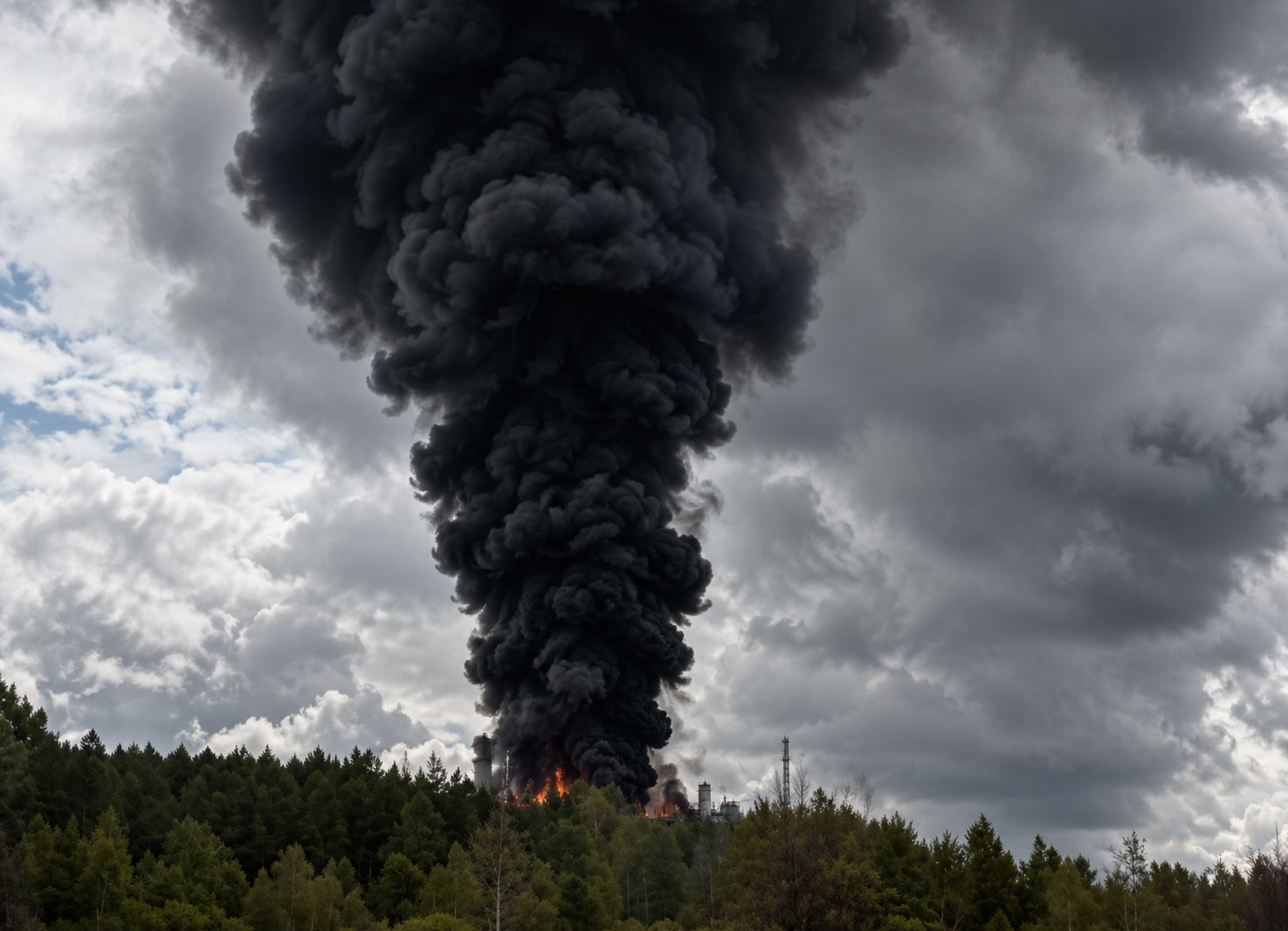
Russian regional officials said the Yaroslavl region came under a mass drone attack overnight, with Governor Mikhail Yevrayev acknowledging that fuel storage facilities had been hit and that emergency services were working to extinguish a fire. Ukrainian media, citing the governor and local reports, said the attack had caused a major fire at a fuel storage facility in Yaroslavl. Images and local accounts circulating after the attack showed a large column of dark smoke rising from an industrial area, consistent with a fire involving fuel or petroleum products.
The target was initially reported by some Russian and Ukrainian channels as the Yaroslavl refinery, one of Russia’s major oil-processing sites. Later accounts pointed instead to fuel storage infrastructure linked to the Yaroslavl-3 linear production and dispatch station, a facility associated with the movement of oil through Russia’s pipeline network. The distinction matters operationally, but not strategically. Whether the target was refining capacity or pipeline-linked storage, the strike fits a broader Ukrainian effort to interfere with Russia’s ability to process, move and export oil.
The Yaroslavl region has been hit repeatedly in recent weeks. Earlier this month, explosions were reported in the city after another suspected drone attack, with Ukrainian reporting saying that an industrial facility, possibly linked to oil refining, had been struck. The General Staff of Ukraine also said that a previous strike had targeted the Yaroslavl oil refinery, describing it as one of the largest refining enterprises in Russia and noting that it produced petrol, diesel and aviation fuel.
A separate strike was reported at the Lukoil refinery in Volgograd, where fires have been recorded after previous drone attacks. The Volgograd facility has been struck several times since the start of Russia’s full-scale invasion of Ukraine. In February, Ukraine’s General Staff confirmed a drone strike on the Volgograd oil refinery, while other reports described the site as one of Russia’s largest refining plants. The refinery supplies fuel products used across southern Russia and forms part of the wider energy infrastructure that Kyiv has increasingly treated as a military-economic target.
Ukraine has not always publicly claimed responsibility for individual attacks inside Russia, but its military and political leadership have repeatedly argued that Russian oil infrastructure helps sustain Moscow’s war effort. The logic is straightforward: refineries provide fuel for civilian and military use, while export infrastructure generates revenue that supports the Russian state budget. Pumping stations and storage terminals are therefore not peripheral targets. They are part of the logistical chain that connects Russian crude production to domestic supply, ports, tankers and export income.
The latest strikes also coincide with reports that three Russia-linked tankers were hit by drones off Turkey’s Black Sea coast. The Palau-flagged James II and the Sierra Leone-flagged Altura and Velora were attacked near Turkey’s northern coast, with all crews reported safe. The vessels were said to be in ballast at the time. The Associated Press reported that the tankers were associated with networks used to bypass Western restrictions on Russian oil exports. No party has publicly claimed responsibility for the attacks.
Taken together, the incidents point to a wider operational pattern. Ukrainian strikes are no longer limited to spectacular attacks on individual refineries. They increasingly appear to target the connective tissue of Russia’s energy system: pumping stations, storage facilities, port terminals, tankers, radar assets and air-defence systems protecting key nodes. The aim is not necessarily to destroy the entire sector in a single blow, but to impose cumulative pressure, raise protection costs, create repair bottlenecks and complicate the movement of oil and fuel.
The social and political effects inside Russia are also becoming harder for local authorities to conceal. In Yaroslavl, road closures following drone alerts and strikes have disrupted traffic towards Moscow. Such measures may be temporary, but they show how the war is affecting regions that the Kremlin continues to present as distant from the battlefield. For residents of industrial cities regularly subjected to drone alerts, fires and emergency restrictions, the distinction between front-line war and rear-area security is becoming less clear.
Moscow still has significant defensive capacity, particularly around the capital and strategic military sites. Yet the repeated penetration of drones into central Russia suggests that available air-defence coverage remains uneven. Protecting every refinery, depot, pipeline station, radar installation and tanker route is a far larger task than defending a limited number of political and military centres.
For Ukraine, the campaign offers a way to offset Russia’s advantages in manpower and artillery by targeting economic and logistical systems deep inside Russian territory. For Russia, it creates a dilemma: every additional air-defence unit assigned to refineries or fuel depots is a unit not deployed elsewhere.
The immediate damage from the latest attacks will depend on the scale of the fires, the equipment affected and the speed of repairs. The wider significance, however, is already clear. Russia’s oil infrastructure is no longer a secure rear-area asset. It has become a recurring battlefield in a war increasingly shaped by drones, logistics and economic attrition.