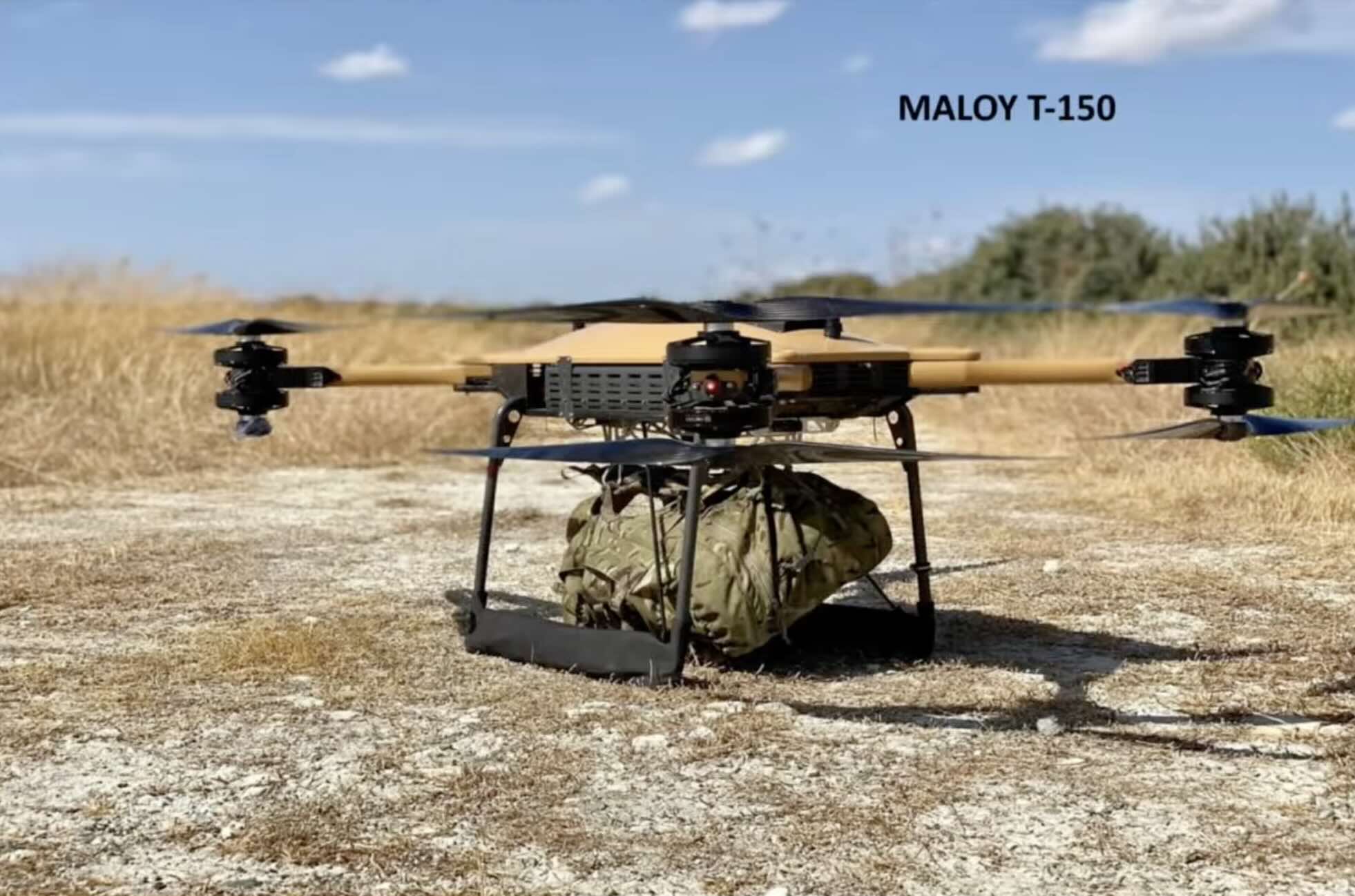
A recent report in The Telegraph has brought fresh attention to an operation in occupied Kherson region that appears to have taken place some time before it entered the public domain. The report said Ukrainian forces used British-made Malloy T-150 heavy-lift drones in an operation against a Russian-controlled bridge crossing over the Konka River, a waterway running through the left-bank part of Kherson region.
What makes the episode significant is not simply that a bridge was attacked. Throughout the war, both sides have treated bridges, ferries and river crossings as legitimate military infrastructure because of their role in sustaining frontline forces. The importance of this case lies in what it suggests about method. According to The Telegraph, the bridge was not destroyed by a single drone hit or missile strike, but through a sustained operation in which transport drones carried explosive loads to a vulnerable point in the structure over a period of weeks.
That is a notable distinction. A one-off strike is an attack. A repeated effort to accumulate explosive force at a bridge support is closer to a combat engineering mission carried out from the air. The report said the drones conducted about 30 sorties over two months, carrying around 1.5 tonnes of explosives in total before the crossing was finally brought down. If that account is accurate, the operation represents a different model of drone warfare: not merely hitting a target, but methodically degrading it until collapse becomes possible.
The geographical setting helps explain the operational value of such a strike. The Konka River lies within the complicated riverine terrain east of the Dnipro, where channels, islands and marshland create a fragmented battlespace. In that environment, even relatively modest crossings can be important for moving supplies, ammunition and personnel between rear positions and the narrow belt of territory nearer the main river line. Ukrainian and Russian reporting alike have repeatedly highlighted the military importance of river logistics in Kherson region, where resupply routes are constrained by water obstacles and exposed movement corridors.
This is also why the story has resonance beyond one bridge. The war has already demonstrated how difficult major crossing points can be to destroy outright. In 2022, Ukraine repeatedly struck the Antonivskyi bridge near Kherson during the campaign to isolate Russian forces on the western bank of the Dnipro. Those attacks inflicted serious damage and reduced the bridge’s usability, but complete structural destruction was not immediate. Large Soviet-era bridges were often built with substantial margins of strength, and damage to the deck does not necessarily mean the supporting structure will fail.
That is what makes the reported Kherson operation so interesting from a defence perspective. Instead of trying to strike the roadway from above, the drones were reportedly used to place or deliver charges close to the bridge’s supporting elements. In practical terms, that is a far more efficient way to bring down a crossing, because it targets the part of the structure that actually carries the load. A bridge deck can be patched. A failed support is a different matter.
The use of the Malloy T-150 is central to the story. This is not a conventional kamikaze drone. It is a logistics platform designed to move cargo, with a payload capacity suited to resupply missions in difficult terrain. Its reported adaptation for demolition work illustrates one of the main features of this war: systems developed for one purpose are repeatedly being modified for another. Ukrainian forces have already shown a consistent capacity to improvise with unmanned systems at sea, in the air and on land. This case suggests that logistics drones can also be turned into tools for precision infrastructure attack.
There is a broader implication here. Russian military commentators have often asked why Moscow has not been able to destroy Ukraine’s bridges over the Dnipro in a systematic way, given their importance for internal supply routes from western Ukraine towards the east and south. The answer, at least in part, is that destroying a bridge is harder than hitting it. It requires sustained access, accurate targeting of critical structural points, and enough explosive force delivered in the right place. The reported Kherson operation appears to demonstrate precisely that principle.