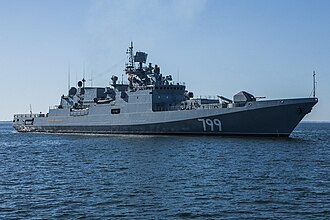
Britain’s recently announced power to board sanctioned shadow fleet vessels in UK waters has come under immediate scrutiny after a Russian frigate escorted two sanctioned tankers through the English Channel this week, in what appears to be the clearest early test of how far London is willing and able to enforce its new policy. The UK government had said on 25 March that British military and law-enforcement personnel would be able to board shadow fleet vessels transiting UK waters as part of a broader effort to disrupt Russian oil exports funding the war in Ukraine.
The fresh pressure point emerged on 9 April, when the Kremlin publicly defended Russia’s right to protect what it described as its maritime interests after reports that the frigate Admiral Grigorovich had escorted two sanctioned tankers through the Channel. The two vessels, identified as the Russian-flagged Universal and the Cameroon-flagged Enigma, were carrying diesel loaded at the Russian port of Primorsk and were tracked moving through one of Europe’s busiest sea lanes. The earliest reliable public confirmation of the new peg is a 9 April report published at 9:49 AM UTC, followed the same day by Kremlin comments defending the escort.
That makes the episode more than a maritime curiosity. It directly tests the credibility of the announcement made by Downing Street and the Ministry of Defence last month. In that 25 March statement, the government said British forces had been given permission to board sanctioned ships transiting UK waters, presented the move as a direct blow to Russia’s shadow fleet, and linked it to wider allied efforts to reduce the Kremlin’s ability to move oil outside the sanctions regime. The statement also said more than 300 shadow fleet movements had been recorded in and around UK waters in the first three months of 2026.
The Channel escort suggests the legal power announced in March is only one part of the problem. A policy can exist on paper, but its practical application depends on timing, intelligence, escalation risk and the legal context of passage through international straits and adjacent waters. When a sanctioned tanker is accompanied by a Russian naval vessel, the issue moves beyond sanctions enforcement into deterrence, alliance coordination and rules governing military conduct at sea. None of that invalidates the March measure. It does, however, show that implementation will be more difficult than a press release implies.
There is also a broader strategic point. Shadow fleet traffic is not simply a sanctions story. It sits at the junction of maritime security, energy flows and state-backed coercion. Russia’s use of ageing or obscurely flagged tankers has already become a central feature of its effort to keep oil moving despite Western restrictions. A visible naval escort raises the stakes further, because it signals that Moscow is prepared to attach state military protection to commercially useful movements when it judges the route or cargo important enough. In that sense, the Channel passage was not only about two tankers. It was a signal about how Russia intends to defend parts of its sanctions-evasion network.
For Britain, the problem is not confined to one transit. The March policy was framed as a deterrent: by making interdiction possible, London hoped to force sanctioned vessels to divert or recalculate risk before entering UK waters. That may still happen in some cases. But the 9 April episode indicates that deterrence will be uneven, especially where the vessel’s operators believe the UK is unlikely to intervene against a convoy that includes a warship. The gap between declared authority and credible enforcement is therefore likely to become the central issue in any assessment of the policy’s success.
The official UK line remains that the policy is real and usable. The March announcement was explicit in saying that British forces would be able to board sanctioned ships transiting UK waters. It also linked the step to a wider pressure campaign against the shadow fleet, including sanctions designations and coordination with allies. Yet the Channel escort has demonstrated the limits of treating the issue as a simple boarding matter. Maritime sanctions enforcement becomes more complex when a state navy enters the picture, particularly in a congested and politically sensitive route used by multiple allied navies and commercial operators every day.
The immediate question now is not whether the UK has announced a tougher policy. It has. The question is whether the government is prepared to operationalise that policy in circumstances where enforcement may trigger direct confrontation, or whether the main purpose of the March move was to impose uncertainty and selective deterrence rather than routine interdiction. The Channel incident does not settle that question, but it has brought it forward much sooner than ministers might have expected.
For defence planners and sanctions officials alike, the lesson is straightforward. Britain’s shadow fleet strategy can no longer be discussed only in terms of legal powers and announced intent. It must now be judged against live maritime behaviour, escort patterns, and the degree to which Russia is willing to contest interdiction in practice. The 9 April passage made that shift impossible to ignore.
Britain’s Hollow Shield: A Nation Exposed in the Age of Missiles
Main Image: Mil.ru