

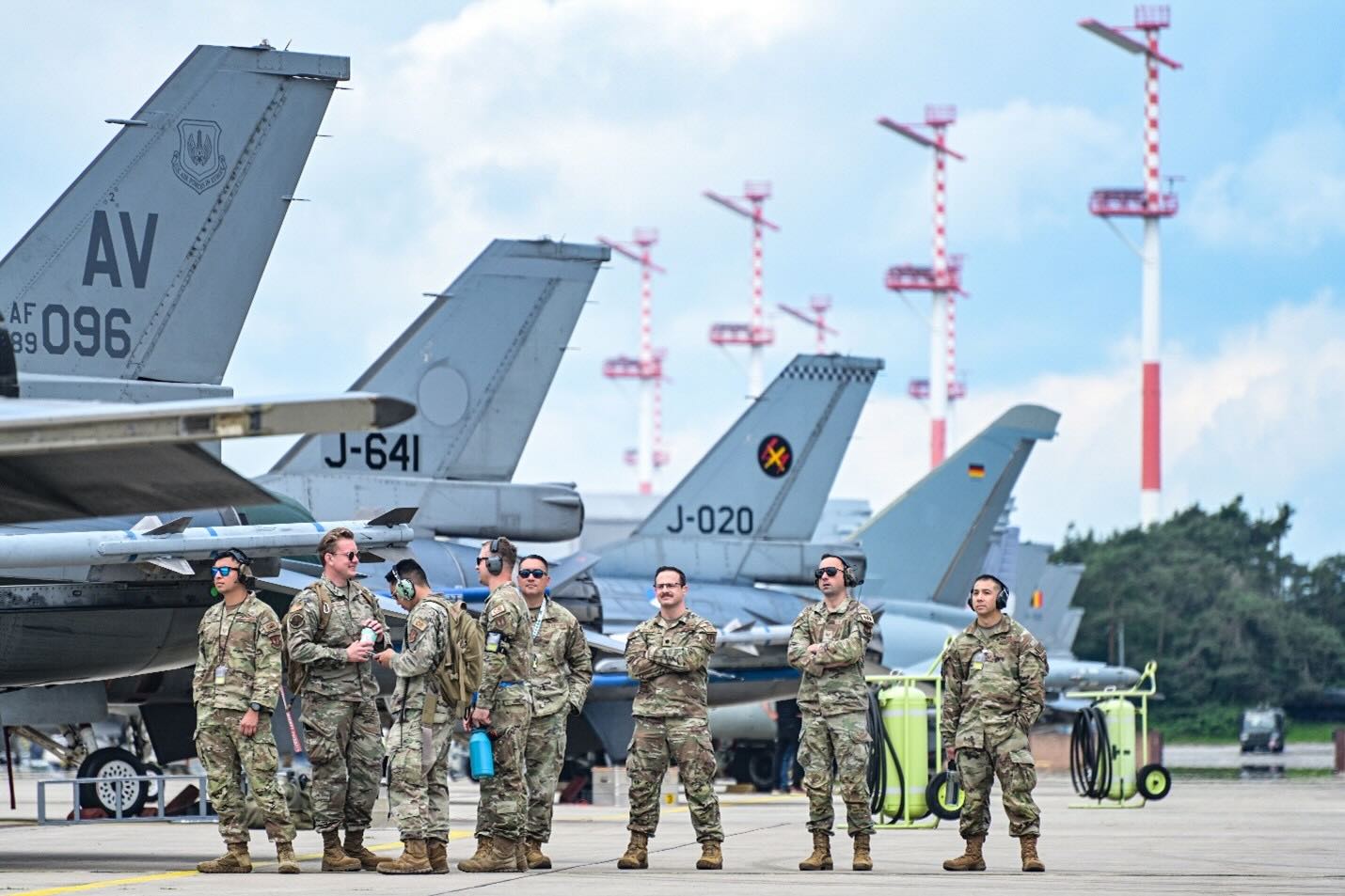
US President Donald Trump has said Washington is reviewing a possible reduction of American forces stationed in Germany, in a move that would test alliance planning at a time of renewed tension between the White House and Chancellor Friedrich Merz over Iran and NATO burden-sharing.
US President Donald Trump has said his administration is considering a reduction in the number of American troops stationed in Germany, raising questions over Washington’s military posture in Europe and the future of transatlantic security planning.
In a post on Truth Social, Trump said the United States was “studying and reviewing” a possible reduction of troops in Germany, with a decision to be made “over the next short period of time”. The White House has not set out the scale of any potential reduction, nor has the Pentagon issued operational details on whether the review would affect permanent basing, rotational deployments, command structures or support units.
The statement comes during a public dispute between Trump and German Chancellor Friedrich Merz over Washington’s handling of the conflict with Iran. Merz criticised what he described as the absence of a clear American strategy, saying Tehran was humiliating the United States during negotiations. Trump responded by accusing the German leader of not knowing what he was talking about and of tolerating the prospect of Iran obtaining nuclear weapons.
The row has taken place against a broader argument inside NATO over European support for US and Israeli operations linked to Iran. Trump has repeatedly criticised several allies for not doing more, including by failing to deploy naval forces in support of efforts to secure maritime routes in the Gulf region. Trump’s warning on Germany followed criticism of NATO members that had not sent naval assets to help reopen the Strait of Hormuz.
Germany remains the most important host nation for US forces in Europe. More than 68,000 active-duty US personnel were stationed in Europe as of December 2025, with more than 36,000 of them based in Germany.
The American presence in Germany includes facilities central to US, NATO and wider allied operations. Ramstein Air Base remains a major logistics and command hub, while Germany also hosts the headquarters of US European Command and US Africa Command. Any substantial reduction would therefore have implications beyond bilateral relations between Washington and Berlin, affecting reinforcement planning, air mobility, medical evacuation, intelligence coordination and US power projection into Europe, the Middle East and Africa.
Trump’s latest comments also echo a policy dispute from his first term, when his administration sought to reduce the US troop presence in Germany amid repeated complaints over defence spending and alliance burden-sharing. That earlier move was later reversed under President Joe Biden. The renewed threat now comes in a different strategic environment, with Europe still responding to Russia’s war against Ukraine and with NATO governments under pressure to increase military expenditure, industrial capacity and readiness.
For Germany, the timing is politically sensitive. Merz has called for a stronger national defence posture and closer European coordination, while Berlin continues to face pressure from Washington over the scale of its military contribution. Despite the dispute between Trump and Merz, senior US defence officials have acknowledged Germany’s recent defence ambitions, including plans to expand the Bundeswehr into Europe’s largest conventional force.
For NATO, the issue is not confined to troop numbers. US forces in Germany form part of a wider network that supports deterrence on the alliance’s eastern flank, rapid reinforcement and operational command. A reduction could be manageable if planned in consultation with allies and offset by other arrangements. If carried out as a political signal, however, it could increase uncertainty among European governments seeking clarity over Washington’s long-term commitment to the continent.
The announcement also underlines a broader shift in US alliance politics under Trump. Rather than treating the American military presence in Europe as a fixed strategic asset, the president has framed it as conditional on allied behaviour and political alignment with Washington’s priorities. That approach gives the White House leverage in disputes with European capitals, but it also risks weakening predictability inside NATO at a time when planning assumptions are central to deterrence.
Berlin has not yet issued a detailed public response to the latest statement. The Pentagon and White House have also not provided further operational detail. Until they do, the announcement remains a political warning rather than a defined military plan. Even so, the prospect of a drawdown from Germany is likely to intensify debate in Europe over dependence on US military infrastructure and the pace at which European states can assume greater responsibility for their own defence.

Britain’s Consistent Message on Ukraine Carries Growing Weight at the OSCE