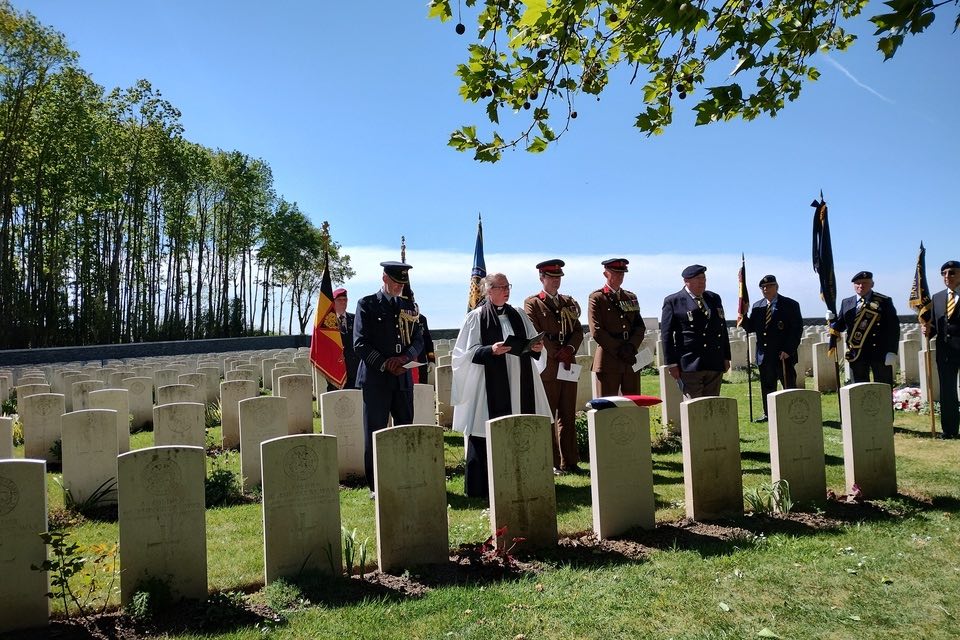
This week, the British government confirmed that two officers killed in the early months of the First World War have at last been identified, 111 years after their deaths. Captain Gordon Cuthbert and Lieutenant Leslie Harvey, both of the 1/8th Battalion, Duke of Cambridge’s Own (Middlesex Regiment), were killed on 25th April 1915 during the bitter fighting near Ypres. For decades, their graves lay unmarked, their identities lost to the chaos of that brutal spring.
Now, at last, they are no longer unknown.
There is something profoundly moving in such moments of recognition — not merely for the descendants who may still carry a faint echo of their names, but for a nation that has long wrestled with the scale of its loss. For every soldier identified, there are many thousands who remain unnamed, their final resting places marked only by a simple, haunting epitaph: “Known unto God.”
The First World War, perhaps more than any conflict before it, produced death on an industrial scale — and anonymity to match. The sheer violence of artillery, the obliteration of trenches, and the shifting lines of battle often left little behind that could be recognised. Bodies were buried hastily, graves destroyed, records lost. In many cases, there was nothing left to identify at all.
Today, more than 300,000 soldiers of the British Empire who died on the Western Front are still commemorated on memorials to the missing, rather than beneath named headstones. Their names are carved into vast walls of stone — at Menin Gate, Thiepval, Tyne Cot — silent rolls of honour for men who have no known grave.
Even among those who were buried, anonymity remains strikingly common. The Commonwealth War Graves Commission records over 200,000 graves of the First World War marked without a name, each bearing Kipling’s stark phrase. It is a number that defies comprehension: an entire army of the unidentified, lying in neat rows across France and Belgium.
And it was not only the British who endured this fate. German, French, and other armies suffered similar losses, their dead often interred in mass graves or lost altogether amid the mud and shellfire. The Western Front was not merely a battlefield; it was, in many places, a vast, unmarked cemetery.
Against that backdrop, the identification of two officers may seem a small thing. Yet it is precisely in such small acts that the past is made human again.
For Cuthbert and Harvey were not abstractions. They were young men, products of Edwardian Britain, who found themselves thrust into a war that few could have imagined and fewer still survived. They died within months of the conflict’s outbreak, at a time when illusions of a short war had already begun to dissolve in the mud of Flanders.
Their battalion was part of the Territorial Force — men who had not expected to serve abroad, yet found themselves in the thick of the fighting. In April 1915, near Ypres, they would have faced shellfire, gas, and the grinding attrition that came to define the war. Their deaths, like those of so many others, were recorded. Their burial places were not.
Until now.
The work that led to their identification is painstaking and often painstakingly slow. It draws on fragmentary records, regimental histories, archaeological evidence, and, increasingly, advances in forensic science. Occasionally, a name emerges from the fog — a life restored to history.
Such moments also serve as a reminder that the First World War is not as distant as it sometimes appears. Its consequences are etched not only into memorials, but into families, landscapes, and the very identity of Europe.
In Britain, the tradition of honouring the unknown dead found its most powerful expression in the burial of the Unknown Warrior in Westminster Abbey in 1920 — a single body chosen to represent the many who had no grave at all. It was an attempt to give form to an absence, to offer a focal point for grief that could not otherwise be resolved.
Yet even that solemn gesture could not answer the deeper question: who were they?
Every identification, however small, is a partial answer. It restores individuality to a war that so often stripped it away. It reminds us that behind every statistic — every “unknown” — there was a name, a family, a story cut short.
In the cemeteries of Flanders, the rows of white headstones stretch on, immaculate and serene. Some bear names; many do not. Together, they form a landscape of remembrance that is both ordered and incomplete.
The naming of Captain Cuthbert and Lieutenant Harvey does not change the scale of that loss. But it does something else, something quieter and perhaps more enduring.
It gives two men back their place in the world.
And, in doing so, it reminds us how many more are still waiting.
Main Image: GOV.UK
British and German soldiers of the Great War laid to rest together near Ypres