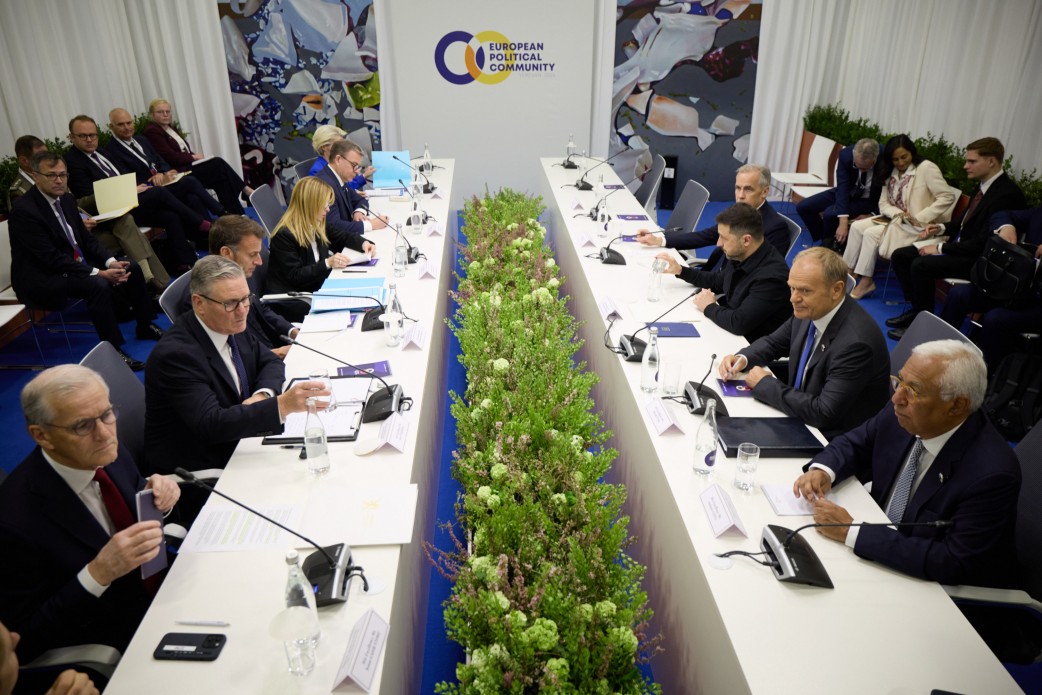
President Volodymyr Zelenskyy has used a meeting with European and NATO partners on the sidelines of the European Political Community summit in Yerevan to call for stronger air defence and a European capacity to respond to ballistic threats.
The meeting, described by the Ukrainian presidency as taking place in the Washington format, brought together Zelenskyy with the leaders of France, the United Kingdom, Italy, Norway, Poland, Finland and Canada, as well as the presidents of the European Council and European Commission and NATO Secretary General Mark Rutte.
According to the Ukrainian presidency, the discussion focused in detail on strengthening air defence, including the production of European systems and missiles, support for the Prioritised Ukraine Requirements List, known as PURL, and ways to equip Europe with its own anti-ballistic capabilities.
The emphasis on anti-ballistic capacity is significant. Ukraine’s experience of Russian missile attacks has shown that air defence is no longer only a national requirement for Kyiv. It has become a European security issue, tied to the continent’s ability to detect, intercept and sustain defences against ballistic and long-range missile threats.
Zelenskyy told partners that Europe must have its own capacity to respond to ballistic threats. The statement reflects a wider shift in European defence policy from emergency transfers of existing equipment to questions of production, stockpiles and long-term capability. The practical issue is whether European states can produce enough interceptors, missile systems and supporting equipment to sustain Ukraine while also improving their own readiness.
The Ukrainian statement said Canadian Prime Minister Mark Carney had announced an additional $200 million for the PURL initiative before the meeting. NATO Secretary General Mark Rutte was also cited as saying that the provision of anti-ballistic missiles to Ukraine remained consistent with earlier arrangements.
PURL has become one of the mechanisms through which partners help Ukraine acquire urgent defence equipment, including items sourced from available stockpiles and coordinated with NATO structures. The Yerevan discussion suggests that the mechanism is being treated not only as a short-term supply tool, but also as part of a broader effort to align European and transatlantic support around specific battlefield requirements.
For defence planners, the key point is production capacity. Europe has increased commitments to Ukraine since Russia’s full-scale invasion, but the war has exposed limits in ammunition output, missile availability and air-defence replenishment. Air-defence systems are valuable only if they can be supplied with sufficient interceptors, maintained under wartime conditions and integrated into a wider command structure.
The Yerevan meeting also underlined the link between Ukraine’s needs and Europe’s own exposure to missile and drone threats. The same technologies used against Ukrainian cities, energy infrastructure and military sites have wider implications for NATO’s eastern flank and for European critical infrastructure. A European anti-ballistic capacity would therefore serve both immediate support to Ukraine and longer-term deterrence.
The issue is not limited to equipment procurement. Anti-ballistic defence requires sensors, launchers, interceptors, command-and-control systems, training, maintenance and predictable industrial supply. It also requires political decisions on where systems are deployed, how they are financed, and whether capabilities remain under national control or are integrated into wider European and NATO planning.
The meeting took place during the European Political Community summit, a format that includes both EU and non-EU states. That setting allowed Ukraine to raise defence production and air-defence priorities with a broader group than the EU alone. The presence of NATO, the European Commission and the European Council gave the discussion a combined political, institutional and alliance dimension.
The Ukrainian presidency also said diplomacy had been discussed, including efforts to reinvigorate negotiations, contacts with the United States and Europe’s role in any future process. The participants, according to the statement, shared the view that Europe’s position must be heard and that Europe must have a place at the negotiating table.
That diplomatic point matters for defence policy. Ukraine’s argument is that military capacity and diplomatic leverage are connected. Stronger air defence, missile production and resilience funding are not presented only as battlefield measures, but as factors that strengthen Ukraine’s position in any future talks.
Energy infrastructure was also discussed. Zelenskyy briefed partners on threats from Russia, based on Ukrainian intelligence, and discussed support for Ukrainian energy resilience. He thanked the European Union for unblocking a €90 billion financial package and said part of the funds would be directed towards resilience plans ahead of winter.
The Yerevan meeting therefore combined immediate wartime priorities with longer-term European capability questions. Ukraine is seeking more air-defence support now, but the broader issue is whether Europe can build the industrial and operational base needed to sustain anti-ballistic defence over time.