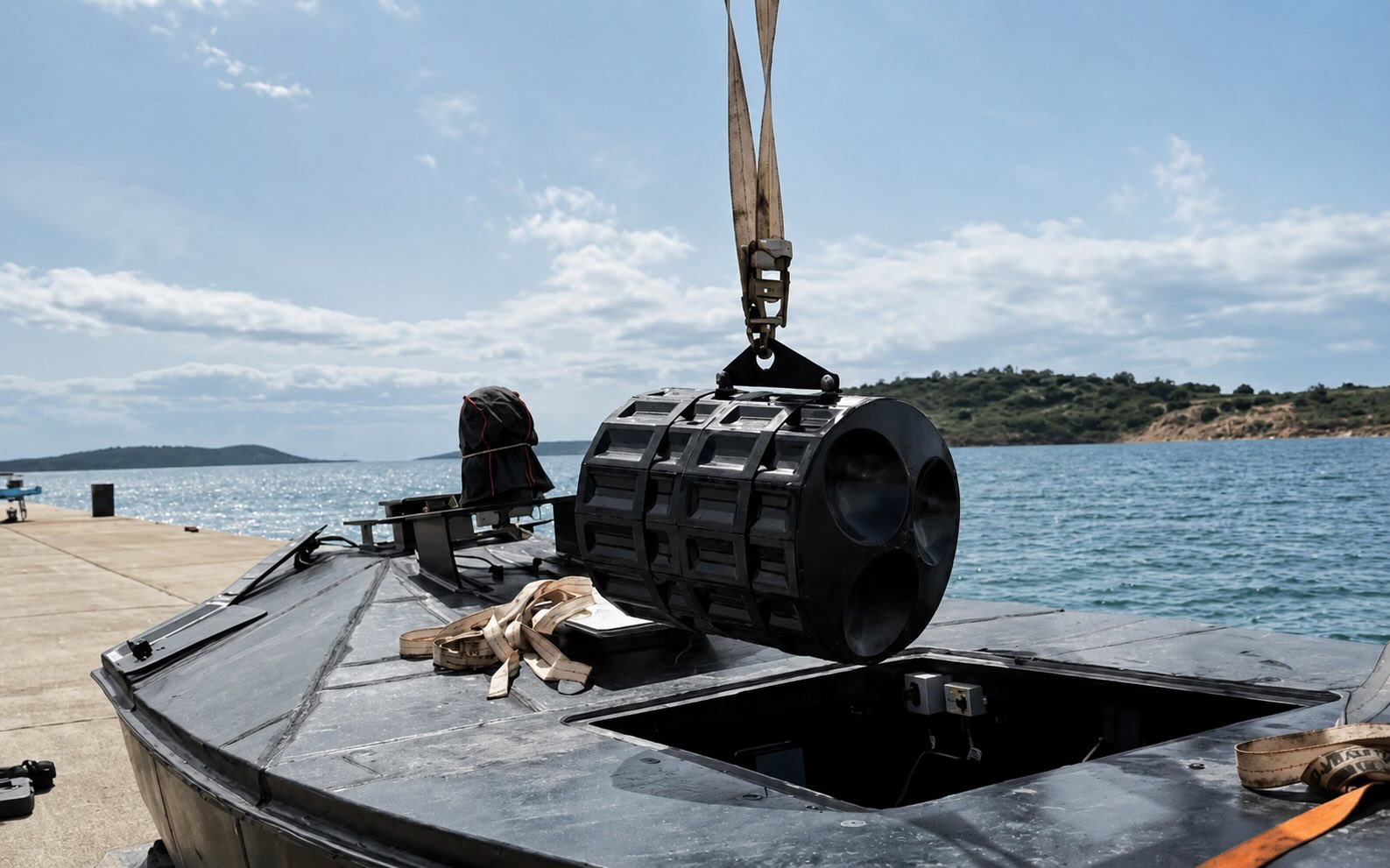
Greek authorities have said they are “certain” that an explosives-laden sea drone recovered off the island of Lefkada was of Ukrainian origin, after preliminary technical examination of the unmanned vessel.
The device was found last Thursday by fishermen near the western Greek island and was later transferred to the Skaramagas naval base, where it is undergoing detailed analysis by Greek naval specialists.
According to information reported by Kathimerini, the vessel is believed to be a Ukrainian-made unmanned surface vehicle of the Mamai type, also known by the trade name Cossack Mamai. The system is designed for one-way strike missions and is capable of carrying a large explosive payload.
Initial assessments had suggested that the vessel could be linked to another Ukrainian naval drone, the Magura. Further examination, however, has pointed towards the Mamai type, a platform used in Ukrainian operations in the Black Sea against Russian naval and maritime targets.
The drone is not considered technologically complex, but its operational significance lies in its speed, explosive capacity and ability to be used in kamikaze-style attacks. The vessel can reportedly reach speeds of up to 110 km/h and has been used in several Ukrainian maritime operations since Russia’s full-scale invasion.
Greek Defence Minister Nikos Dendias raised the issue during the meeting of EU defence ministers in Brussels on Tuesday. Ukraine’s Defence Minister Mykhailo Fedorov joined the discussion by video link.
Dendias said Greece had now established “with certainty” that the unmanned surface vessel recovered off Lefkada was Ukrainian. Fedorov reportedly said he was unaware of the case and undertook to investigate the matter and provide answers.
The Greek minister described the incident as an “extremely serious issue”, saying the presence of an explosives-laden unmanned vessel in Greek waters affected the freedom and security of navigation.
His comments followed remarks by Greek Foreign Minister George Gerapetritis, who warned that any broadening of the war against Russia into the Mediterranean would be a dangerous development.
The technical investigation is being carried out at Skaramagas, where specialists are examining the drone’s structure, components, possible route and origin. Once the assessment is complete, the file is expected to be passed to the Coast Guard and then to judicial authorities.
The working assumption in Athens is that the vessel may have been connected to a possible attack on a Russian or Russia-linked ship. That conclusion has not been confirmed by Kyiv, and Ukrainian officials have not yet provided a public explanation of how the drone reached waters near Lefkada.
Greek officials have identified the vessel as Ukrainian-made, but this does not necessarily establish who launched or controlled it. One possibility under examination should be whether the drone had previously been captured in the Black Sea and later used by Russian actors as part of an intelligence or disinformation operation. That scenario remains unconfirmed and would require analysis of the vessel’s navigation systems, communications equipment and route data.
The incident has raised questions in Greece over maritime surveillance in the Ionian Sea. Opposition parties have criticised the authorities for failing to detect the vessel before it was found by fishermen.
Greek defence officials have rejected that criticism, arguing that locating a small unmanned vessel in open waters would be comparable to detecting a small pleasure craft. They have also noted that the Hellenic Navy maintains a reduced presence in the Ionian Sea, with most of its resources concentrated in the Aegean, where Athens has long focused on tensions with Turkey.
The wider issue is how the episode may affect relations between Athens and Kyiv. Greece has supported Ukraine since the start of Russia’s full-scale invasion in February 2022, including through military assistance and political backing based on the principle of the inviolability of borders.
Athens has also provided support through third parties, while maintaining a cautious approach to the regional implications of the war. The appearance of a Ukrainian-made strike drone in Greek waters introduces a new security concern for a country with major maritime interests and one of the world’s largest commercial fleets.
For the European Union, the incident comes at a time when member states are seeking to maintain military and financial support for Ukraine. The EU defence ministers’ meeting focused on Ukraine’s defence needs, industrial cooperation, and the need to sustain supplies to Kyiv in the coming months.
The Lefkada case is unlikely to change the EU’s wider policy on Ukraine. It may, however, prompt further discussion on the use of unmanned naval systems, the risks they pose to civilian shipping, and the possibility that maritime operations linked to the Russia-Ukraine war could extend beyond the Black Sea.
The incident also underlines the practical and legal difficulties created by long-range unmanned weapons when they drift, malfunction or appear outside their intended theatre of operations. For Greece, the immediate priority is to establish how the vessel reached the Ionian Sea and whether it posed a direct threat to shipping or port infrastructure.