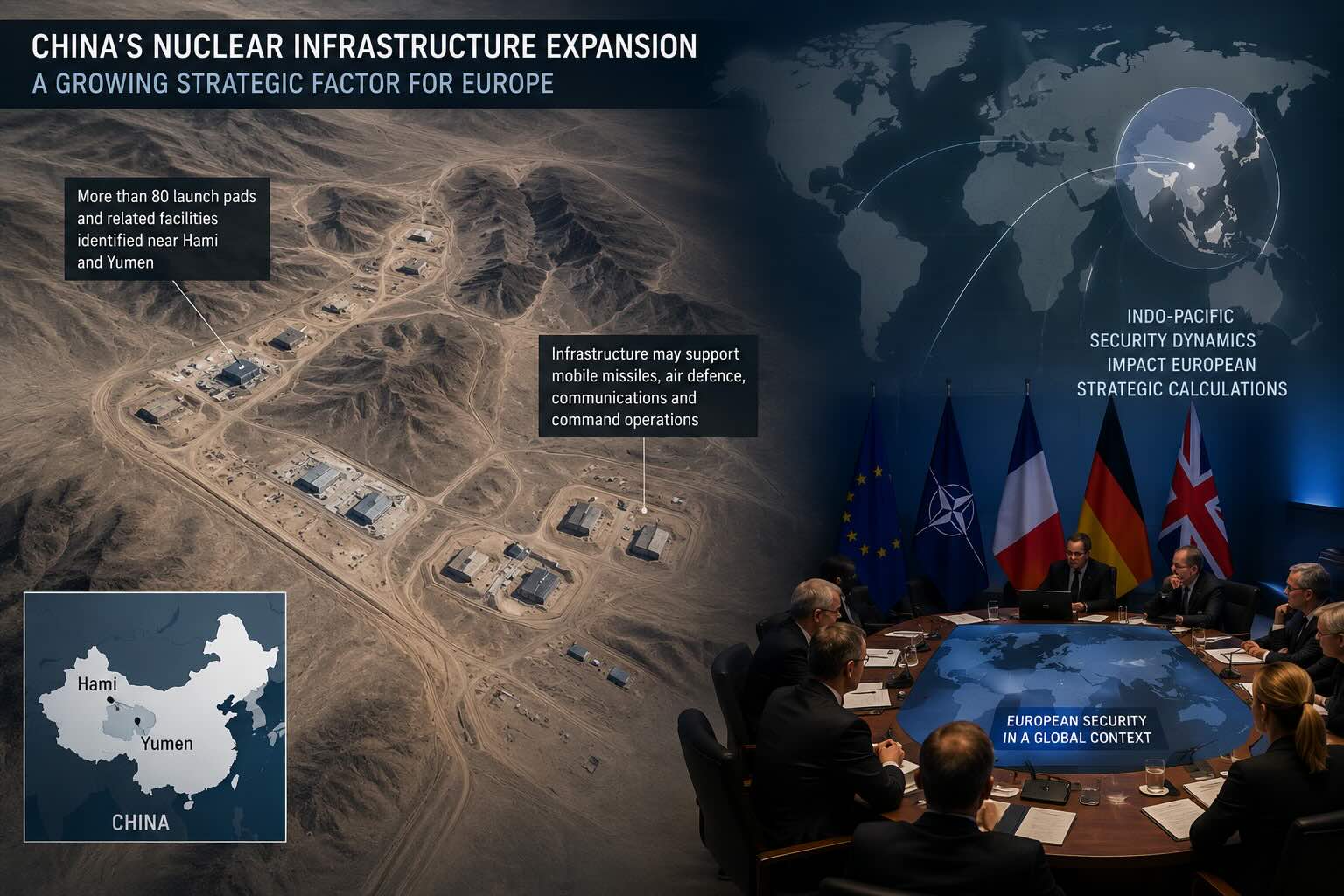
A Reuters satellite investigation has identified more than 80 launch pads and related facilities near China’s isolated intercontinental ballistic missile silos in the north-western desert, including areas around Hami in Xinjiang and Yumen in Gansu. The imagery reviewed by Reuters showed a network of launch pads, bunkers, road connections, communications nodes and large octagon-shaped bases which analysts said could support mobile missile launchers, air-defence systems, electronic warfare, satellite communications and command operations.
The findings add to an already substantial body of evidence that China is moving beyond the more limited nuclear posture traditionally associated with its declared “no first use” policy. The Federation of American Scientists had earlier identified major silo construction in western China, including the Hami missile silo field, while its 2025 assessment noted that China’s nuclear forces were undergoing a significant expansion in scale and complexity.
The Pentagon’s latest China military power report said Beijing maintained “a large and growing arsenal” of nuclear, maritime, conventional long-range strike, cyber and space capabilities. Reuters separately reported, citing the same Pentagon assessment, that China had likely loaded more than 100 solid-fuel intercontinental ballistic missiles into new silo fields and that its nuclear stockpile could exceed 1,000 warheads by 2030.
For Europe, the immediate relevance is not that China is preparing to threaten European territory directly, though Chinese long-range missiles are capable of reaching European targets. The more important issue is the pressure such developments place on the American alliance system. If the United States has to devote more military, intelligence and nuclear-planning resources to deterring China in the Indo-Pacific, European governments will face renewed pressure to assume greater responsibility for their own defence.
That pressure is already visible. The war in Ukraine has exposed limits in European ammunition production, air defence, long-range strike capacity, logistics and industrial readiness. At the same time, the Middle East continues to absorb American diplomatic and military attention. China’s expanding nuclear and missile infrastructure adds another layer to a strategic environment in which Europe can no longer assume that US attention will be concentrated primarily on the Euro-Atlantic theatre.
The development also matters because China’s build-up is not confined to fixed silos. The launch pads identified by Reuters appear potentially suited to mobile missile systems and supporting air-defence batteries. This points to a survivability problem for any adversary: even if silo locations are known, mobile launchers, hardened communications nodes and dispersed support sites make targeting more difficult. A force designed to survive a first strike and retaliate credibly strengthens deterrence, but it also complicates crisis management.
That is particularly relevant in any future Taiwan crisis. A larger and more survivable Chinese nuclear force could make Beijing more confident that it can limit outside intervention, or at least raise the perceived cost of US involvement. For Europe, that would not be a remote Asian issue. A major conflict over Taiwan would have direct consequences for trade, semiconductors, shipping, sanctions policy, supply chains and the transatlantic alliance. European governments would be drawn into decisions on export controls, financial restrictions, maritime security and diplomatic alignment.
There is also an arms-control dimension. The existing nuclear order was built largely around the United States and Russia. China’s rise as a larger nuclear power makes that framework increasingly incomplete. Beijing has resisted being drawn into formal nuclear arms-control limits comparable to those negotiated between Washington and Moscow, arguing that its arsenal remains smaller than those of the two largest nuclear powers. As China’s stockpile grows, that argument may become harder to sustain politically, but the path towards any three-way restraint remains unclear.
European states have limited direct leverage over China’s nuclear policy. However, they do have an interest in a more transparent strategic environment. France and the United Kingdom are nuclear powers, while NATO’s deterrence posture remains dependent on the United States. Any change in the balance between Washington and Beijing therefore affects alliance planning, even if Europe is not the primary theatre.
The Reuters findings should not be read as proof of imminent conflict. They are evidence of a long-term military build-up aimed at strengthening China’s deterrent, improving survivability and expanding operational flexibility. But for Europe, that distinction offers limited comfort. The practical consequence is the same: the United States is facing a more demanding nuclear and conventional competitor in Asia just as Europe is still rebuilding its own defence capacity after decades of underinvestment.
The strategic message for European capitals is clear enough. China’s desert missile infrastructure may be thousands of miles away, but the consequences are not. A more heavily armed China will shape American priorities, alliance burdens and global crisis management. Europe’s Indo-Pacific posture can no longer be treated as a matter of trade diplomacy alone. It is becoming part of Europe’s own security calculation.