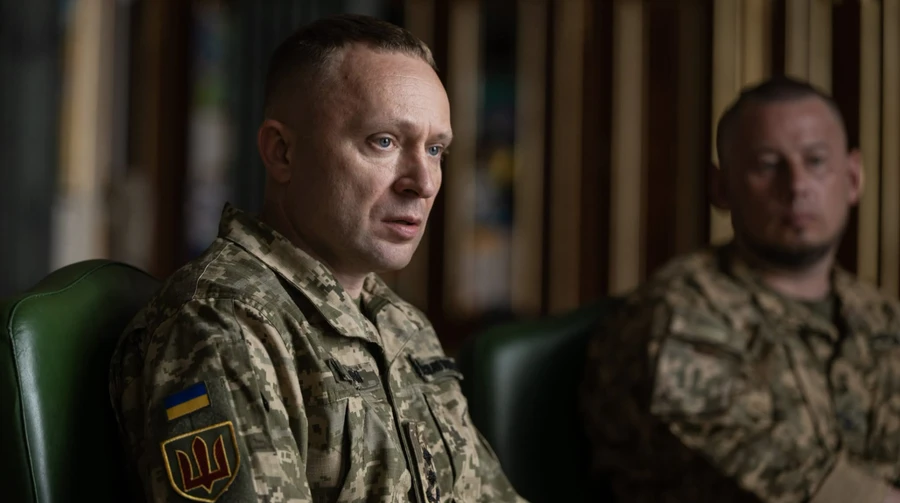
President Volodymyr Zelenskyy has said that Mykhailo Drapatyi will become Ukraine’s new commander-in-chief, replacing Oleksandr Syrskyi after days of consultation with senior commanders and mounting pressure over the future direction of the armed forces. In a 21 July address published by the presidential office, Zelenskyy said he had reviewed army-management priorities and the path of modernisation with commanders across the defence and security forces.
The statement did more than announce a personnel change. Zelenskyy linked Drapatyi’s appointment to a reshaping of the General Staff, a renewed defence strategy, continuation of the corps-system reform, drone and equipment supply to combat units, air-defence priorities and a clearer view of mobilisation. He also thanked Syrskyi for his role in Ukraine’s defence of Kyiv, the Kharkiv offensive and the Kursk operation, indicating that the transition is being framed as institutional rather than punitive.
The immediate background is the open dispute that followed Mykhailo Fedorov’s departure as defence minister. Recent analysis of the Fedorov-Syrskyi dispute identified the core disagreement as one over command culture, drone-led warfare, procurement data and how resources are distributed to units. Earlier coverage of Fedorov’s position in the command structure showed that the issue had already moved beyond a normal cabinet reshuffle.
Drapatyi now inherits a command system under stress. Ukraine is holding a long front against continuing Russian pressure, trying to regenerate manpower, defend cities against missile and drone attacks, expand deep-strike capacity and reform formations into a more coherent corps structure. None of those tasks can wait for a comfortable transition.
The political significance lies in the way the decision absorbs public protest into a formal chain of command. Demonstrations and resignations after the Fedorov-Syrskyi dispute showed a rare level of visible disagreement over military leadership. Zelenskyy’s announcement transfers that pressure from the street and the media into an official restructuring process. That may calm immediate tensions, but it also raises expectations that the new leadership will deliver visible changes.
The most urgent test will be drones. Ukraine’s battlefield advantage depends increasingly on cheap precision systems, interceptor drones, medium-range strike drones, unmanned ground vehicles and software-driven targeting. Fedorov’s critique was that technology adoption and procurement reform were being slowed by military bureaucracy. Drapatyi will be judged partly on whether he can integrate that agenda without weakening operational discipline.
The second test is mobilisation. Zelenskyy explicitly referred to the need for a real vision of the mobilisation process. Ukraine cannot sustain operations on technology alone. It needs trained personnel, predictable rotations, credible recruitment and command relationships that soldiers trust. A commander-in-chief who is seen only as a technology reformer would fail. Drapatyi must also address the human arithmetic of a long war.
The third test is the General Staff. Zelenskyy said Drapatyi, Yevhen Khmara and Pavlo Palisa had worked on how the staff should be reconfigured. That matters because a change at the top is not enough if planning, intelligence, procurement requests and front-line feedback continue to move through the same slow channels. Reforming the staff while Russia is advancing is one of the hardest institutional tasks in wartime.
Continuity is still necessary. Syrskyi’s removal does not mean all earlier operations were wrong. Ukraine’s long-range strike plan and what Zelenskyy called the middle-strike programme are to continue. The danger in any command transition is that commanders wait for new instructions, staff officers protect themselves and units lose clarity. Zelenskyy’s emphasis on an orderly transfer suggests that risk is understood.
For Ukraine’s partners, the appointment matters because military aid is increasingly linked to reform confidence. European and American support depends not only on battlefield need, but on confidence that equipment is allocated rationally and that Ukraine’s command system can absorb new technologies. If Drapatyi can create faster feedback between brigades, corps, procurement agencies and industry, donor support may become easier to defend.
Russia will look for disruption. A change in commander-in-chief creates a short window in which the opponent may test coordination, morale and decision speed. Moscow will probably continue pressure with ground attacks, missile strikes and drone saturation while Ukraine’s new leadership sets priorities.
The appointment therefore resolves one question and opens another. Zelenskyy has chosen change rather than preserving the status quo. The next measure is whether Drapatyi can translate that political decision into command adaptation: faster procurement, clearer corps authority, stronger air defence, credible mobilisation and a General Staff that can fight today’s drone-shaped war rather than yesterday’s.