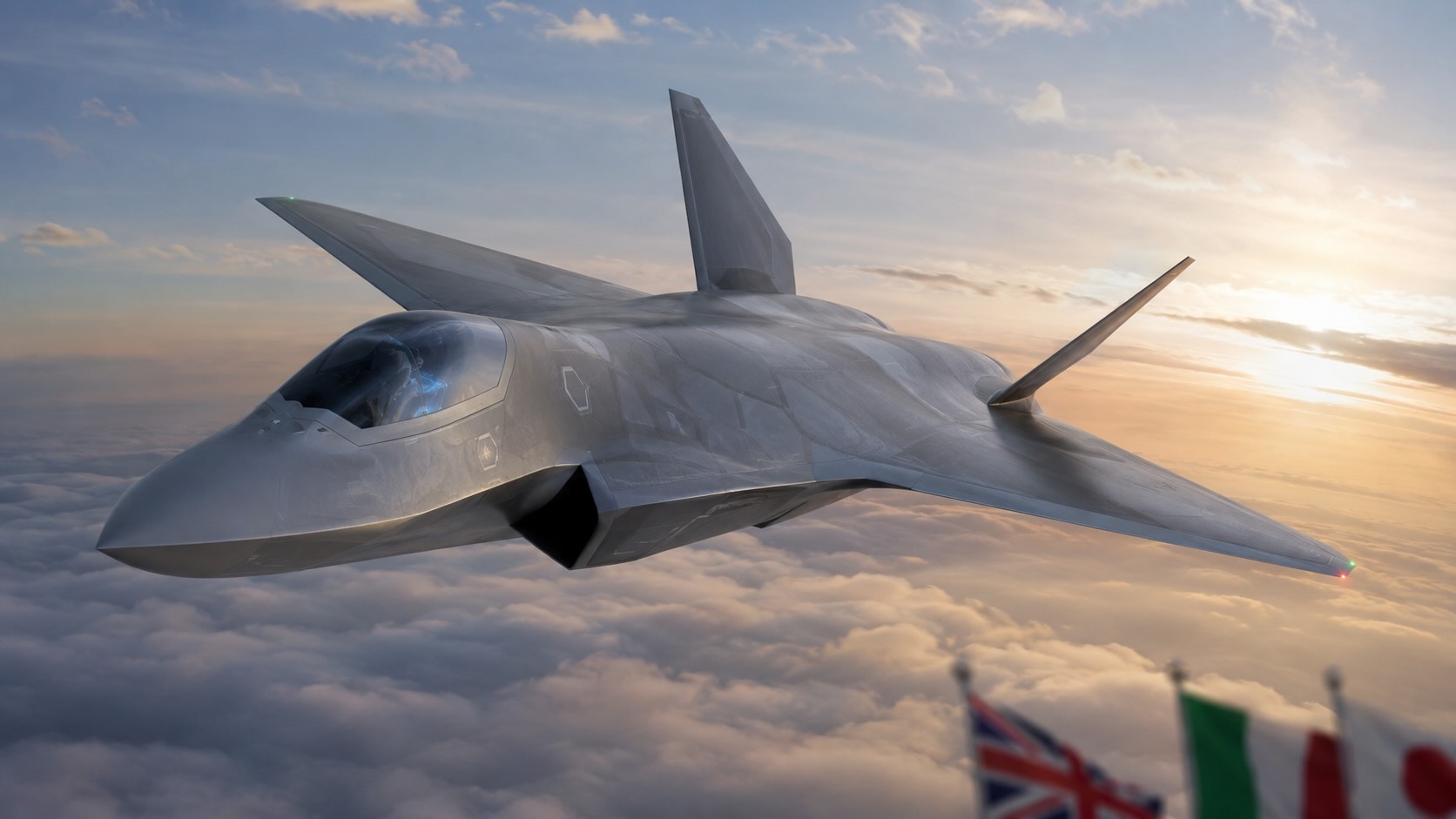
The chief executive of the Global Combat Air Programme joint venture says the British-Italian-Japanese fighter project will keep its 2035 service-entry deadline even if another country joins. Marco Zoff, chief executive of Edgewing, told reporters at Farnborough that the timetable would not be jeopardised, according to Reuters. Reuters also reported that Canada had reached a deal to become an observer to the programme, with a formal announcement expected at Farnborough.
The pledge matters because sixth-generation fighter programmes are hard even before new partners are added. GCAP must combine aircraft design, propulsion, sensors, weapons, software, combat cloud architecture, manufacturing and national industrial workshare across three founding countries. A 2035 deadline is ambitious in that context.
Defence Matters previously examined how GCAP expansion exposes Europe’s fighter-jet realignment. The new statement advances that discussion because Edgewing is attaching a firm delivery assurance to possible expansion rather than treating new partners as a distant political option.
The attraction of expansion is clear. Additional countries can bring money, industrial capacity, technology, export markets and political weight. Canada, even as an observer, would give GCAP a North American link at a time when Ottawa is trying to diversify defence-industrial relationships. Other potential partners may see GCAP as more credible after the rival Franco-German-Spanish FCAS project ran into serious difficulty.
The risk is equally clear. Multinational combat-air programmes slow down when requirements diverge. One country may prioritise range, another carrier compatibility, another local assembly, another sensor access or sovereign software control. Workshare negotiations can consume time that engineers need for design.
GCAP’s 2035 target is politically important because Japan, Britain and Italy need a credible replacement path for future air-combat capability. If the deadline slips, air forces may need interim upgrades, additional F-35 purchases or life-extension programmes. That would change budgets and reduce confidence in European and Japanese industrial autonomy.
Zoff’s argument is that government pressure to keep the timing strict will force accommodation. That may be true if new partners join as observers or limited industrial participants. It becomes harder if a new country wants full design influence, assembly rights or bespoke requirements.
The concept-assessment phase due by the end of 2027 will be a critical milestone. Until then, programme leaders can promise discipline. After that, the aircraft’s architecture, industrial footprint and requirements will become harder to adjust without consequence. New partners who join before design freezes may influence more; those who join later may have to accept less.
FCAS provides the warning. Multinational ambition can fail when industrial champions disagree over technology leadership and workshare. GCAP’s structure may be cleaner because BAE Systems, Leonardo and Mitsubishi Heavy Industries have a defined partnership. But the lesson remains: governance matters as much as technology.
Canada’s observer role, if confirmed, is therefore a low-risk first step. It allows Ottawa to inspect the programme without committing money or demanding redesign. It gives GCAP diplomatic reach without immediately complicating requirements. The real test would come if observer status becomes membership.
For Europe, GCAP’s progress also affects strategic balance. If FCAS remains uncertain and GCAP appears disciplined, the centre of gravity in European future combat air shifts towards London, Rome and Tokyo. That would have consequences for suppliers, export campaigns and defence politics.
Zoff’s deadline guarantee is useful because it sets a public standard. Programme leaders can now be judged against it. The more GCAP expands, the harder that standard becomes. The promise is not impossible. It is simply the hardest kind of defence-industrial promise: deliver faster, include more partners and keep requirements under control.
Canada’s observer role illustrates the opportunity and the risk. Additional partners can widen the industrial base, bring specialist technologies and increase the programme’s political weight. They can also complicate export policy, workshare disputes and requirements management if participation is not tightly structured. GCAP cannot become a diplomatic club first and an aircraft programme second. The partners’ task is to welcome useful capability without recreating the slowest habits of older European defence projects. The 2035 target will survive only if expansion is treated as a disciplined engineering choice, not as proof of prestige.