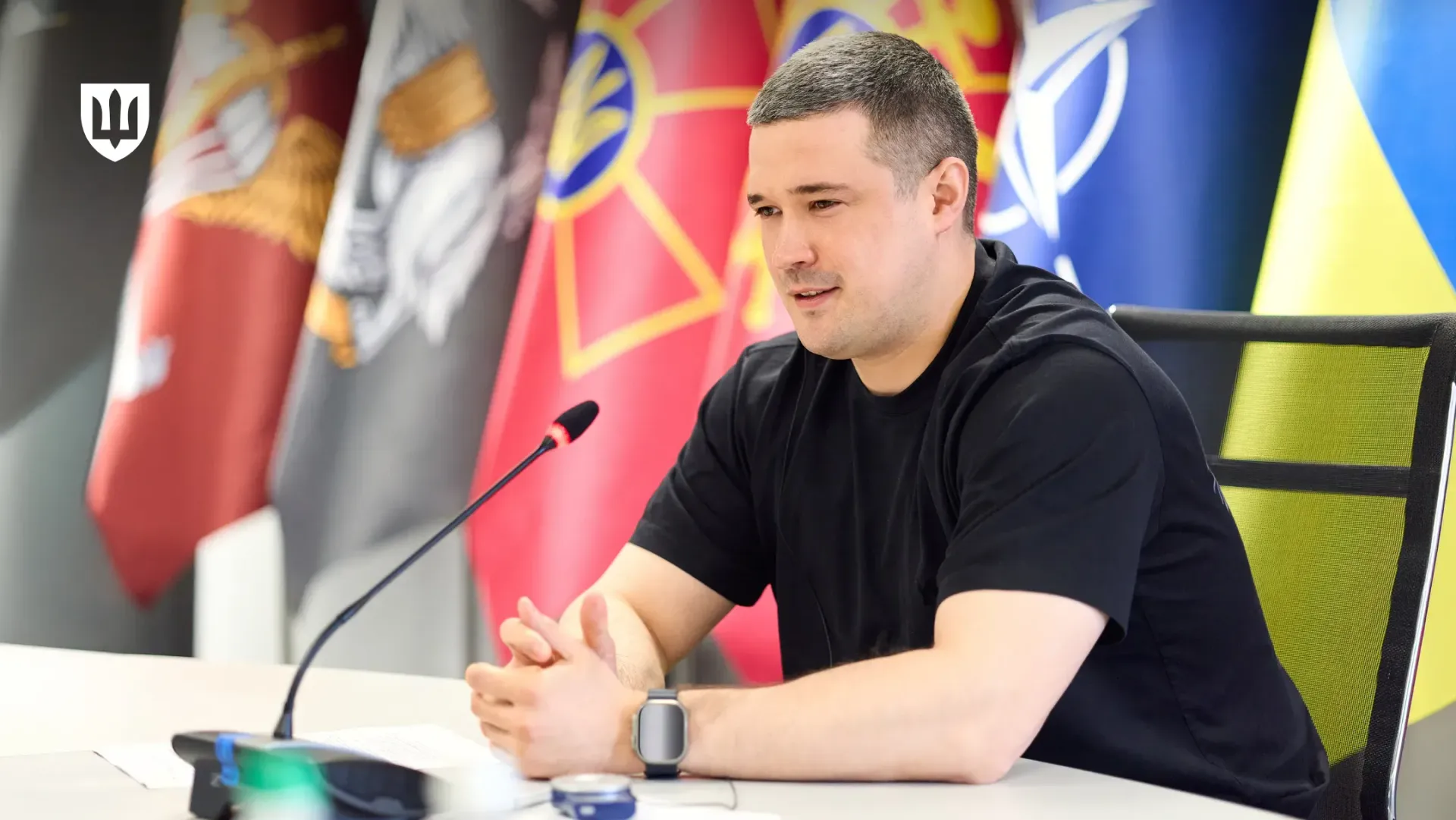
President Volodymyr Zelenskyy’s pending decision on the future of Defence Minister Mykhailo Fedorov has exposed a central problem in Ukraine’s management of the war: the division of authority between the presidency, the Defence Ministry and the Armed Forces command.
Zelenskyy said on 15 July that he would meet Fedorov and senior military leaders before deciding whom to nominate as defence minister in Ukraine’s next government.
The president identified co-operation between the ministry and the Armed Forces, reform of the territorial recruitment centres, air defence and defence-industrial development among the matters requiring discussion.
The timing is operationally sensitive. Ukraine continues to face Russian missile and drone attacks, a shortage of air-defence interceptors, pressure on several parts of the front and continuing difficulties in recruitment and force regeneration.
The government reshuffle began with the departure of Prime Minister Yulia Svyrydenko, placing the Cabinet in an acting capacity while parliament prepares to consider new appointments. Fedorov’s position has become one of the principal questions surrounding the reorganisation.
Fedorov has been defence minister for only six months. Parliament approved his appointment by 277 votes on 14 January 2026, following his nomination by Zelenskyy.
His appointment was intended to bring the methods associated with Ukraine’s digital transformation and defence technology sectors into the administration of the Defence Ministry.
Before taking over the ministry, Fedorov had played a central role in programmes including the Army of Drones and the Brave1 defence technology cluster. He was closely associated with attempts to accelerate the development, testing and procurement of Ukrainian drones, electronic warfare equipment, missiles and robotic systems.
At the Defence Ministry, Fedorov has promoted a technology-centred approach based on drone production, battlefield data, digital management and the use of lower-cost systems against Russian personnel, equipment and logistics.
He has also sought additional Western support for Ukraine’s most immediate requirements. In June, Fedorov said that Ukraine urgently required Patriot PAC-3 interceptors and continued support through allied procurement mechanisms.
His record remains contested. Supporters argue that the ministry has begun to adopt faster procurement procedures and closer relations with Ukrainian defence technology companies. Critics point to unresolved recruitment problems, weaknesses in personnel management and continuing allegations of abuse within territorial recruitment centres.
Many of these problems predate Fedorov’s appointment and extend beyond the Defence Ministry. Mobilisation involves the military command, parliament, regional authorities and law-enforcement institutions. A defence minister can influence the system but cannot reform it independently.
The more immediate issue is whether the political and military leadership agree on where the minister’s authority ends and that of the commander-in-chief begins.
The Defence Ministry is responsible for defence policy, budgeting, procurement, contracts and civilian administration. The commander-in-chief and General Staff control military operations, force deployment and operational planning. Zelenskyy, as supreme commander-in-chief, retains the decisive political role and appoints senior military leaders.
In principle, this division protects civilian oversight while allowing professional commanders to run operations. In practice, the boundaries can become disputed whenever the ministry intervenes in procurement, personnel policy, force development or the distribution of resources.
Ukrainian commentary has repeatedly referred to disagreements between Fedorov and Commander-in-Chief General Oleksandr Syrskyi. The exact substance and extent of these disagreements have not been set out publicly by either official.
Zelenskyy’s decision to consult both the minister and the Armed Forces leadership suggests that institutional relations are being considered alongside Fedorov’s personal performance.
Three broad outcomes are possible.
The first is that Zelenskyy selects another defence minister and offers Fedorov a different government position. Such an outcome could remove the immediate source of institutional tension but would raise questions about the future of reforms launched during his six months in office.
The second is that Zelenskyy nominates Fedorov but parliament fails to approve him. Although his original appointment secured a comfortable majority, the political support available for his reappointment is less certain.
The third is that Fedorov remains defence minister while differences with parts of the military establishment continue. In that case, the presidential administration would need to establish clearer procedures for resolving disputes between civilian and military authorities.
Each outcome carries operational risks.
Replacing the minister could delay procurement programmes, disrupt relations with domestic manufacturers and create uncertainty over international industrial agreements. Retaining him without resolving institutional disagreements could produce competing centres of influence within the defence establishment.
The central test is whether the reforms associated with Fedorov have become established government policy or remain dependent upon his personal authority.
A wartime defence system cannot be reorganised whenever a minister or commander is replaced. Procurement procedures, battlefield data platforms, industrial contracts, research programmes and force-development plans must continue across changes in personnel.
The same applies to Ukraine’s international commitments.
On 18 June, Fedorov and German Defence Minister Boris Pistorius signed implementing arrangements for anti-ballistic capabilities and the joint production of TerMIT unmanned ground vehicles in Germany.
The agreement forms part of Ukraine’s attempt to connect its defence industry with European manufacturing capacity. Kyiv is seeking similar co-operation in drones, missiles, ammunition, air defence and unmanned ground systems.
Ukraine’s partners therefore have an interest in knowing whether projects negotiated under one minister will continue under his successor. They also require identifiable authorities capable of making procurement and industrial decisions without becoming involved in disputes between the ministry and the military command.
Fedorov’s political popularity is relevant but should not be the principal measure of his suitability for the post. Claims that he intends to form a political party or challenge Zelenskyy have not been substantiated by any public organisational activity.
The more important questions concern command, accountability and continuity.
Ukraine requires a system in which the president, defence minister and commander-in-chief can define their respective responsibilities, resolve disagreements and maintain procurement and military reform during personnel changes.
Fedorov’s future matters because of the programmes currently under his control. The larger issue is whether Ukraine’s defence institutions can preserve those programmes independently of any one minister, commander or political dispute.