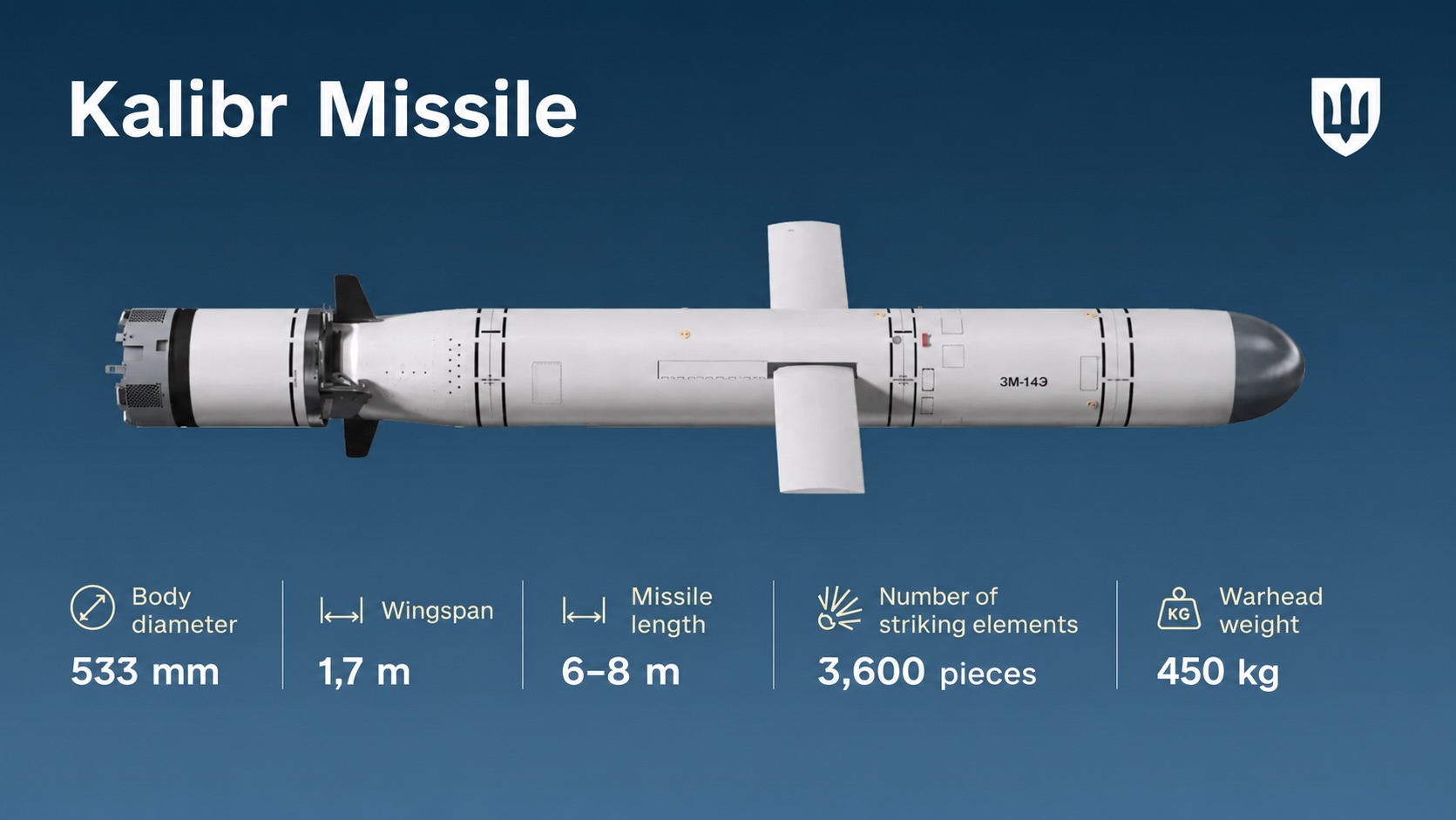
The findings were published after Ukrainian defence specialists examined downed 3M14 Kalibr missiles and dismantled them “down to the board”. According to the published analysis, each component was checked and a full structural and functional scheme of the missile was compiled.
The ministry said the most important change identified in 2026 was the use of a cluster warhead in Kalibr missiles shot down in the spring. Ukrainian specialists said this was the first time such a warhead had been found in this type of missile during the full-scale war. The warhead was described as similar to one already used in Russia’s Kh-101 air-launched cruise missile.
Until now, Kalibr missiles used by Russia between 2022 and early 2026 had generally carried high-explosive fragmentation warheads. These contained about 3,600 striking elements and were designed to penetrate up to 10cm of concrete, according to the Ukrainian assessment.
The new warhead appears to be intended to increase the area affected by each strike. Ukrainian officials assessed that it would make the missile more effective against dispersed targets, including aircraft at airfields, hangars and open military positions.
The finding points to continued adaptation of Russia’s long-range strike systems as the war enters another phase of technological adjustment. Moscow has repeatedly modified missile designs since the start of the full-scale invasion, including the Kh-101, which Ukrainian officials say has been changed several times in an effort to improve its ability to penetrate air defences.
A second important finding concerns the missile’s control systems. Ukraine’s Ministry of Defence said circuit boards in the missile’s seeker head were again made up largely of foreign-produced components. It said more than 80 to 90 per cent of the boards consisted of imported electronics.
The ministry presented this as a verified finding rather than an estimate, saying every component had been marked and inspected by military specialists. It said that in 2023 and 2024 Russia had attempted to move towards a domestic component base, but that a missile manufactured in 2025 again contained imported parts in its onboard digital computer.
Ukrainian specialists believe the attempted switch to Russian-made electronics may have reduced the accuracy of the missile’s guidance system. The ministry said this could explain why the manufacturer returned to the earlier design using imported components.
The finding is relevant to sanctions policy. Since 2022, Ukraine and its partners have repeatedly argued that Russia’s missile production remains dependent on foreign microelectronics, often acquired through indirect procurement networks, third countries or pre-existing stockpiles. In late May, European ambassadors in Kyiv were shown foreign-made components recovered from Russian missiles and drones used in recent attacks, including parts from Kalibr, Kh-101 and Kinzhal missiles, as well as Shahed-type drones.
The Ukrainian ministry said it believed Russia may still have access to reserves of components purchased before sanctions were imposed. It also said it had identified the producers of electronics used in Kalibr missiles, as well as chief designers and managers involved in production. The data will be passed on for further work within Ukraine’s sanctions policy.
Another element highlighted in the study was the SN-99 navigation system, described by the ministry as one of the missile’s key blocks. According to available documentation cited by Ukrainian specialists, the system was developed in the 2000s in the Ukrainian city of Smila. Serial production is now carried out in Russia, but the original design base is of Ukrainian origin, the ministry said.
The analysis also found that parts of the Kalibr missile are unified with other Russian missile systems. Components including the control surfaces, satellite navigation system and onboard digital computer are also used in Iskander cruise missiles, while some blocks are identical to elements used in the Bereg and Bastion coastal defence systems.
Such standardisation has practical consequences. It may allow Russia to maintain production across several missile families despite industrial pressure, but it also creates common vulnerabilities that can be studied by Ukraine and its partners.
The Kalibr remains one of Russia’s main sea-launched cruise missiles. It has been used throughout the full-scale war against Ukraine, launched from ships and submarines. Although Ukraine has improved its ability to intercept many types of cruise missiles, Russian modifications continue to pose challenges for air defence systems already under pressure from combined drone and missile attacks.
The latest Ukrainian assessment suggests that Russia is not simply using existing stocks, but continues to alter its missiles in response to battlefield experience. The introduction of cluster warheads indicates a focus on wider area effects, while the return to imported electronics suggests that sanctions have complicated, but not stopped, Russia’s access to critical components.
For Kyiv and its partners, the findings add weight to two parallel priorities: strengthening air defence and tightening enforcement against supply chains that continue to feed Russia’s missile industry.