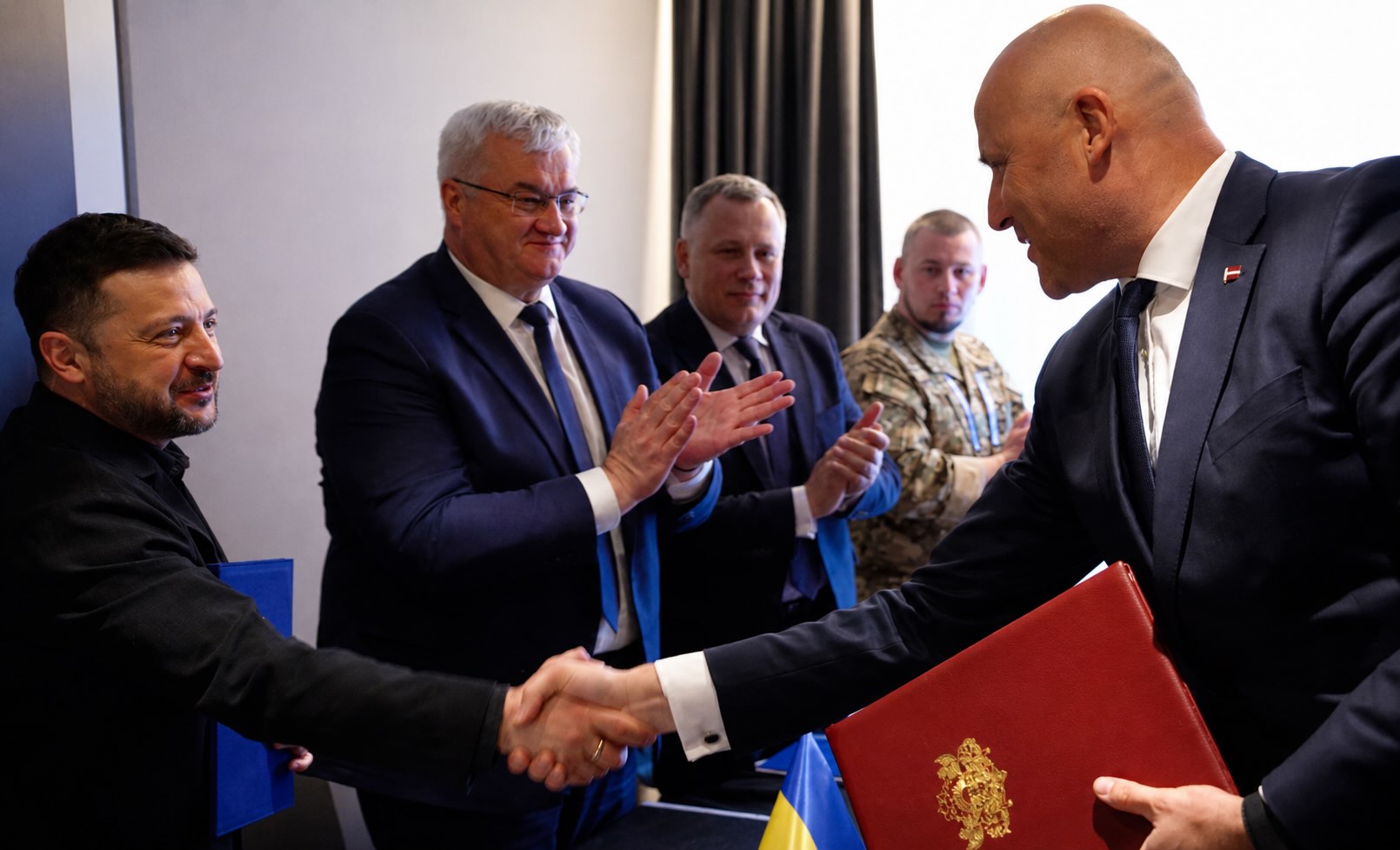
President Volodymyr Zelenskyy announced the agreement on Tuesday during a summit of Ukraine and Nordic-Baltic leaders in Tallinn. According to Reuters, Zelenskyy said the deal represented concrete work to strengthen joint defence and co-production, while allowing Ukraine’s experience from the battlefield to support partner countries.
Latvian Prime Minister Andris Kulbergs said the agreement would give Latvia access to technological know-how and co-production opportunities. He linked the deal directly to the need to defend Latvian airspace, saying that no country had more relevant experience in countering drones than Ukraine.
The agreement comes after a series of drone incidents around the Baltic region, which have exposed the difficulty of protecting NATO’s eastern flank against unmanned systems, electronic interference and airspace spillover from the war in Ukraine. On Monday, a French Rafale fighter jet operating as part of NATO air policing shot down a drone that entered Latvian airspace from Russia. Latvia’s military said the drone crossed the border as a result of Russian electromagnetic warfare.
Latvia’s Defence Ministry said before the signing that the agreement with Ukraine would accelerate the introduction of Ukrainian experience into Latvia’s defence system and help develop the capabilities required to protect the country’s airspace and borders. The ministry described the arrangement as part of a wider defence-cooperation effort with Kyiv, according to its official announcement.
For Latvia, the issue is no longer theoretical. Drone incursions have become a live test of NATO border management, national air defence and political confidence. Previous incidents involving drones diverted or disrupted by Russian electronic warfare have caused alarm in Baltic states, where national militaries must distinguish between deliberate attack, navigational disruption and unintended spillover from Ukraine’s strikes on targets inside Russia.
That ambiguity is one reason the Ukraine-Latvia agreement matters. Counter-drone defence is not limited to shooting down aircraft. It requires radar coverage, electronic detection, jamming resilience, command procedures, trained operators and rules for deciding when a drone becomes a military threat. Ukraine has had to develop those systems under wartime conditions and at scale.
Kyiv is now seeking to turn that experience into a diplomatic and industrial asset. Rustem Umerov, chairman of Ukraine’s defence and security council, said Latvia had become the sixth country to join Ukraine’s drone co-operation initiative. Zelenskyy said last month that nearly 20 countries were interested in such agreements with Ukraine.
The agreement also gives Latvia a route into co-production, not only technology transfer. That is important for a small NATO state with limited industrial depth but an immediate requirement to strengthen airspace protection. Latvia has already been one of the leading countries behind the Drone Coalition for Ukraine, a multinational initiative designed to supply Kyiv with unmanned systems while also strengthening European production capacity.
Ukraine’s offer to share drone technology with the Nordic and Baltic states was also addressed by Zelenskyy at the Tallinn summit. The Associated Press reported that he proposed sending Ukrainian experts and sharing experience with cheaper interceptor drones, at a time when the region is seeking practical methods to counter unmanned aircraft without relying only on expensive missiles or fighter aircraft.
That cost question is central. NATO countries have advanced aircraft and air-defence systems, but using high-value missiles or fighter jets against relatively cheap drones is financially and operationally difficult over time. Ukraine has been forced by necessity to develop lower-cost interception methods, including mobile fire teams, electronic warfare, acoustic detection, interceptor drones and layered local defence.
For NATO’s eastern members, Ukraine’s experience offers lessons that standard procurement cycles may struggle to deliver quickly. The Baltic states face a particular problem because of their geography, proximity to Russia and Belarus, and limited strategic depth. A drone crossing their airspace can become a domestic political issue within minutes and a NATO security concern soon afterwards.
The agreement is also relevant beyond Latvia. If Ukraine can formalise similar arrangements with other allies, it may become not only a recipient of Western military aid but a supplier of operational knowledge and defence technology. That would alter part of the political balance in European security: Kyiv would still need weapons, funding and air defence from its partners, but it would also provide lessons that many European militaries do not yet possess.
The immediate purpose of the Latvia deal is practical: better protection of skies and borders. Its wider importance is strategic. The war has made drones a central feature of European security. The countries closest to Russia are now trying to adapt before another incident forces a costlier response.