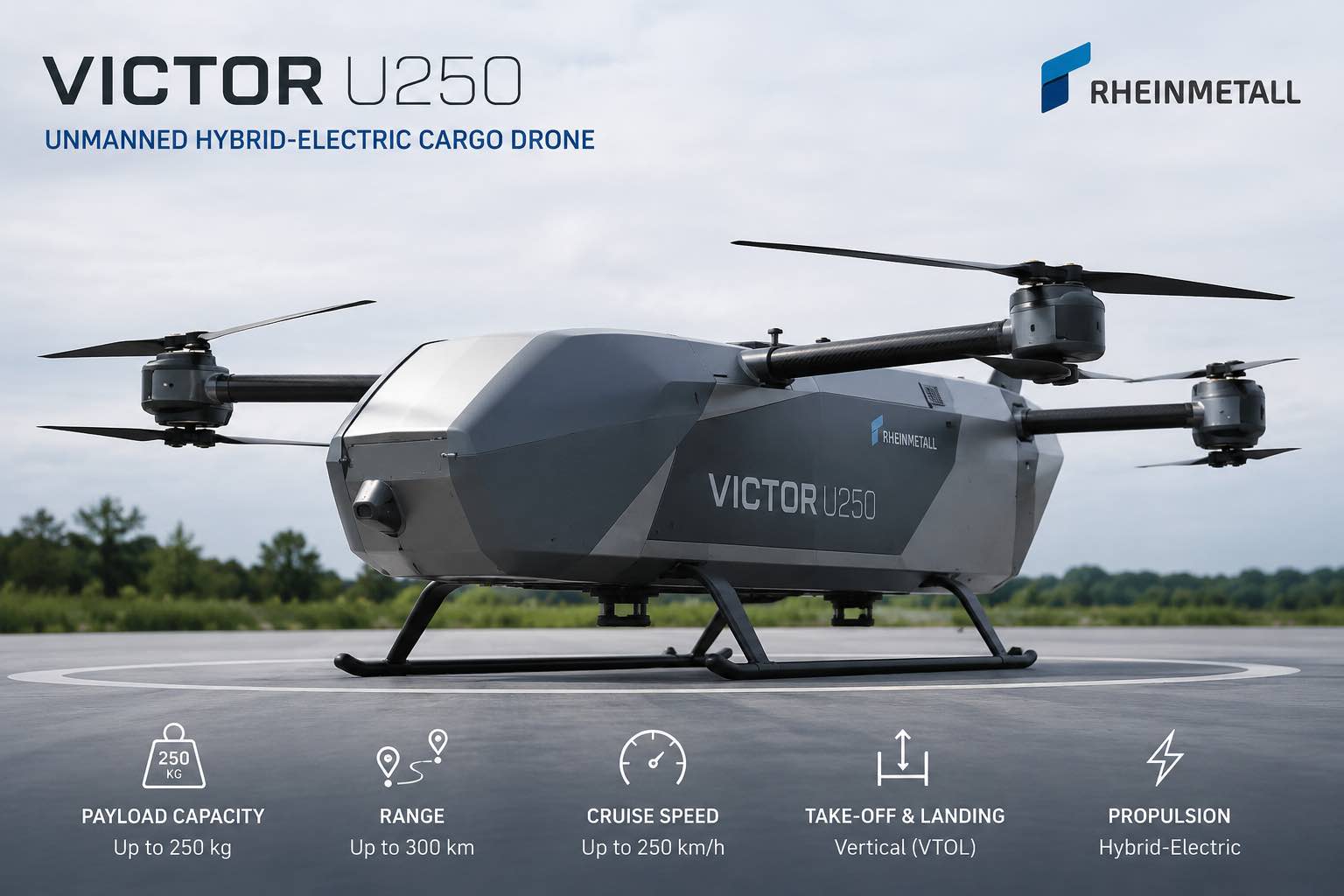
The Düsseldorf-based manufacturer has signed a letter of intent with Munich drone start-up ERC System and the state government of North Rhine-Westphalia to explore the production of heavy-lift cargo drones in western Germany. At the centre of the agreement is ERC’s Victor U250, a hybrid-electric unmanned aircraft designed to transport supplies to locations where conventional logistics chains struggle to operate.
The move reflects a broader transformation underway across Europe’s defence sector. Having spent decades optimising for efficiency and peace dividends, governments and manufacturers are now investing heavily in resilience, sovereign production capabilities and technologies shaped by the lessons of modern warfare.
Drones have emerged as perhaps the clearest example of this shift.
While public attention has often focused on armed systems and loitering munitions, military planners increasingly recognise the importance of logistics platforms capable of moving equipment, ammunition and medical supplies without exposing personnel to unnecessary risk. In contested environments, the ability to sustain frontline units may prove as decisive as the ability to strike adversaries.
The Victor U250 has been designed with precisely such scenarios in mind. According to the companies involved, the aircraft can carry payloads of up to 250 kilograms over distances of approximately 300 kilometres. Its hybrid-electric propulsion system enables vertical take-off and landing without requiring dedicated infrastructure, while cruising speeds approaching 250 kilometres per hour allow it to cover significant distances quickly.
For Rheinmetall, the agreement represents another step in its evolution from a traditional defence contractor into a broader technology enterprise. The company has benefited substantially from Europe’s rising defence budgets, with demand for ammunition, armoured vehicles and air-defence systems surging since Russia’s full-scale invasion of Ukraine.
Yet management appears increasingly aware that tomorrow’s battlefield will reward adaptability as much as industrial scale.
“Ultimately, our aim is, ideally, to work with ERC and the State of North Rhine-Westphalia to scale up the Victor U250 heavy-lift drone both technologically and industrially,” Rheinmetall chief executive Armin Papperger said following the announcement.
The involvement of North Rhine-Westphalia is equally significant. Regional governments across Germany have sought to position themselves as beneficiaries of increased defence investment, particularly as Berlin encourages domestic production of strategically important capabilities.
Officials estimate that the project could support hundreds of jobs by the end of the decade through the establishment of manufacturing facilities and associated supply chains.
For ERC System, a company owned by engineering services group IABG, collaboration with an established industrial partner offers a route to commercialisation that many defence start-ups struggle to achieve. Europe’s innovation ecosystem has historically suffered from a disconnect between promising technological concepts and the manufacturing capacity needed to deliver them at scale.
Large incumbents, meanwhile, often lack the agility required to develop disruptive technologies independently.
The partnership therefore illustrates a model increasingly favoured by policymakers: combining entrepreneurial innovation with the production expertise and financial resources of established defence companies.
Whether the Victor U250 ultimately secures substantial military orders remains uncertain. Defence procurement processes remain lengthy, budgets face competing pressures and technological optimism has disappointed investors before.
Nevertheless, the initiative highlights an important reality. Europe’s rearmament is not solely about purchasing more tanks, missiles or fighter aircraft. It is also about reshaping industrial ecosystems to accommodate technologies that scarcely featured in defence planning a decade ago.
Heavy-lift drones may never attract the headlines generated by combat aircraft or naval programmes. Yet if future conflicts continue to emphasise dispersed operations, contested supply routes and rapid adaptation, the seemingly mundane challenge of moving supplies safely could assume strategic importance.
In that context, Rheinmetall’s latest venture appears less an experiment on the margins of defence policy and more a signpost pointing towards the industry’s future.
Rheinmetall and Deutsche Telekom Plan 5G-Enabled Anti-Drone Shield