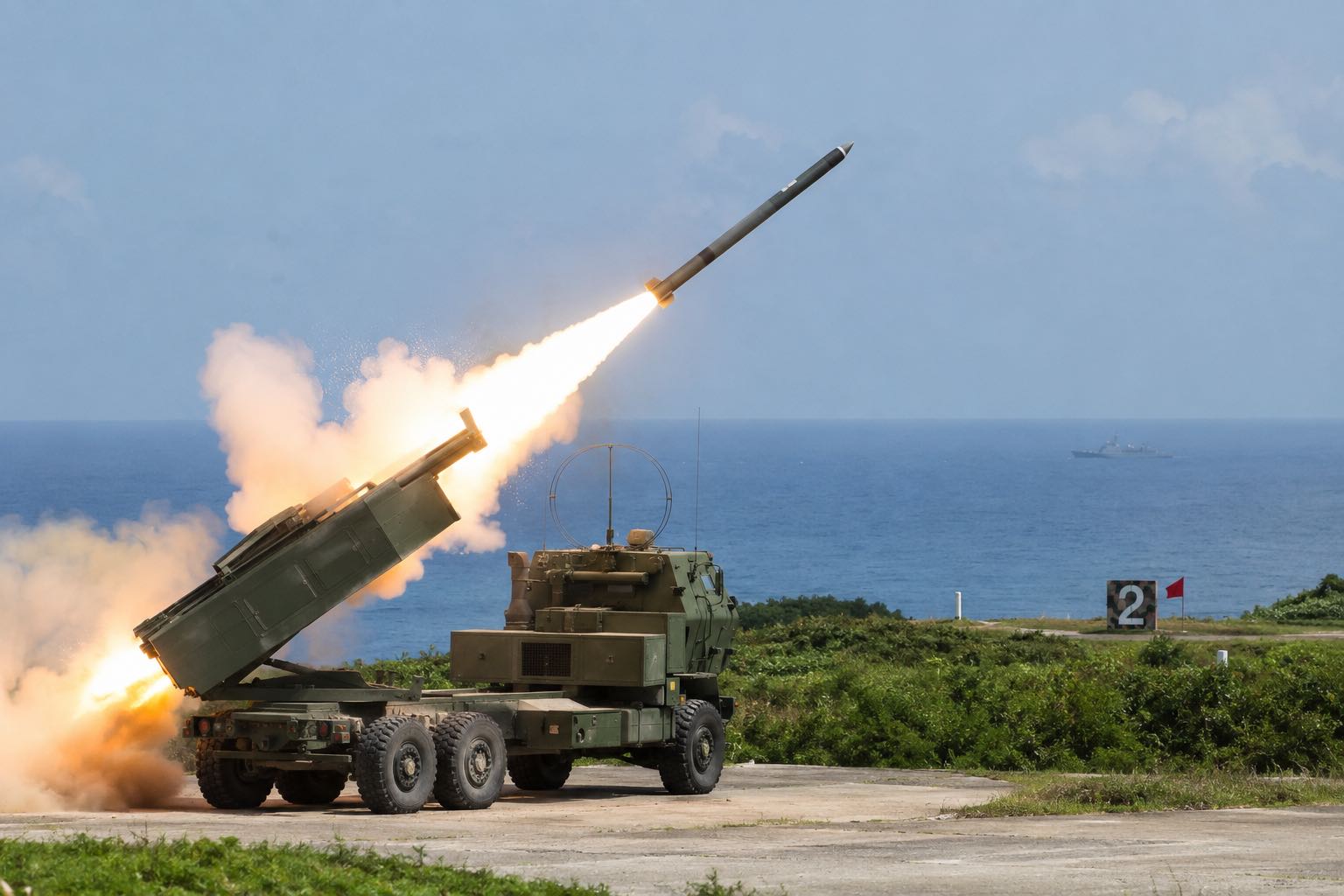
On Wednesday, Taiwanese forces fired U.S.-supplied High Mobility Artillery Rocket Systems (HIMARS) during drills designed to simulate resistance against a Chinese amphibious assault. It marked the first occasion the precision-guided rocket launchers had been deployed operationally on Taiwan’s west coast, directly facing mainland China. Reuters reported that the exercises focused on the launchers’ ability to rapidly fire and relocate before enemy forces could respond.
The emphasis on so-called “shoot-and-scoot” tactics reflects a broader transformation within Taiwan’s armed forces. For decades, military planners invested heavily in conventional capabilities, including fighter aircraft, tanks and major naval assets. Yet as China’s military modernisation accelerated, Taiwan increasingly recognised that attempting to mirror the People’s Liberation Army’s capabilities was neither economically sustainable nor strategically effective.
Instead, Taipei has embraced aspects of what defence analysts call the “porcupine strategy”. The objective is not necessarily to defeat China outright, but to complicate invasion plans through dispersed, resilient and highly mobile defensive systems capable of imposing severe losses on an attacking force.
The HIMARS system fits neatly within this framework. Mounted on wheeled vehicles, the launchers can be deployed quickly, strike targets with precision, and withdraw before hostile radar systems can identify their location. Their combat record in Ukraine has enhanced their reputation, demonstrating how relatively small numbers of mobile rocket systems can disrupt larger adversaries.
Taiwan’s military leadership has sought to draw practical lessons from contemporary conflicts. The battlefield experience emerging from eastern Europe has reinforced the importance of concealment, flexibility and rapid manoeuvre in an age of pervasive surveillance and precision-guided munitions.
The latest exercises followed separate live-fire drills involving Taiwan’s domestically developed Thunderbolt-2000 multiple launch rocket systems. Together, the demonstrations highlighted a defence establishment increasingly focused on creating overlapping layers of firepower along potential invasion corridors. Reuters noted that recent training has become more realistic, with shorter preparation times and greater emphasis on operating under wartime conditions.
The political messaging was equally significant.
China continues to claim Taiwan as part of its territory and has refused to renounce the use of force to achieve unification. Beijing’s military aircraft and naval vessels routinely operate near the island, while large-scale exercises have become a regular feature of cross-strait tensions.
For Taiwan’s government, demonstrating preparedness serves both domestic and international audiences. At home, it reassures a population increasingly conscious of regional instability. Abroad, particularly in Washington, it signals Taipei’s willingness to invest seriously in its own defence.
That message matters. Taiwan’s security ultimately rests on a delicate balance involving deterrence, diplomacy and uncertainty surrounding external intervention. Showing that the island is capable of mounting a determined and sophisticated defence strengthens arguments for continued international support.
Yet significant challenges remain. Taiwan continues to grapple with recruitment difficulties, reserve force reform and the logistical complexities of sustaining prolonged military operations. China’s numerical advantages in personnel, naval tonnage and missile inventories remain overwhelming.
No single weapons system can alter that reality.
Nevertheless, the images emerging from Taiwan’s western coast this week illustrated an important strategic shift. Rather than preparing for symmetrical confrontation, Taipei appears increasingly committed to exploiting agility and geography in pursuit of deterrence.
Whether that approach ultimately preserves peace in the Taiwan Strait remains uncertain. But Taiwan’s military planners are making a clear calculation: if conflict cannot be prevented through diplomacy alone, ensuring that invasion carries unacceptable risks may offer the strongest incentive for avoiding war altogether.
China and Taiwan’s Maritime Stand-off Signals a Dangerous New Phase