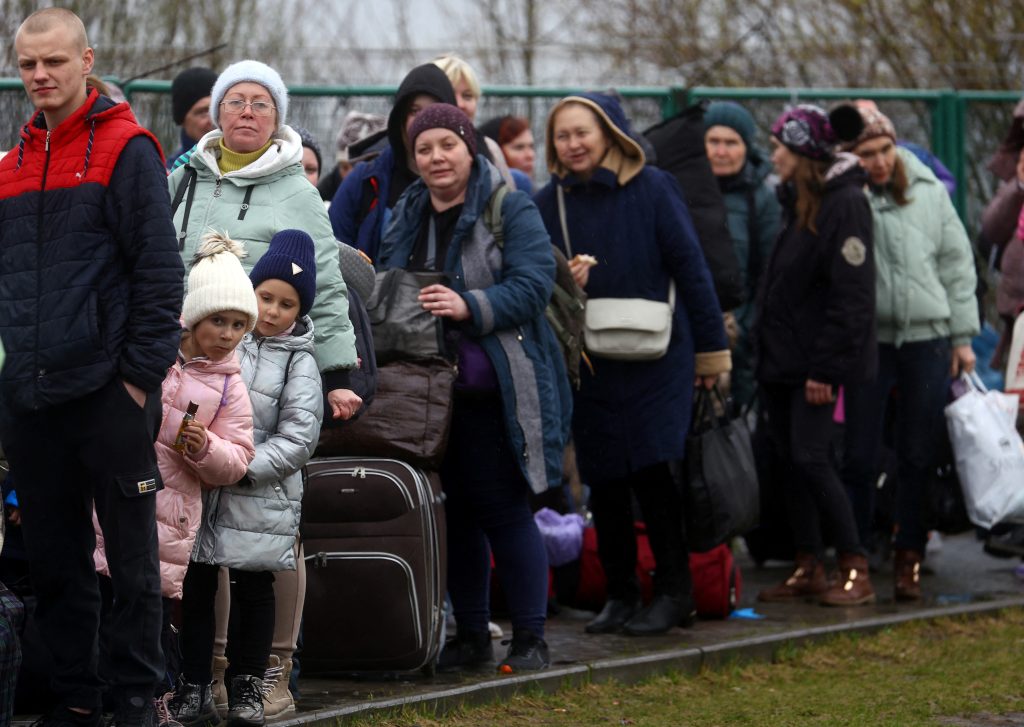
After all, more than four years after Russia’s full-scale invasion, millions of Ukrainians remain unable to return home safely, and the conflict shows few signs of ending.
Yet it is not the extension itself that has sparked debate in Brussels. Rather, it is a far more sensitive question: should Ukrainian men of military age continue to benefit automatically from the same protections as other refugees?
The European Commission’s proposal seeks to limit access to temporary protection for newly arriving military-age men who do not possess authorisation from Kyiv to leave the country. Existing beneficiaries would remain unaffected. The intention, according to European officials, is to avoid undermining Ukraine’s ability to defend itself at a time when the country continues to face severe military and demographic pressures.
The issue touches upon one of the most uncomfortable dilemmas produced by a long war.
On one side are those who argue that refugee protection should remain a humanitarian principle, not a military instrument. Men fleeing conflict may have a variety of personal circumstances, family obligations or legitimate fears. Critics of the proposal warn against creating categories of refugees based upon their potential military usefulness. They argue that Europe should be cautious about allowing immigration policy to become entangled with wartime manpower considerations.
On the other side are those who point to Ukraine’s increasingly difficult strategic position. The country has suffered hundreds of thousands of casualties, millions have left the country, and maintaining adequate troop levels has become a growing challenge. If Europe continues to offer automatic sanctuary to military-age men who are expected by their own government to remain available for mobilisation, critics ask whether the bloc is unintentionally weakening the very country it claims to support.
Neither argument is easily dismissed.
What makes the debate particularly complex is that it sits at the intersection of humanitarian law, national sovereignty and military necessity. Unlike many refugee crises, Ukraine is not a failed state. It remains a functioning democracy engaged in a war of national survival. Kyiv has its own laws regarding mobilisation, military service and who may legally leave the country.
This raises an obvious question. Who should ultimately decide whether military-age Ukrainian men are entitled to protection abroad: European policymakers in Brussels, or the elected government in Kyiv?
There is a strong argument that such decisions should rest primarily with Ukraine itself. European governments have repeatedly stated that Ukraine is fighting not merely for its territorial integrity but for its right to determine its own future. If that principle is to be taken seriously, it follows that Kyiv’s views on military mobilisation should carry considerable weight.
At the same time, the European Union cannot simply outsource its refugee policy to another government, however friendly. The bloc has legal obligations under international and European law. It must also ensure that individual rights are respected and that asylum systems remain independent of political pressure.
The result is a tension that may prove impossible to resolve entirely.
For Brussels, the easiest political option would be to avoid the question altogether. Yet after more than four years of war, that is no longer possible. The longer the conflict continues, the more difficult questions inevitably emerge. What began as a temporary humanitarian response is gradually evolving into a broader discussion about Europe’s relationship with a nation fighting for its survival.
The proposal itself reflects this reality. Extending protection until 2028 acknowledges that millions of Ukrainians remain unable to return home and deserve legal certainty. Few serious voices argue otherwise. The controversy lies in determining whether all categories of Ukrainian citizens should continue to be treated identically under the scheme.
Supporters of the Commission’s approach argue that Europe cannot ignore Ukraine’s manpower needs indefinitely. Opponents counter that humanitarian protections should not be contingent upon military considerations.
Both positions contain legitimate concerns.
Ultimately, the debate reveals how the war has moved beyond the initial wave of solidarity that characterised 2022. Policymakers are now grappling with second-order consequences and difficult trade-offs. There are no simple answers, only competing obligations.
Perhaps the most sensible conclusion is that neither Brussels nor Kyiv can resolve this issue alone. Ukraine has a legitimate interest in maintaining its capacity for self-defence. Europe has a legitimate interest in upholding refugee protections and legal standards. Any lasting solution will likely require close cooperation between the two.
What is clear is that the question of military-age men has become one of the most politically sensitive aspects of Europe’s support for Ukraine. It touches on sovereignty, security, human rights and national survival simultaneously.
That is precisely why it deserves careful consideration rather than easy slogans. In a war that has repeatedly challenged assumptions across Europe, this may be one of the most difficult decisions of all.