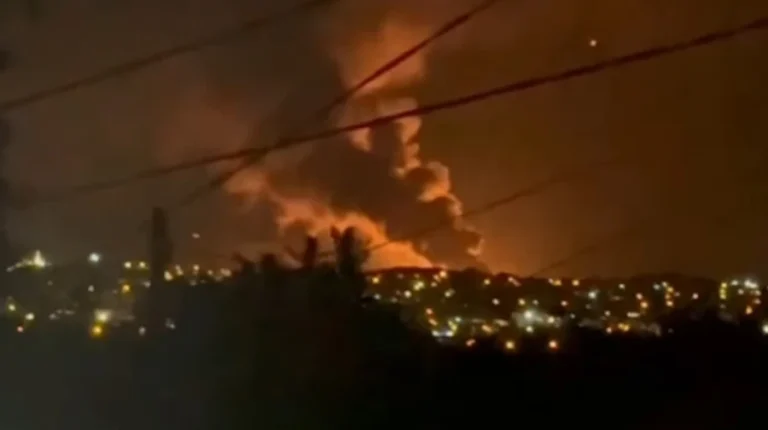
Russia’s expanding air-defence problem is no longer only a question of whether drones can reach Moscow. It is a question of what the Kremlin is willing to leave less protected when it reinforces the capital, oil refineries and military-industrial targets against Ukrainian long-range strikes.
Recent reporting and open-source claims have pointed to movements of S-300, S-400 and Pantsir systems away from some older or more remote positions, including parts of Russia’s Arctic defence network. Those individual claims require caution because air-defence redeployments are difficult to verify from public imagery alone. The broader pattern, however, is visible: Ukraine’s deep-strike campaign has made Russia’s strategic depth much harder to defend.
Recent reporting on Ukrainian drone swarms against Moscow and Russian infrastructure described a sustained campaign that has forced Russia to absorb repeated attacks on the capital region, energy facilities and logistics nodes. Each attack creates political pressure to move more systems closer to high-profile targets. That pressure competes with the need to protect occupied Crimea, military airfields, refineries, arms factories, command sites and Northern Fleet infrastructure.
The problem is structural. Long-range systems such as S-300 and S-400 batteries cannot be everywhere at once. A battery assigned to protect Moscow is not simultaneously protecting a refinery in Bashkortostan, an air base near Murmansk or a shipyard in Severodvinsk. Russia can layer shorter-range systems around some targets, but high-end coverage remains finite.
The interceptor problem is just as important as launcher placement. Moving a battery may improve coverage on a map, but the battery also needs missiles, trained crews, radars, maintenance and command links. If Ukraine can force Russia to fire expensive interceptors at cheaper drones, the burden is not only geographic. It is economic and logistical.
Ukraine appears to be exploiting that scarcity. Strikes against oil refineries, bomber bases, air-defence radars and logistics infrastructure do not need to destroy Russia’s entire network to create strategic effect. They only need to force Russia to redistribute systems, crews and interceptors in ways that expose other assets.
Defence Matters has already examined how Ukraine’s air-defence needs cannot be solved quickly by production announcements. Russia faces a related but different version of the same equation: defending a very large country against cheaper long-range drones while preserving high-end systems for military and strategic sites.
The refinery problem is especially difficult. Energy facilities are fixed, economically valuable and increasingly targeted. Russia can place Pantsir systems around some plants, but each protected refinery draws equipment away from another target. If Ukrainian drones can hit both oil infrastructure and military airfields, Moscow must decide whether political visibility, economic output or strategic military value comes first.
The Arctic dimension is more sensitive. Positions around Novaya Zemlya, Severodvinsk and the Northern Fleet’s support network are connected to Russia’s strategic-military posture. If systems have been reduced at some sites, the issue is not that Russia’s nuclear deterrent has ceased to function. It is that supporting infrastructure, shipyards, airfields and command nodes may become more exposed to unconventional long-range attack.
That exposure matters because Russia has long treated the Arctic as a protected rear area. Ukrainian reach now challenges that assumption. The 2025 attack on Olenya air base and subsequent strikes on deep Russian targets showed that distance is no longer a guarantee of safety. Even when drones are intercepted, the need to defend against them imposes cost.
Moscow can respond by producing more air-defence systems, hardening sites, dispersing assets, improving electronic warfare and relocating vulnerable equipment. But those responses take time and money. The immediate effect is an allocation crisis: every system moved to one priority leaves another priority thinner.
That allocation crisis is politically uncomfortable. Russian citizens expect Moscow and major cities to be protected. Military commanders want coverage over bases, depots and occupied territory. Energy officials want refineries defended because fuel shortages can affect the economy and the war effort. Strategic commanders want northern and nuclear-support sites shielded from surprise attack. These demands are not easily reconciled.
The result is a new strategic pressure point. Ukraine may not be able to overwhelm Russia’s air defences everywhere, but it can force Russia to reveal what it values most. Moscow, refineries, occupied territories and strategic military bases are now competing inside the same defensive equation.