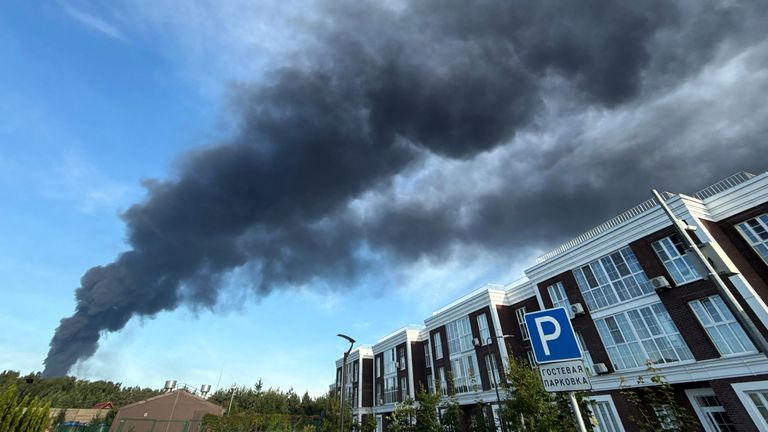
Ukraine’s long-range drone campaign is now pressing directly on the logistics belt around Moscow, where industrial parks, warehouses, transport corridors and fuel sites sit beside the political centre of the Russian state. Russian officials said drones struck the Moscow region overnight on 20 July, with damage reported in Domodedovo, Podolsk and Odintsovo district. A Reuters report carried by MarketScreener cited Moscow Mayor Sergei Sobyanin as saying more than 400 drones were launched towards the region and 85 were destroyed on the approach to the capital.
The operational details remain partly contested. Moscow region governor Andrei Vorobyov said air-defence and electronic-warfare systems repelled the attack, while civilian infrastructure was damaged. Meduza, citing official statements and Russian independent reporting, described fires at an industrial park in Domodedovo, reported damage in Podolsk and noted claims that an oil depot was burning. Ukraine’s President Volodymyr Zelenskyy said Kyiv had struck logistical facilities and an oil depot in the region of the Russian capital.
The significance is not that every warehouse or industrial building is automatically a military target. The significance is that modern weapons production depends on networks that often look civilian from the outside. Drones require motors, navigation modules, cameras, antennas, batteries, controllers, packaging, storage and transport. Military production therefore depends not only on final assembly plants but also on logistics firms, distribution centres and commercial warehouses.
That is why recent coverage of dual-use warehouse strikes is directly relevant. Ukraine has argued that some Russian logistics sites support drone production and navigation equipment. Russia has emphasised casualties and civilian damage. Both claims can be true in part: a commercial facility may contain civilian workers while also serving a military supply chain.
The Moscow region adds another layer. Unlike strikes on remote refineries or airfields, attacks near the capital create political visibility. They force Russian authorities to explain why air defences did not prevent fires in districts that residents associate with the state’s protective core. They also impose disruption on firms that may be important to ordinary commerce as well as the war economy.
Logistics targets are attractive because they can produce effects without destroying a weapons factory outright. A damaged warehouse can delay deliveries, force dispersal, complicate insurance, disrupt inventory records and push suppliers into less efficient routes. If components are specialised or sanctioned, even a partial interruption can matter. Russia can replace some stock, but moving, hiding and guarding it consumes time and manpower.
The campaign also creates a defensive allocation problem. The more Ukraine threatens warehouses, fuel depots and industrial parks around Moscow, the more Russia must spread short-range air-defence systems, electronic-warfare units and emergency services across ordinary-looking infrastructure. That burden competes with protection for refineries, airbases, naval facilities, command sites and occupied territory.
There is a legal and information-war risk for Ukraine. Targeting dual-use logistics requires a strong intelligence case. If a facility’s military function cannot be demonstrated, Russia will portray the strike as an attack on civilian commerce. If Ukraine can show that the facility supplied drone components, navigation equipment or military cargo, the attack becomes easier to defend under the logic of disrupting Russia’s war industry.
The 20 July strikes therefore mark another step in the war’s movement into supply networks. Ukraine is not only attacking platforms after they are built. It is trying to affect the chain that makes Russian drone and missile attacks possible. Warehouses, industrial parks and logistics hubs are becoming relevant because they are the connective tissue between imported components, domestic production and frontline use.
For Moscow, the problem will not be solved by claiming interception numbers. If drones repeatedly reach the logistics belt, companies will harden storage, evacuate staff during alerts, disperse inventory and demand greater protection. Those adaptations reduce efficiency. That is one of the quiet effects of deep-strike warfare: even when damage is limited, the defensive system becomes more expensive to run.
Ukraine’s message is clear. The Russian capital’s rear area is no longer separate from the industrial geography of the war. The next test is whether Kyiv can sustain enough pressure on verified military-linked logistics to disrupt Russian production without handing Moscow a stronger civilian-casualty narrative.