Drone activity in Moscow region’s Odintsovo district should not be exaggerated into a claim that Russia’s nuclear command system was attacked. The available public reporting does not support that conclusion. But the location matters. Odintsovo is part of the wider geography around Vlasikha, the closed military settlement associated with Russia’s Strategic Missile Forces, and repeated drone alerts in that district raise questions about how Russia protects high-value command zones against long-range unmanned systems.
During the 20 July attack on the Moscow region, Russian officials reported damage in several districts, including Odintsovo. Meduza cited Governor Andrei Vorobyov as saying a car and a private home were damaged in Odintsovo, while drones caused fires and other damage elsewhere in Podolsk and Domodedovo. A Reuters report described the broader attack as involving hundreds of drones directed at the capital region.
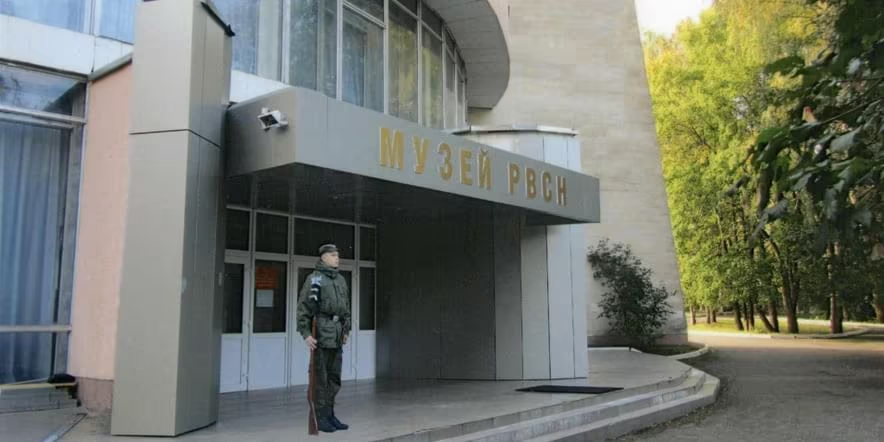
Vlasikha’s significance is publicly visible. A Russian cultural listing for the Strategic Missile Forces museum describes it as being located in the garrison of the Strategic Missile Forces, where the service’s main headquarters is based. That does not mean a drone falling anywhere in Odintsovo threatens strategic command and control. It does mean that Moscow region air defence is now operating around a district that contains unusually sensitive military infrastructure.
The issue is exposure rather than damage. Ukraine’s drones do not need to hit a command facility to create a security problem. Their presence forces Russia to activate air defences, electronic warfare, emergency services and protective procedures across areas that had long been treated as deep rear zones. Even false alarms or interceptions impose a cost when they occur near strategic command geography.
Russia’s air-defence allocation problem has already been visible around Moscow, refineries and northern military sites. Earlier analysis of Russia’s air-defence dilemma argued that Moscow must now choose among political visibility, energy infrastructure and strategic military assets. Odintsovo sharpens that problem because the area is not only suburban. It sits near a command ecosystem with national-security significance.
Strategic facilities are protected through layers: secrecy, perimeter security, hardened structures, air defence, electronic warfare, redundancy and dispersal. Small drones challenge some of those layers differently from ballistic missiles or aircraft. They can fly low, arrive in numbers, use circuitous routes and force defenders to distinguish between weapons aimed at strategic sites and weapons aimed at commercial or fuel infrastructure nearby.
That creates escalation-management risk. If a drone were to strike near strategic command infrastructure, Russia could portray the incident as a threat to its nuclear deterrent even if the target were unrelated or the weapon had gone off course. Ukraine and its partners therefore have strong incentives to avoid ambiguity around nuclear command-and-control targets. At the same time, Russia’s decision to place sensitive facilities within a region also containing fuel depots, warehouses and ordinary urban infrastructure complicates the defensive picture.
The military question is whether Russia can maintain reliable low-altitude coverage across the capital region while also defending the rest of the country. Moscow’s layered air defence was designed around high-priority threats, but mass drone raids create volume. A system that can intercept many targets may still allow some to fall, misidentify debris paths or consume scarce missiles and crews on low-cost drones.
Ukraine’s strategic logic is likely broader than Odintsovo itself. By reaching the Moscow region repeatedly, Kyiv demonstrates that Russia’s rear areas are vulnerable and that the Kremlin must devote resources to homeland defence. The pressure is psychological, political and logistical. Every Pantsir vehicle, radar and electronic-warfare team tied to the capital region is unavailable somewhere else.
The distinction between deterrent vulnerability and command-zone exposure also matters for Western policymakers. Ukraine’s partners want Russia’s war machine constrained, but they do not want ambiguous strikes to be misread as attacks on nuclear command and control. That creates a premium on careful targeting, clear communication and disciplined public claims. The more drones operate near sensitive districts, the more important it becomes to separate verified military targets from surrounding strategic geography.
The responsible conclusion is narrow but important. There is no public evidence that Vlasikha was attacked. There is evidence of repeated drone activity in the wider district that hosts sensitive strategic infrastructure. In a war increasingly fought through long-range unmanned systems, that distinction is exactly where the risk lies.