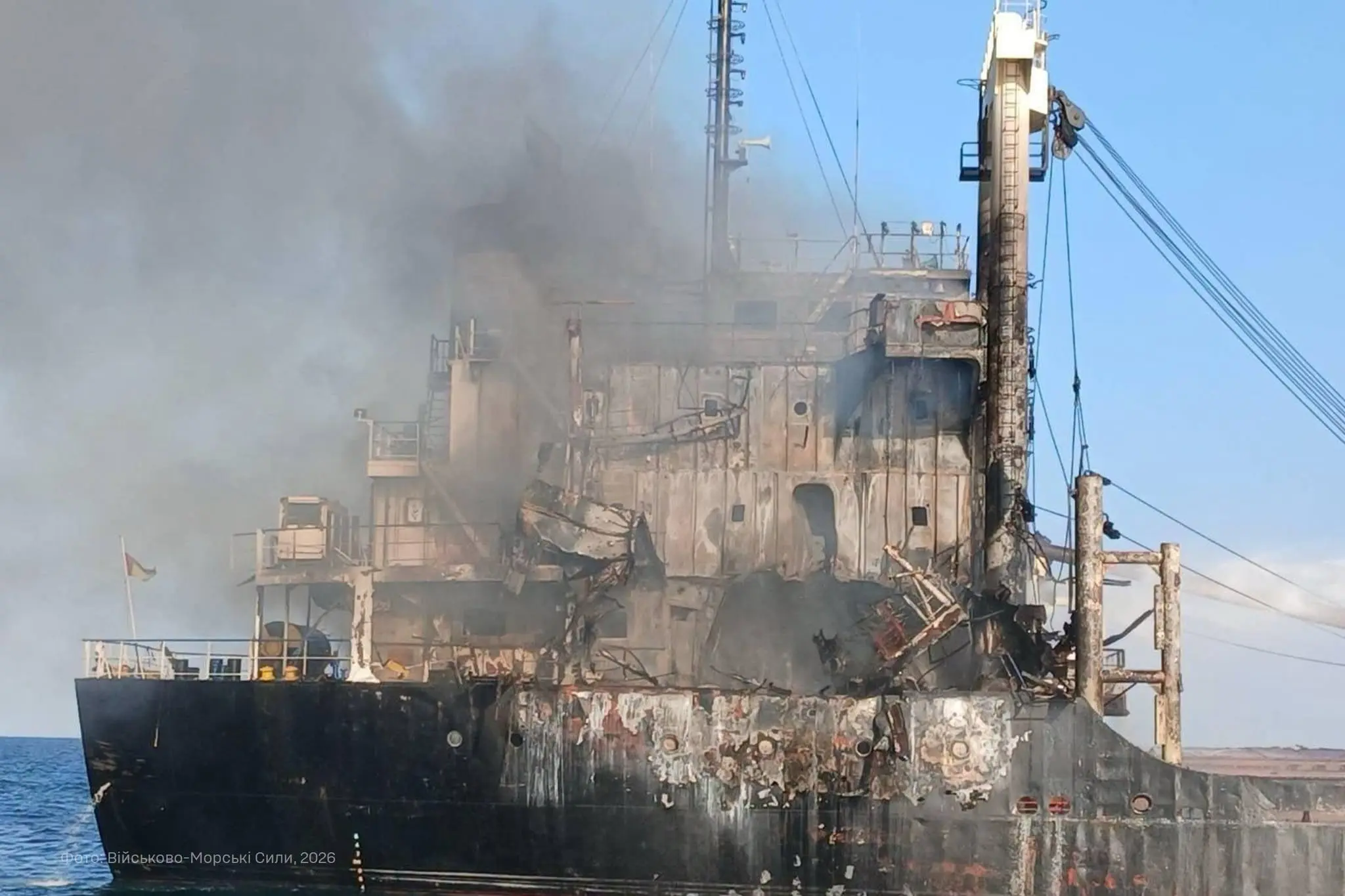
The reported Russian strike on the merchant vessel Golden Leo near Odesa has widened the risk picture for Black Sea navigation. Ukraine has accused Russia of hitting the ship with missiles, killing crew members and leaving others missing. EU Today reported that the vessel was struck near Odesa while carrying grain, with a multinational crew and a Ukrainian maritime pilot among the dead.
The precise weapon identification matters. Ukrainian accounts described cruise missiles, while early discussion around some maritime incidents often includes uncertainty over whether a vessel was struck by a drone, anti-ship missile, cruise missile or secondary blast. Until detailed imagery, radar data or debris analysis is available, the responsible approach is to avoid overclaiming the weapon type beyond what officials and reliable reporting state. The military significance, however, is already clear: commercial vessels operating near Ukrainian ports remain exposed to a strike environment designed for warships, ports and logistics nodes.
Russia’s target narrative will be central. Moscow has repeatedly argued that Ukrainian ports and vessels can support military logistics. Ukraine and its partners argue that attacks on grain ships and port infrastructure threaten civilian trade and food security. A merchant vessel can become legally and militarily contentious if one side claims it is carrying military cargo or operating in support of military activity. But the burden of proof is high, and the consequences for ordinary shipping are immediate.
Earlier analysis of pressure on Ukraine’s Black Sea grain corridor showed that Russia does not need to announce a formal blockade to impose costs. Repeated strikes on port infrastructure, storage sites, power systems or vessels can raise insurance premiums, reduce available ships, slow loading schedules and make traders reroute cargo through more expensive channels.
The Golden Leo incident fits that logic. Even if it remains a single strike, shipowners will look at the risk differently. Crews will ask whether port calls near Odesa can be conducted safely. Insurers will reassess war-risk cover. Charterers will price delay, rerouting and hazard pay. The result is a military effect produced through commercial caution.
For Ukraine, maritime resilience depends on layered protection. Ports require air defence, early warning, fire response, repair teams, protected anchorage procedures and coordination with ship operators. Vessels also need clear movement windows and reliable communication with Ukrainian maritime authorities. A civilian grain corridor cannot function if ships believe they are being treated as dual-use targets by default.
For Russia, attacking or threatening commercial shipping can create pressure on Ukraine’s economy without seizing territory. Grain exports support farmers, port workers, rail networks, state revenue and foreign exchange. Disrupting them weakens Ukraine’s resilience. It also sends a signal to countries dependent on Black Sea food supplies that the war can affect prices and availability beyond Europe.
The tactic carries diplomatic risks for Moscow. Strikes involving foreign-owned vessels, foreign crew or non-Ukrainian flags can draw in governments that may otherwise view the war primarily through sanctions or humanitarian support. A ship’s ownership, flag, crew nationality and cargo all matter. Each creates a different set of diplomatic and legal relationships after an attack.
The Black Sea has already become a theatre of reciprocal maritime pressure. Ukraine has struck Russian vessels, ports and logistics around occupied Crimea, Novorossiysk and the Sea of Azov. Russia has targeted Ukrainian ports and export infrastructure. Merchant shipping now operates inside that contested environment, where civilian, military and dual-use categories can blur under missile and drone fire.
Freedom of navigation is therefore no longer an abstract legal principle. It depends on whether vessels can move without being attacked, whether insurers will cover them, whether ports can load them and whether coastal defences can keep missile and drone threats far enough away. The Golden Leo strike suggests that the margin is narrowing.
The immediate question is attribution and evidence. The strategic question is whether commercial shipping near Ukraine can remain viable under repeated long-range strike pressure. If vessels are treated as potential military logistics by Russia, the Black Sea corridor becomes less a trade route than a defended maritime operation. That is a profound change for grain markets, port security and the military geography of the war.