Thales reported a 21 per cent rise in first-half order intake to 12.47 billion euros, showing that Europe’s rearmament cycle is now flowing into the financial statements of major defence suppliers. Reuters reported that the French group easily exceeded analyst expectations, with defence sales up 13.1 per cent and adjusted operating profit rising as demand for surveillance, aerospace and defence systems strengthened.
The results matter because defence policy often moves through rhetoric before money. Governments announce higher spending, but the industrial effect only becomes real when ministries sign contracts, companies book orders, suppliers receive work and factories expand. Thales’s figures suggest that the first stage of European rearmament has moved beyond political declarations.
The company said in its first-half results materials that demand remained strong across core activities. The order intake included large contracts and reflected the group’s exposure to the parts of defence spending most in demand: air defence, sensors, communications, electronic systems, cyber-secure networks, aerospace equipment and naval electronics.
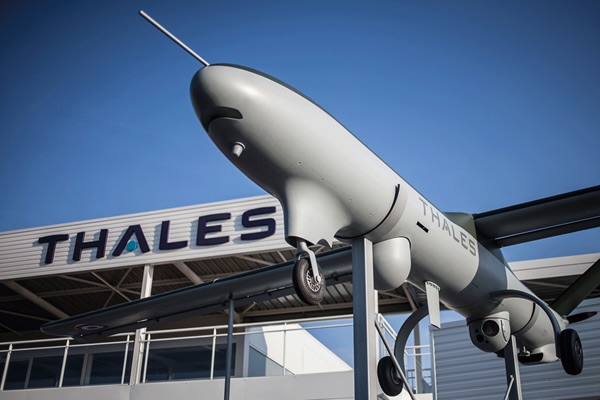
This is the less visible side of rearmament. Public debate often focuses on tanks, aircraft, ships and missiles. Thales sits in the systems layer: radars, sonars, command-and-control, optronics, secure communications, avionics and data links. Modern armed forces cannot use expensive platforms effectively without that layer. A frigate without sensors is a hull. An interceptor without radar and command systems is a stored munition. A drone without secure communications is a fragile aircraft.
Recent Defence Matters coverage of Thales’s proposed acquisition of Exail examined consolidation in underwater robotics and mine warfare. The first-half results show why such consolidation is financially possible. Strong order intake and cash flow give a company room to buy capability, integrate suppliers and position itself for long programmes.
The counterpoint is that rearmament is uneven. Thales’s defence and aerospace performance offset weaker cyber and digital activity. That matters because many governments now treat cyber as part of national defence, yet commercial cyber markets can behave differently from military procurement. A company can benefit from sovereign defence budgets while still facing weaker demand, pricing pressure or execution challenges in digital activities.
The F126 frigate cancellation also shows that even a strong cycle contains programme risk. Germany’s decision to cancel the F126 frigate programme imposed a major charge on Thales. Defence orders are large, political and long-lived; they can disappear when governments change requirements, budgets or industrial preferences. Rearmament creates opportunity, but it does not remove political risk from defence balance sheets.
Margins are politically sensitive. Defence companies are being asked to scale production quickly while governments worry about value for money. If margins rise too much, politicians may accuse industry of profiting from war. If margins are too low, companies may lack the incentive to invest in factories, workers and supply chains. Thales’s performance sits inside that tension. Strong profitability can support capacity expansion, but it also invites scrutiny.
The order surge also reveals the importance of production bottlenecks. Europe can allocate more defence money quickly, but radar modules, electronics, skilled engineers, explosives, propulsion systems and secure chips cannot always be produced at political speed. Companies with existing supply chains and integration capability will benefit first because they can absorb demand more quickly than new entrants.
For governments, the lesson is that rearmament must be managed as industrial policy. It is not enough to place orders. States must think about supplier resilience, stockpiles, export controls, workforce training, financing and long-term demand signals. A one-year spike in orders will not necessarily create durable capacity if companies fear budgets will fall again.
For Thales, the strategic task is to convert demand into delivery without overextending. Customers want faster production, but they also want reliability, cybersecurity and interoperability. Defence electronics are not commodities. A radar or combat-management system must work inside complex national and alliance networks. Scaling such systems is harder than scaling simpler hardware.
The wider European implication is clear. Rearmament is beginning to appear in company accounts. That is a necessary step if NATO countries are to rebuild inventories and adapt to Russian, Iranian and Chinese missile and drone threats. But balance-sheet strength is only one measure. The next test is whether orders become delivered capability fast enough to matter.