

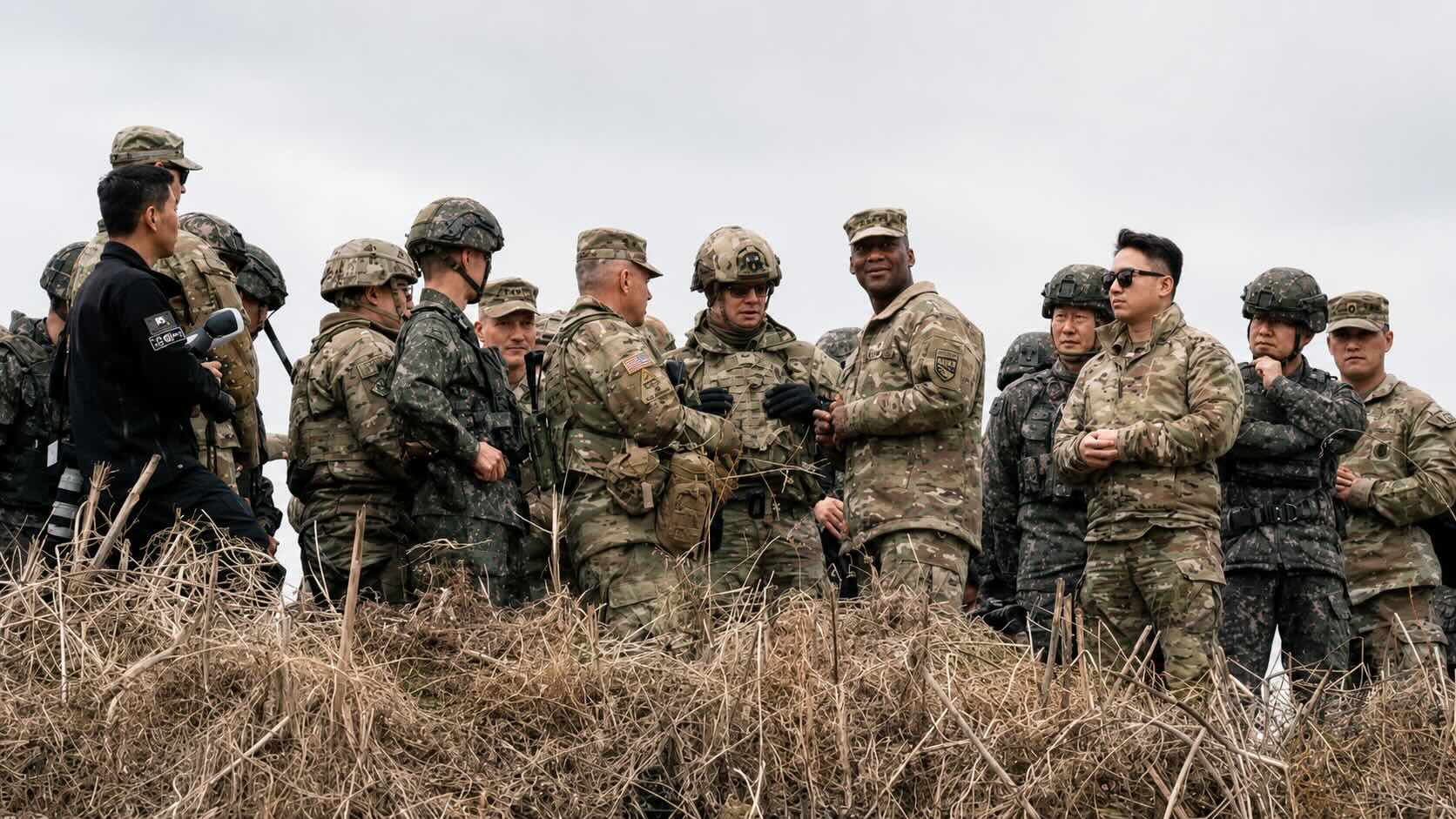
US President Donald Trump has ordered the Pentagon to scale back joint military exercises with South Korea, reopening questions over Washington’s security commitments in East Asia as North Korea continues to expand its nuclear and missile capabilities.
Trump announced the decision on 16 August, hours before the annual Ulchi Freedom Shield exercises were due to begin. He said he was unhappy with the cost and scale of American participation and argued that the drills sent an unnecessarily hostile signal to Pyongyang.
The president also referred to what he described as his “very good relationship” with North Korean leader Kim Jong Un, saying North Korea had been “unthreatening and respectful” during his presidency. He instructed Defence Secretary Pete Hegseth to “substantially reduce” US participation in the exercises.
Trump additionally linked his dissatisfaction with Seoul to South Korea’s response to the conflict with Iran. He said he had asked South Korean President Lee Jae Myung whether Seoul would participate in American efforts over Iran and had been turned down.
The South Korean presidential office gave a more qualified account, saying Seoul was discussing possible military contributions with Washington while considering its defence requirements on the Korean Peninsula and the domestic procedures required for overseas deployments.
Despite Trump’s intervention, the Ulchi Freedom Shield exercises began on 17 August and are scheduled to continue until 27 August.
Around 18,000 South Korean military personnel are participating. This year’s programme includes preparations for drone attacks, GPS disruption and cyber warfare, reflecting both developments in North Korea’s capabilities and lessons from recent conflicts.
Military officials have said the exercises are focused on threats to the Korean Peninsula and the defence of South Korea. US officials have also pointed to the battlefield experience acquired by North Korean troops deployed alongside Russian forces in the war against Ukraine.
It remains unclear which elements of Ulchi Freedom Shield will be reduced following Trump’s instruction.
The decision does not in itself alter the longstanding US-South Korea mutual defence arrangements or order the withdrawal of American forces stationed on the peninsula. The alliance is based on the Mutual Defense Treaty signed in 1953, under which both countries recognise that an armed attack against either party in the Pacific area would endanger their own peace and security.
However, the announcement revives questions raised during Trump’s first presidency over the future scale of the American military presence and joint training programme.
After his first summit with Kim in Singapore in 2018, Trump suspended major joint exercises, describing them as costly and provocative. Large-scale training was subsequently restored after negotiations over North Korea’s nuclear programme stalled.
Trump and Kim met in Singapore in 2018, Hanoi in February 2019 and at the inter-Korean border later that year. The Hanoi negotiations ended without an agreement, and subsequent talks also failed to produce a settlement limiting North Korea’s nuclear arsenal or ballistic missile programmes.
North Korea was already a nuclear-armed state long before Trump’s diplomacy with Kim began. It conducted its first declared nuclear test in October 2006, during George W Bush’s presidency, and ultimately carried out six tests between 2006 and 2017.
The security environment confronting the US-South Korean alliance is now substantially different from that of Trump’s first term.
North Korea has continued to develop ballistic missiles capable of threatening South Korea, Japan and potentially the continental United States. Earlier this month, Pyongyang carried out another ballistic missile launch from the Wonsan area, with South Korean authorities saying the missile travelled approximately 700 kilometres.
Pyongyang has also strengthened its military relationship with Moscow. North Korean troops have fought alongside Russian forces against Ukraine, giving them direct exposure to a battlefield dominated by drones, electronic warfare and precision weapons.
Before Ulchi Freedom Shield began, North Korea condemned the planned exercises, accusing Washington, Seoul and Tokyo of developing what it called a “nuclear alliance” and saying it would respond by strengthening its own nuclear deterrent.
At the same time, South Korean President Lee has sought to reopen political contacts with Pyongyang. In a speech on 15 August, he called for renewed talks aimed ultimately at replacing the armistice that ended active fighting in the Korean War with a more permanent peace arrangement. North Korea has so far rejected Seoul’s attempts at engagement.
Trump’s decision also comes as American military resources are being divided between Europe, the Middle East and the Indo-Pacific.
Air and missile defence has become an especially important constraint. Patriot systems and their interceptors are required to protect American forces and allies from ballistic and cruise missile attacks, while demand has risen considerably because of conflicts in Ukraine and the Middle East.
Reducing participation in Korean exercises does not therefore amount to a withdrawal of the US security guarantee. But repeated changes to the scale and character of exercises can influence military readiness and, equally importantly, perceptions of Washington’s intentions among both allies and adversaries.
For South Korea, the immediate question is whether Trump’s order remains limited to individual exercises or develops into a broader reassessment of US military commitments on the peninsula.
For Washington, the issue is whether reducing military pressure can create conditions for renewed diplomacy with Kim without weakening deterrence at a time when North Korea possesses a larger and more experienced military capability than during Trump’s first negotiations with Pyongyang.

Trump’s VA Gamble: Less Bureaucracy, More Service