Russia is expanding a dispersed network of launch sites for long-range attack drones close to Ukraine and NATO’s eastern flank, increasing both the scale of its current strike campaign and the number of locations from which future operations could be conducted.
A satellite-based investigation published on 16 August identified as many as 10 drone facilities containing at least 59 launch rails across western Russia.
Several of the sites are located in the Kursk and Bryansk regions, close to Ukraine and Belarus. The infrastructure includes launch positions at existing military facilities as well as newly developed sites away from major air bases.
For Russian forces, dispersal offers a clear operational advantage. Launching drones from a larger number of locations makes the system more difficult to suppress, complicates Ukrainian intelligence and targeting, and reduces the effect of destroying any single launch complex.
The network also provides greater capacity for preparing concentrated drone salvos, which have become an increasingly important part of Russia’s long-range strike campaign against Ukrainian cities, military facilities and infrastructure.
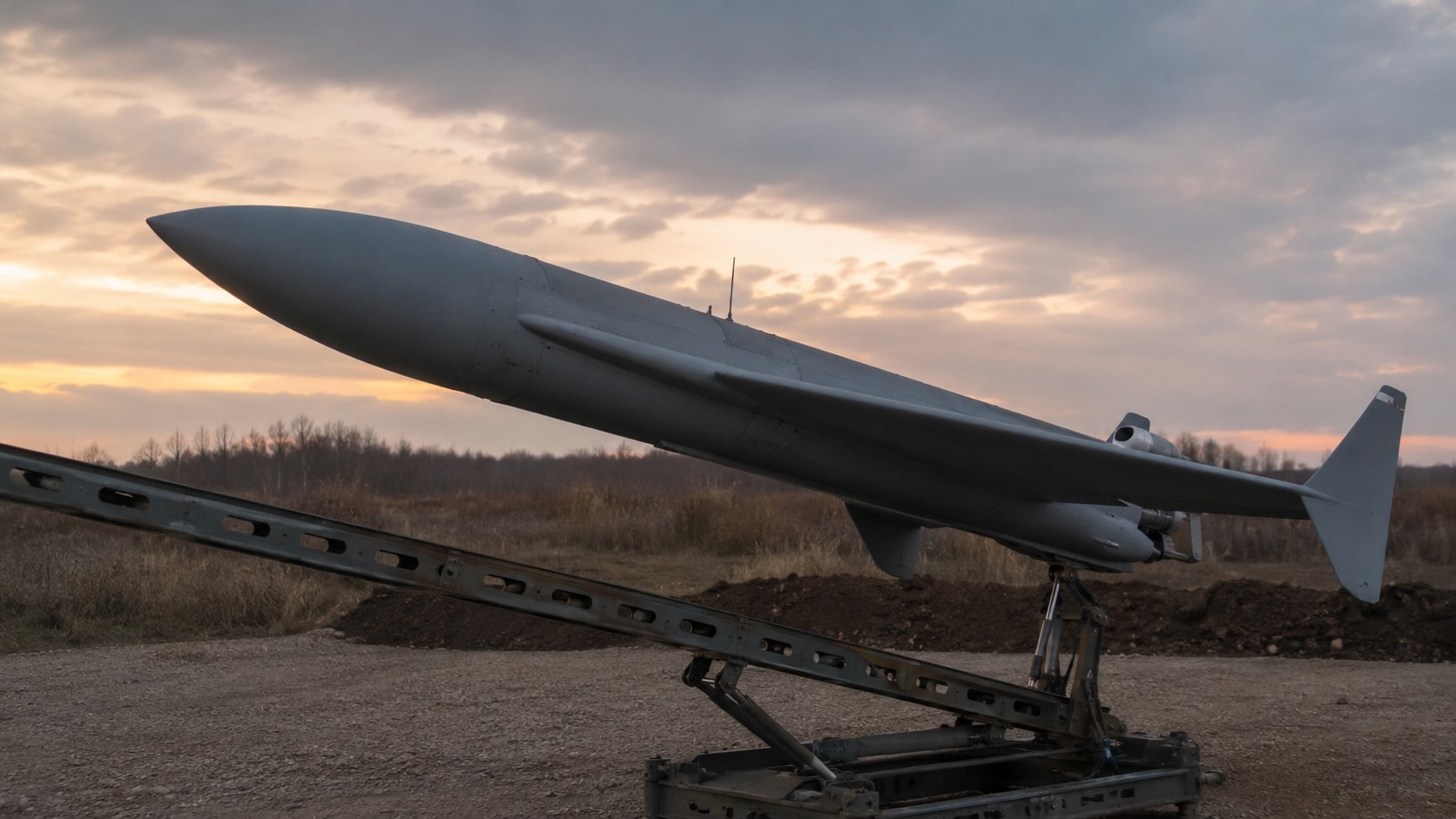
The most important feature identified in the imagery is the presence of approximately 20 longer launch rails, assessed as being suitable for newer, larger and faster jet-powered attack drones rather than only the propeller-driven Geran-2.
Russia has progressively expanded its Geran family beyond the Iranian-derived Shahed architecture used during the earlier stages of the war.
Ukraine’s Defence Intelligence has published technical information on the Geran-4, a jet-powered strike drone whose production preparations were completed during 2026.
According to the agency’s War & Sanctions database, the Geran-4 has a reported flight range of about 770 kilometres and a maximum speed of roughly 350 km/h.
The larger Geran-5 represents a more substantial change in capability. Ukrainian intelligence assesses the aircraft as having a range of approximately 950 kilometres, a cruising speed of between 450 and 600 km/h, and an operating altitude of up to around 6,000 metres.
The increased speed reduces the time available to air-defence crews to detect, classify and engage incoming aircraft. It also makes jet-powered Gerans more difficult targets for some of the cheaper interceptor drones and mobile gun teams increasingly used against conventional Shahed-type systems.
They remain vulnerable to dedicated air-defence weapons, but their performance forces defenders towards more capable—and often more expensive—interceptors.
That cost imbalance is one of the reasons such systems matter. Even a relatively inexpensive attack drone can impose a disproportionately expensive defensive response if slower counter-UAS systems cannot reliably engage it.
Ukraine remains the immediate target of the new infrastructure.
Russia has increasingly relied on very large mixed strike packages combining drones, cruise missiles and ballistic missiles in an effort to overwhelm Ukrainian air defences.
A larger number of prepared launch sites allows Russia to generate attacks from different directions, increase uncertainty over launch points and reduce the warning value of monitoring a limited number of traditional bases.
The network could also be important during winter operations, when Russia has repeatedly concentrated attacks on Ukraine’s electricity, heating and energy infrastructure.
The combination of conventional Gerans and faster jet-powered variants would allow Russian planners to create more complex attack profiles, with different systems approaching targets at different speeds and altitudes.
For Ukrainian air defence, this increases the requirement for layered systems rather than relying on a single interception method.
The location of the new bases also has implications for NATO.
A Geran-5 with an estimated range approaching 1,000 kilometres could reach parts of Alliance territory from launch positions in western Russia. Depending on the exact site, potential coverage extends into Poland and parts of the Baltic region, while Warsaw could fall within range from some locations.
This does not demonstrate that Russia is preparing an imminent attack against Poland or another NATO member.
The identified facilities currently form part of Russia’s strike infrastructure for the war against Ukraine. However, they also constitute a military capability that could be redirected in the event of a wider confrontation.
NATO has already increased its focus on the counter-UAS problem. Following Russian drone violations of Polish airspace in September 2025, the Alliance launched Eastern Sentry, combining additional air-defence, surveillance and counter-drone assets along the eastern flank.
Allies have also committed to substantial further spending on drone and counter-drone systems as they reassess the economics of defending against large numbers of comparatively cheap unmanned aircraft.
The Russian launch-site expansion illustrates why that work is becoming urgent.
For Moscow, the value of the new network lies not only in the individual drones it can launch, but in the ability to disperse weapons, increase sortie generation and complicate enemy targeting.
For Ukraine, it represents another expansion of Russia’s long-range strike architecture.
For NATO, it is a reminder that the infrastructure being built for the present war is simultaneously creating capabilities that could be used beyond it.