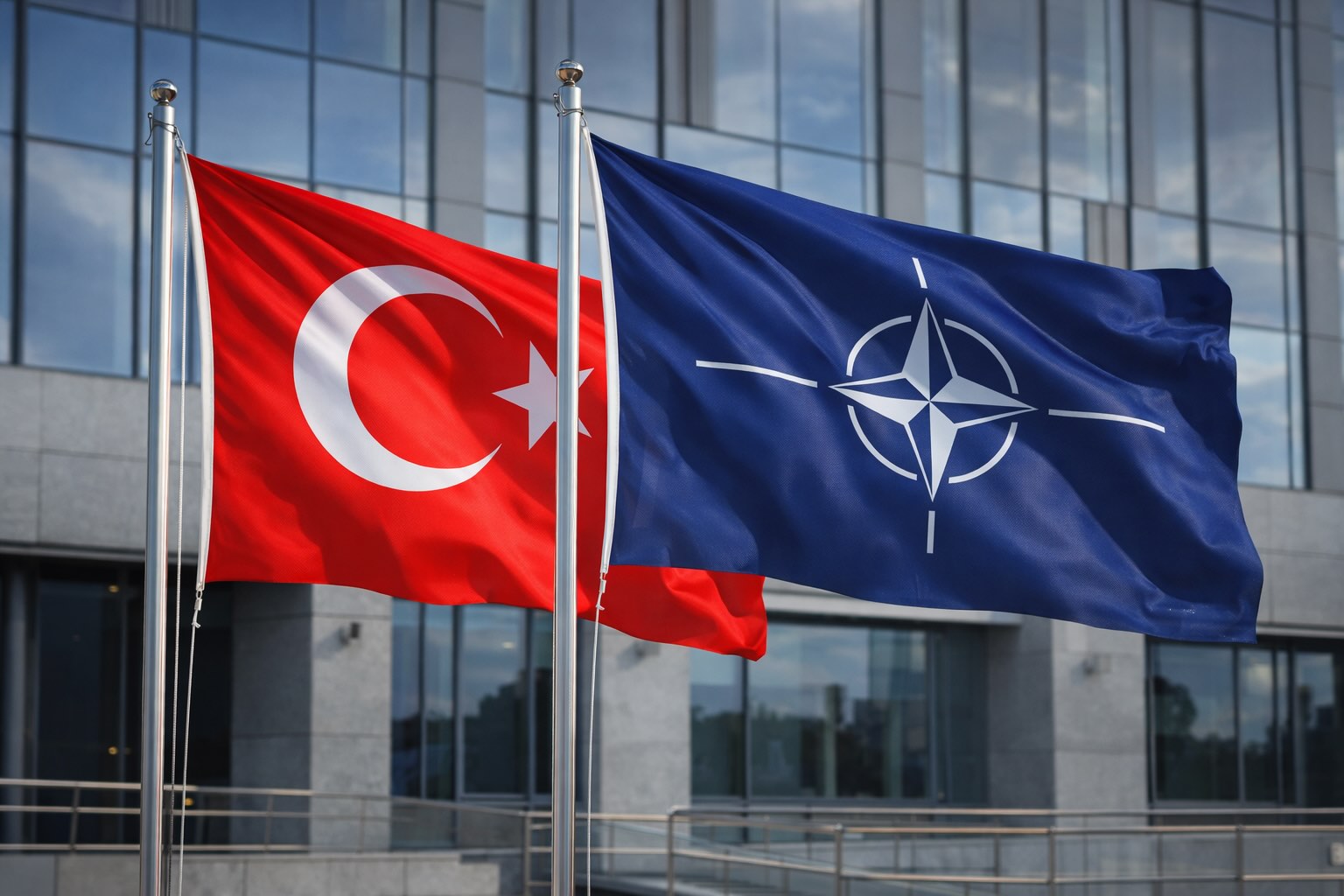
The issue has gained renewed relevance because of Ankara’s position as a major NATO member outside the European Union. That status gives Turkey a central place in alliance planning, but leaves it outside several EU-led defence instruments and procurement frameworks. For Ankara, this creates a structural gap between Europe’s military requirements and the political rules governing access to EU defence initiatives.
Turkish Defence Minister Yaşar Güler has argued that European security arrangements should not exclude NATO allies that are not EU members. His remarks reflect a long-standing Turkish position, but they come at a time when European states are under pressure to increase defence spending, expand industrial capacity and prepare for a less predictable American role in European security.
Turkey’s case rests on three arguments: geography, capability and industrial production. It controls access between the Black Sea and the Mediterranean, borders several conflict-affected regions, maintains NATO’s second-largest armed forces by personnel, and has developed a defence industry with growing export reach. Turkish-made drones, armoured vehicles, naval platforms and missiles have become part of Ankara’s wider foreign and security policy.
The question for European governments is not whether Turkey matters militarily. It clearly does. The more difficult question is how far the EU can integrate a non-member state into defence-industrial initiatives that are funded, regulated or politically controlled by the Union.
This tension has become sharper as Brussels has developed new instruments to strengthen European defence production. EU defence initiatives are intended to increase procurement, support joint production and reduce fragmentation across European industry. However, eligibility rules and political conditions can limit participation by non-EU countries, even when those countries are NATO allies.
From Ankara’s perspective, exclusion weakens the practical purpose of European defence integration. Turkey argues that Europe cannot build credible deterrence while leaving out major allied capacity on its south-eastern flank. It also sees defence-industrial cooperation as part of a broader strategic relationship with Europe, rather than a narrow procurement question.
For EU member states, the issue is more complicated. Some governments see Turkey as an indispensable NATO partner whose defence industry could help expand European production capacity. Others remain cautious because of political disputes, tensions in the eastern Mediterranean, Cyprus, democratic concerns, and Ankara’s separate defence relationships with non-Western partners.
These concerns have direct policy consequences. Defence procurement is not only a commercial matter. It can involve sensitive technologies, long-term dependencies, interoperability, export controls and political trust. EU governments will therefore weigh Turkey’s military contribution against the political risks of deeper integration.
The debate also intersects with NATO’s wider adaptation. European allies are being asked to carry a larger share of the burden for conventional deterrence, ammunition production, air defence, logistics and military mobility. If the United States reduces its role in parts of the European theatre, European capability gaps will become more visible. Turkey’s argument is that such a shift makes exclusion of capable non-EU allies harder to justify.
Yet Turkey’s inclusion would not be automatic. The EU’s defence-industrial agenda is also designed to strengthen the European industrial base inside the Union. Opening EU-funded programmes too widely could dilute that objective. Brussels will also need to ensure that common funding supports political priorities agreed by EU member states.
The likely outcome is not full integration, but selective cooperation. Turkey may seek access to specific procurement, industrial and capability projects where its contribution is clear and where political obstacles can be managed. Such cooperation could be easier in areas such as ammunition, drones, naval systems, air defence, logistics and Black Sea security, where operational need is substantial.
For NATO, the debate exposes a wider institutional problem. Europe’s security is organised through two overlapping structures: NATO, which includes Turkey, and the EU, which does not. As defence policy becomes more industrial and financial, this split becomes harder to ignore.
Turkey’s demand for a larger role is therefore not a marginal diplomatic complaint. It reflects a structural question for European defence: whether the continent’s security architecture can remain effective when military capability, political membership and industrial funding do not align.
The answer will depend on whether EU governments can separate practical defence cooperation from wider political disputes. If they cannot, Europe may find that some of its available military and industrial capacity remains outside the frameworks designed to strengthen its security.