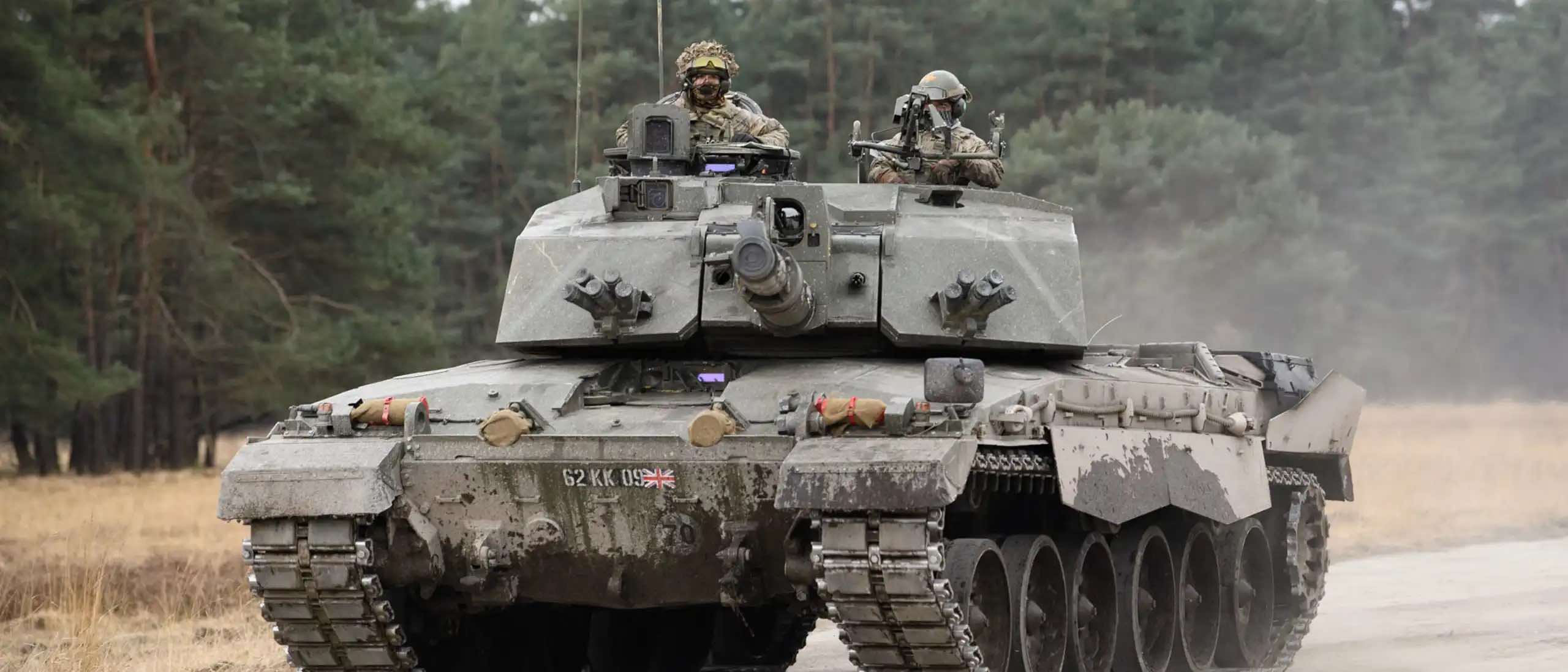
Trials conducted by troops from the Queen’s Royal Hussars offer a glimpse into a battlefield where tanks no longer operate as isolated steel behemoths, but as nodes within a wider digital and aerial network.
Held in Sennelager, Germany, the exercise brought together more than 350 soldiers to test how drones might be integrated directly into armoured manoeuvre. The concept is straightforward but transformative: rather than relying on separate reconnaissance units or dismounted drone operators, tank crews themselves launch and control unmanned systems while on the move.
At the heart of the trial was the ability to deploy both surveillance and strike drones from moving armoured vehicles. These drones provided real-time intelligence feeds, shared instantly across units, allowing crews to identify threats, track enemy movements and coordinate responses without exposing themselves. Such connectivity, long promised in defence circles, begins to blur the line between reconnaissance and combat, compressing decision-making cycles in a way that could prove decisive in high-intensity warfare.
Equally significant was the emphasis on keeping crews protected. Traditionally, drone operation has required soldiers to dismount, often placing them in vulnerable positions. By integrating launch systems into the vehicles themselves, the Army is seeking to maintain the protective advantages of armour while expanding situational awareness. This reflects lessons drawn from recent conflicts, particularly in Ukraine, where drones have become ubiquitous and deadly.
The trials also included new wearable technology, notably a redesigned helmet that allows personnel to transition seamlessly between operating inside a vehicle and fighting on foot. While less dramatic than the drones themselves, such developments underline a broader effort to reduce friction in modern combat, where adaptability and speed are paramount.
This experimentation forms part of a wider reappraisal of the tank’s role on the contemporary battlefield. For over a century, armoured vehicles have been synonymous with shock action and breakthrough capability. Yet their vulnerability to cheap, widely available drones has raised uncomfortable questions about their future. Recent conflicts have shown how even advanced tanks can be detected, tracked and destroyed by relatively inexpensive unmanned systems, forcing armies to reconsider how best to employ them.
Rather than abandoning armour, however, the British approach appears to be one of adaptation. By embedding drones within armoured units, tanks can extend their reach, detect threats earlier and engage targets with greater precision. In effect, the tank becomes less a standalone weapon and more a command platform within a dispersed, networked force.
The implications extend beyond tactics. Drone warfare, broadly defined as the use of unmanned systems for reconnaissance, strike and support roles, has already reshaped military thinking across NATO and beyond. From small, hand-launched quadcopters to larger systems capable of carrying munitions or supplies, these technologies offer a combination of affordability, flexibility and reduced risk to personnel that is difficult to ignore.
The British Army’s experiments also highlight the growing importance of “manned-unmanned teaming” – the integration of human operators with autonomous or semi-autonomous systems. In this model, drones act as force multipliers, extending the senses and reach of traditional units while allowing commanders to make more informed decisions. The ability to share live data across a formation, as demonstrated in the Sennelager trials, is central to this concept.
Yet challenges remain. The proliferation of drones has led to an equally rapid development of countermeasures, from electronic warfare systems to directed-energy weapons. Maintaining an advantage in this evolving contest will require constant innovation, as well as investment in training and doctrine. There is also the question of scale: integrating drones effectively across an entire army is a far more complex task than demonstrating their utility in controlled exercises.
Moreover, the human dimension of warfare endures. While drones can enhance situational awareness and deliver precision strikes, they do not eliminate the need for soldiers on the ground. As some British officers have observed, the fundamentals of land warfare – endurance, discipline and the ability to hold terrain – remain unchanged, even as technology advances.
In this context, the recent trials should be seen not as a revolution in themselves, but as part of a broader evolution. The British Army, like many of its counterparts, is seeking to reconcile the enduring value of heavy armour with the disruptive potential of unmanned systems. The result is a hybrid model, in which tanks, drones and digital networks operate in concert.
Whether this approach will prove sufficient in the face of rapidly changing threats is an open question. What is clear, however, is that the age of the isolated tank is drawing to a close. In its place emerges a more connected, more agile force – one in which the distinction between man and machine becomes increasingly blurred.
The Sound of War: British Troops Gain Instant Fire Detection Capability