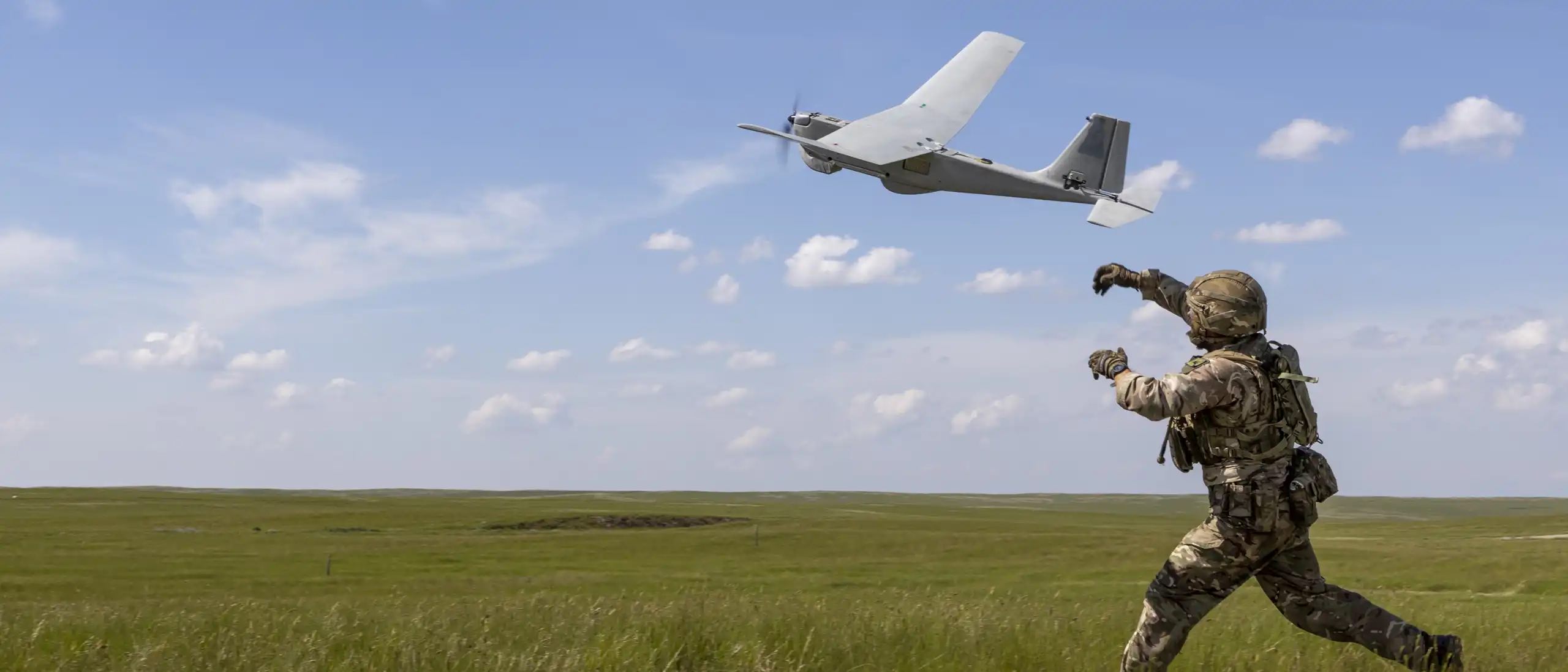
Yet on the Canadian prairie this month, members of the Parachute Regiment found themselves fighting a very different battle—one in which laptop computers, electronic sensors and small unmanned aircraft were every bit as important as rifles and mortars.
Exercise Rhino Bizz, involving around 350 British and Canadian troops, offers a revealing glimpse into the British Army’s evolving doctrine. While airborne infantry remain at the centre of the exercise, their effectiveness increasingly depends upon an ecosystem of drones, electronic warfare specialists and artificial intelligence designed to locate, identify and destroy an adversary before traditional combat even begins.
The exercise reflects a wider reassessment taking place across Western militaries. The conflict in Ukraine has demonstrated with uncomfortable clarity that relatively inexpensive first-person-view drones can destroy vehicles costing millions of pounds. At the same time, electronic warfare capable of disrupting satellite navigation, radio communications and targeting systems has become an indispensable component of modern military operations.
For the British Army, these lessons are no longer theoretical.
During Rhino Bizz, soldiers from 2 PARA’s Uncrewed Aircraft Systems Platoon work alongside artillery, engineers, communications specialists and Canadian infantry to simulate combat against an opponent equipped with similar capabilities. The emphasis is not simply on flying drones but on integrating reconnaissance, electronic surveillance, precision strike and conventional infantry into a seamless operational network.
Targets identified by surveillance drones can be engaged almost immediately using attack drones, Javelin anti-tank missiles, mortars or infantry assaults. Success depends less upon overwhelming firepower than on compressing the time between detection and engagement.
That philosophy—sometimes summarised as “find first, understand first, act first”—has become a defining characteristic of twenty-first century warfare.
The choice of Canada is also significant.
Its expansive training areas allow British troops to operate drones over distances impossible on many UK ranges while simultaneously practising electronic jamming and live-fire attacks under realistic battlefield conditions. Unlike many peacetime exercises, soldiers are expected to operate while their own communications and navigation systems are under constant electronic attack, mirroring conditions increasingly encountered in real conflicts.
Perhaps the most striking aspect of the exercise is the changing skill set expected of frontline soldiers.
Lieutenant Colonel Craig Shephard observed that troops have learned not only to fly drones but also to build electronic equipment, write software and programme artificial intelligence systems before integrating those technologies into tactical operations. Such capabilities would once have belonged exclusively to specialist engineers. They are now becoming part of the professional toolkit of airborne infantry.
This reflects a broader transformation underway throughout British defence.
Earlier this year the Army announced a dedicated undergraduate drone engineering degree intended to accelerate the development of specialists in autonomous systems, while the Strategic Defence Review places considerable emphasis on making British land forces significantly more lethal through AI, drones and autonomous technologies.
The shift is driven partly by economics.
Modern precision drones cost only a fraction of conventional guided missiles while delivering remarkable tactical effects. Their relatively low cost permits mass deployment, rapid adaptation and continual innovation. Military organisations can improve hardware and software over months rather than waiting years for traditional procurement programmes.
For defence planners facing constrained budgets, this flexibility has obvious appeal.
Yet technology alone does not guarantee battlefield success.
Electronic warfare has become an increasingly sophisticated contest of adaptation and counter-adaptation. GPS signals can be jammed. Radio frequencies can be intercepted. Drone communications can be disrupted. Artificial intelligence may accelerate decision-making, but human judgement remains essential when information becomes incomplete or deliberately manipulated.
Exercises such as Rhino Bizz therefore test not merely equipment but organisational resilience. Soldiers must continue operating effectively when digital systems inevitably fail or come under attack.
The British Army’s recent development of dedicated drone platoons reflects recognition that autonomous systems are no longer supporting assets but integral elements of combat formations. Earlier training initiatives have already moved beyond reconnaissance towards “one-way attack” missions, in which explosive-laden first-person-view drones conduct precision strikes against enemy positions.
This evolution mirrors broader NATO thinking.
The alliance increasingly views modern warfare as a contest fought simultaneously across physical, cyber and electromagnetic domains. Infantry, armour and artillery remain indispensable, but their effectiveness now depends upon the ability to dominate information networks and deny those same advantages to an adversary.
Rhino Bizz demonstrates that Britain’s airborne forces are adapting accordingly.
The enduring qualities traditionally associated with elite infantry—discipline, aggression and initiative—remain unchanged. What has altered is the technology accompanying those attributes.
Tomorrow’s paratrooper may still arrive by parachute, but upon landing will likely deploy autonomous aircraft, analyse live digital intelligence, coordinate electronic attacks and direct precision strikes long before engaging an opponent face-to-face.
For Britain’s armed forces, that represents more than technological modernisation. It marks a fundamental redefinition of what it means to fight—and survive—on tomorrow’s battlefield.