Security surrounding senior European defence-industry executives is being increased as intelligence services examine threats ranging from surveillance and espionage to alleged assassination plots.
The issue has acquired greater importance as European manufacturers expand production and supply weapons, ammunition and unmanned systems to Ukraine. Threat assessments that previously concentrated primarily on factories, computer networks and supply chains increasingly extend to executives’ homes, travel and personal routines.
A recent analysis of the threat to European defence-company leaders described an environment in which executives can no longer assume that their personal security is separate from the strategic role of their companies.
The cases behind that assessment are not all equivalent, however.
Some have involved intelligence findings pointing to Russian state activity. Others have generated suspicion because of unusual circumstances but produced no evidence of espionage. Separating those categories is essential.
The clearest case concerns Rheinmetall chief executive Armin Papperger.
US intelligence uncovered what officials described as a Russian plan to assassinate Papperger in 2024 and informed Germany, after which his protection was increased. Moscow denied involvement.
The case subsequently moved beyond anonymous intelligence reporting.
In January 2025, NATO official James Appathurai publicly confirmed that the murder plot had formed part of a wider campaign of Russian sabotage activity directed against alliance countries. He placed it alongside incidents including arson, attempted sabotage and attacks on infrastructure.
Rheinmetall is one of Europe’s largest defence manufacturers and a major supplier of ammunition, armoured vehicles and other equipment to Ukraine.
The Papperger case established that personal security around defence executives could no longer be treated simply as conventional corporate protection.
The security question has returned this month following reports concerning Stefan Thumann, head of German drone manufacturer Donaustahl.
German reporting says intelligence authorities believe Thumann was placed under surveillance by people working for a Russian intelligence service after his company became involved in supplying unmanned systems and components to Ukraine.
Two people — a Ukrainian national and a Romanian national — were arrested in connection with the investigation. They are accused of suspected intelligence-agent activity for a foreign service. Reports based on German investigative material say surveillance included photographing or filming Thumann’s home and company premises.
There is an important legal qualification.
Although German intelligence material reportedly refers to a suspected assassination plan, the arrest warrants against the two suspects concern alleged intelligence activity. They do not accuse them of attempted murder or terrorism.
Thumann said in an interview published this week that he now changes locations frequently and believes his life is threatened by Russian military intelligence. Those statements are his assessment of the threat rather than a judicial finding.
A recent case involving Saab chief executive Micael Johansson shows why heightened security can also produce suspicions that are not eventually substantiated.
Two Russian citizens living in Spain were detained after camping about 50 metres from a property outside Gävle associated with Johansson. One entered the property and asked whether she could fish from a private jetty. The pair also had walkie-talkies, according to Swedish public broadcaster SVT.
Johansson has personal protection because of his position at Saab, and his guards contacted police.
The circumstances immediately generated speculation about possible Russian surveillance.
But the subsequent investigation did not establish that.
The couple said they were tourists, opposed Russia’s war in Ukraine and had not known that Johansson was staying nearby. A Swedish court lifted their detention, and Swedish reporting subsequently said the criminal suspicions against them had been dropped.
They should therefore not be described as Russian spies or as participants in a confirmed plan to kidnap or kill the Saab executive.
The episode nevertheless demonstrates the security environment in which defence-industry leaders now operate. Behaviour that might otherwise attract little attention can trigger a police and counter-intelligence response when it occurs beside the temporary residence of the head of a company producing Gripen fighters, radar systems, missiles and other military equipment.
Threats against individuals form only one part of the pressure on Europe’s defence industry.
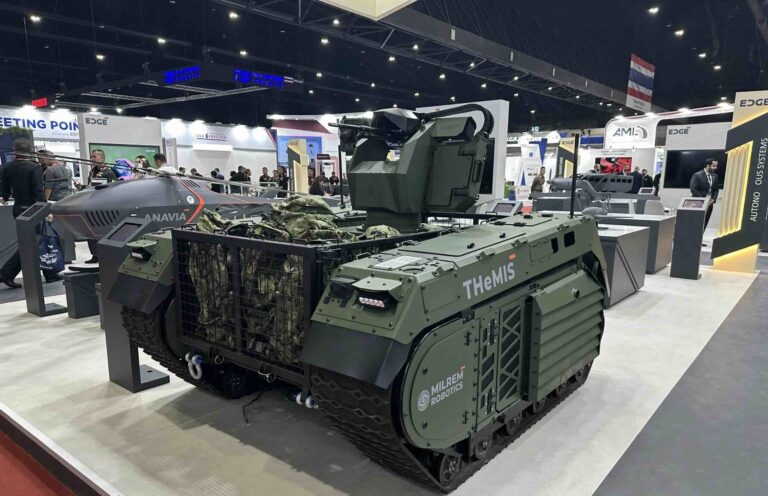
Defence Matters reported earlier on Thursday on a suspected arson attack involving a building used by Estonia’s Milrem Robotics. Estonian authorities are investigating possible sabotage and possible Russian involvement, but attribution has not been established.
Taken together, the cases show the widening security problem facing European manufacturers.
Production sites need physical protection. Supply chains must be monitored. Computer systems require cyber defence. Employees can be approached for information. Senior managers may require protection at their homes and during travel.
But the evidence threshold remains important. The confirmed NATO account of the Papperger plot, the intelligence allegations surrounding Thumann and the unsubstantiated suspicions in Sweden belong in the same security discussion, but they are not the same type of case.
That distinction will become increasingly important as European defence production expands and security services devote more resources to protecting the people responsible for it.