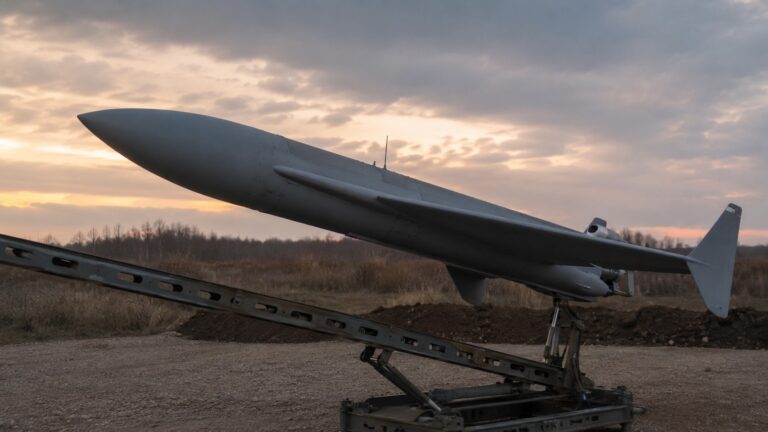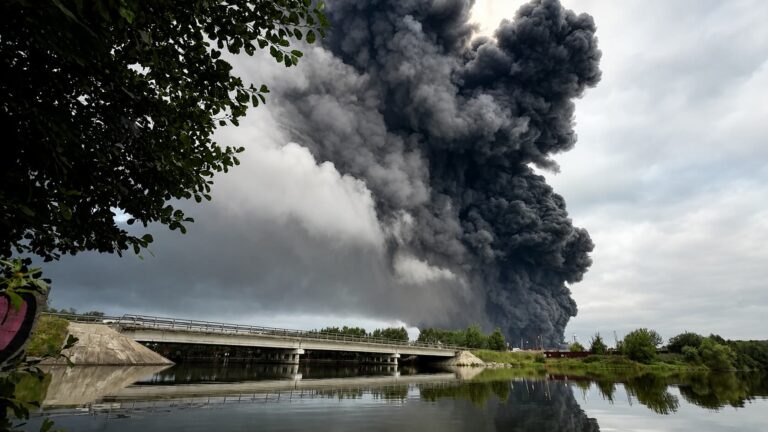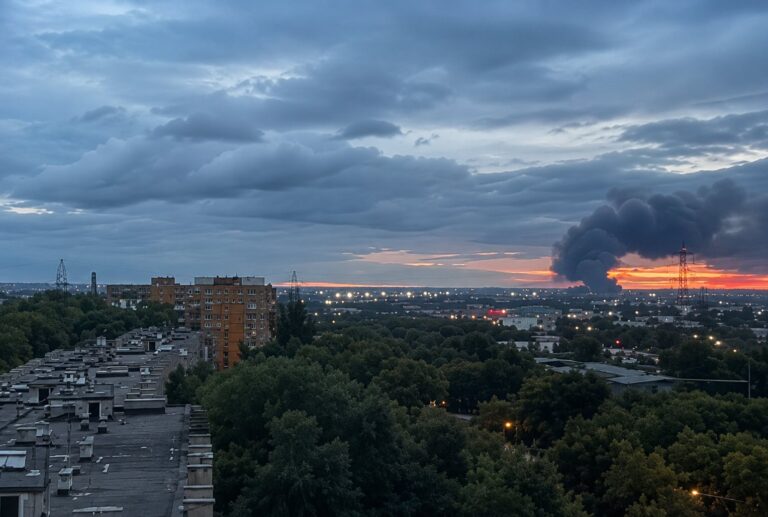
Ukraine carried out one of the largest long-range drone operations directed at the Moscow region overnight on 17–18 August, presenting Russian air defences with a prolonged saturation challenge across the capital and its surrounding infrastructure.
Moscow Mayor Sergei Sobyanin said that 620 unmanned aerial vehicles had flown towards the Moscow region between Monday evening and 5am on Tuesday. According to his account, 180 were destroyed within the Moscow region. The figures are Russian official claims and have not been independently verified.
The distinction between the number approaching the region and the number intercepted there is important. It does not establish that hundreds of drones penetrated Moscow’s air-defence perimeter: some may have been destroyed in neighbouring regions, diverted by electronic warfare or assigned to other targets.
What the figures do indicate is the scale of the air-defence problem created by a large, geographically dispersed attack.
Long-range drone warfare increasingly involves forcing defenders to respond to multiple tracks simultaneously rather than relying solely on individual UAVs reaching high-value targets.
A raid numbering in the hundreds requires radar operators, electronic-warfare units, mobile fire groups and surface-to-air missile systems to identify and prioritise threats over several hours. It also forces civilian airspace restrictions and the deployment of emergency services across a wide area.
Moscow regional governor Andrei Vorobyov separately reported that more than 150 drones had been intercepted using air-defence and electronic-warfare systems across several districts surrounding the capital.
Russian authorities reported activity around Ramenskoye, Pavlovsky Posad, Orekhovo-Zuyevo, Elektrostal, Kolomna and Bogorodsky, underlining the geographical extent of the operation.
The effect of such attacks therefore cannot be measured solely by the number of targets physically destroyed. Even unsuccessful drones can consume interceptor missiles, expose air-defence positions, force radar emissions and interrupt transport or industrial operations.
One of the clearest secondary effects occurred east of Moscow, where electricity supplies were interrupted after grid equipment was damaged.
Regional electricity operator Mosoblenergo reported that 109 transformer substations lost supply, affecting more than 5,000 customers and 46 socially important facilities in Likino-Dulyovo and Orekhovo-Zuyevo.
Emergency generating equipment was deployed while repair teams worked on the network.
The available information does not establish whether the electricity installations were deliberately targeted. Infrastructure can be damaged by a direct strike, a drone that has lost navigation after electronic interference, or debris from an interception.
From an operational perspective, however, the cause is less important than the effect: a sufficiently large aerial attack can create disruption across infrastructure networks without every UAV successfully reaching a predetermined target.
That presents an increasingly difficult defensive calculation for Moscow. Russia must protect military facilities and defence-industrial plants while also covering fuel depots, power substations, communications infrastructure, transport hubs and a large civilian metropolitan area.
The attack also affected aviation around Moscow, with temporary restrictions imposed at airports serving the capital.
Such closures have become a recurring consequence of Ukrainian deep strikes into Russia. Their military significance is indirect but measurable.
Airspace restrictions complicate civilian flight schedules, require aircraft diversions and place additional demands on air-traffic management. They can also affect airports with mixed civilian, governmental or logistical importance.
For the attacking side, this means that relatively inexpensive unmanned systems can impose disruption that extends considerably beyond the physical damage caused by individual warheads.
The Moscow operation forms part of a broader Ukrainian effort to increase the reach and scale of domestically produced long-range weapons.
Ukraine has repeatedly used one-way attack drones against Russian oil refineries, fuel depots, logistics facilities and defence-industrial sites. The operational objective has generally been to damage resources directly supporting Russian military activity while forcing Moscow to disperse air-defence assets across a very large territory.
The latest raid indicates that Ukraine can also assemble sufficiently large strike packages to place pressure on the air-defence architecture around Russia’s most heavily protected urban region.
This has implications beyond Moscow.
Every additional air-defence system assigned to protect infrastructure deep inside Russia is a system unavailable elsewhere, including near the Ukrainian front or around military facilities in occupied territory. The same applies to electronic-warfare systems, radar coverage and trained personnel.
The military value of the operation cannot yet be determined from the numbers of drones involved.
A raid involving hundreds of UAVs may appear impressive while producing limited physical damage if Russian interception rates remain high. Conversely, modest infrastructure damage can still have operational value if achieving it forces Russia to expend expensive interceptors, relocate defensive systems or repeatedly close strategically important airspace.
The principal development is therefore not the temporary blackout experienced by several thousand customers.
It is the ability to generate a massed deep-strike package against a region hundreds of kilometres from Ukraine and force multiple elements of the Russian defensive system to react simultaneously.
As both sides expand long-range drone production, Russia’s challenge will increasingly be one of scale. Protecting Moscow itself is achievable with concentrated defences. Protecting every substation, refinery, industrial plant, warehouse, airfield and transport node surrounding it is substantially more difficult.
The 18 August raid demonstrated the difference.