Fincantieri has agreed to acquire majority stakes in four Italian underwater-technology companies, committing around €600 million to build an integrated business around marine drones, seabed surveillance and critical-infrastructure protection.
The shipbuilding group will acquire Next Geosolutions, WSense, Graal Tech and Defcomm. In its formal announcement on 6 July, Fincantieri described the plan as the creation of a vertically integrated underwater operator covering platforms, communications, geoscience, software and services.
The acquisitions are commercially significant, but their strategic importance lies in the market Fincantieri is trying to assemble. Undersea security is moving beyond submarines and minehunters towards distributed sensors, autonomous vehicles and persistent monitoring of cables, pipelines, ports and offshore energy infrastructure.
Next Geosolutions provides marine survey, geoscience and offshore construction-support services. Its capabilities include mapping and understanding the physical environment in which undersea systems operate.
WSense specialises in underwater wireless communications and the “Internet of Underwater Things”. That is a critical technical area because radio signals travel poorly through water, making navigation and data exchange among submerged platforms difficult.
Graal Tech develops autonomous underwater and surface vehicles. Defcomm contributes communications and defence-related technology. Fincantieri plans to consolidate NextGeo, WSense and Graal Tech after completion, while Defcomm would be fully consolidated if a call option raises Fincantieri’s holding to 51 per cent.
Together with the group’s existing submarine, WASS, Remazel and IDS businesses, the companies are intended to cover the chain from vehicle construction and launch systems to communications, surveying and operational services.
The logic differs from a conventional shipyard acquisition. Fincantieri wants to become an operator and service provider in a domain where hardware, software and data must work together.
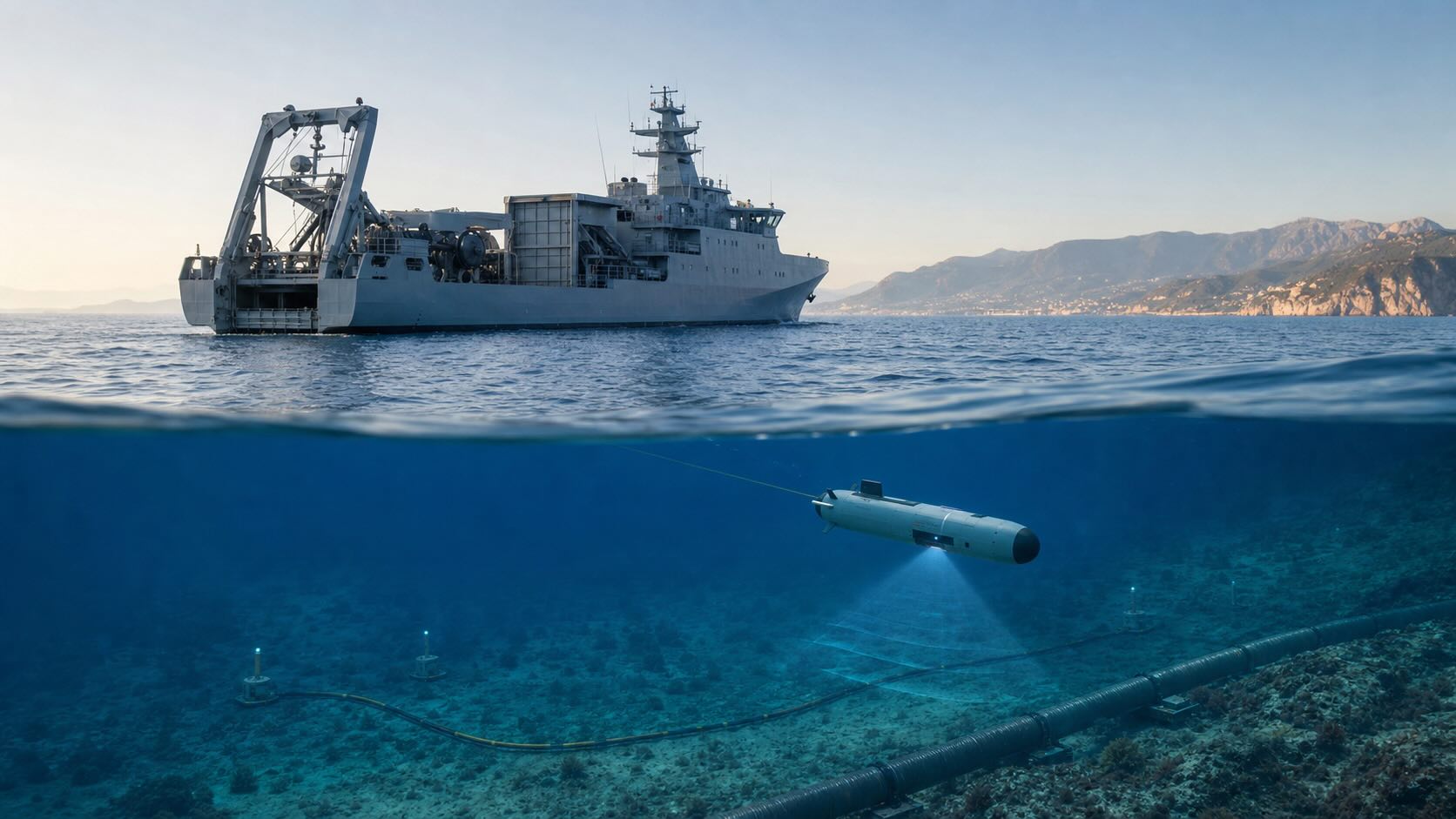
A survey vessel built by the group’s Vard subsidiary could deploy a Graal Tech drone through a Remazel launch-and-recovery system, connect it through WSense communications and use NextGeo expertise to interpret seabed data. That is the kind of end-to-end model governments increasingly seek for infrastructure protection.
The initial expenditure will be financed partly through the €500 million capital increase completed in February and through other group resources. Fincantieri expects the transactions to increase pro-forma earnings and accelerate the underwater strategy in its 2026–2030 business plan.
Subsea cables carry much of the world’s digital traffic, while pipelines and electricity interconnectors connect European economies. Damage can create economic disruption without the visible signature of a conventional attack.
That makes persistent detection and rapid inspection essential. Autonomous systems can monitor wide areas and investigate anomalies without tying up scarce crewed vessels. They also have military uses in mine warfare, reconnaissance, anti-submarine operations and covert logistics.
Defence Matters has described how Britain’s Atlantic Bastion programme seeks to protect seabed infrastructure from Russian activity. Fincantieri’s acquisitions show Italy building a comparable industrial base suited to the Mediterranean and international markets.
The Italian move arrives as Thales advances a takeover of French underwater-drone specialist Exail. The two transactions point to a common trend: major European defence groups want control of specialist autonomy, navigation and communications businesses before demand expands further.
For governments, stronger system integrators may simplify procurement and increase investment. For smaller companies, acquisition can provide capital, testing facilities and access to export customers. The risk is that innovation becomes concentrated inside a few national champions and cross-border standards remain fragmented.
Italy’s challenge will be to connect its national underwater hub with NATO and EU programmes. The Commission has identified integrated maritime and seabed defence as a priority common project. Fincantieri now has a stronger portfolio with which to lead or shape that work.
The €600 million commitment is therefore more than corporate expansion. It is a wager that the seabed will become a permanent defence market and that navies will buy integrated autonomous services alongside ships and submarines. Italy intends to be one of the states setting that market’s architecture.