A 20-tonne retardant drop over the Gironde wildfire demonstrates the A400M’s civil-protection value, but also exposes the limits of borrowing scarce military airlift.
A French Air and Space Force A400M has carried out its first operational firefighting drop, releasing approximately 20 tonnes of retardant over the major wildfire in Gironde on 25 July.
The deployment was accelerated as extreme fires placed France’s civil-protection fleet and ground services under pressure. The adapted military transporter joined specialist water bombers, helicopters and around 1,400 firefighters in the region. France’s Interior Ministry had announced the A400M reinforcement on 23 July, while the Ministry of the Armed Forces described military bases as essential support points for aircraft fighting the fires.
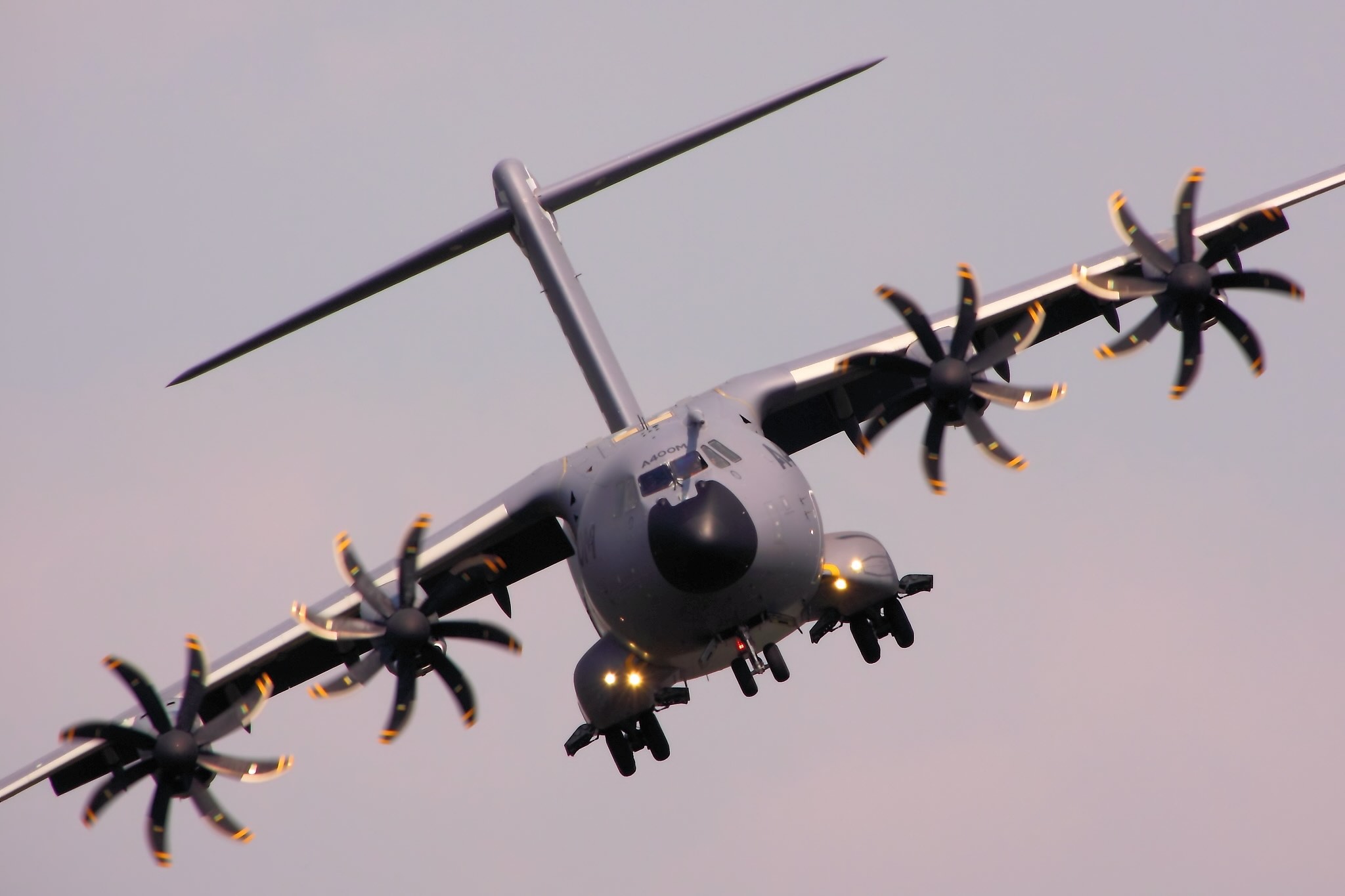
The mission was visually impressive: a large strategic and tactical transport aircraft flying low enough to place a broad retardant line ahead of an advancing fire. Its real importance lies in what it reveals about dual-use capability.
The A400M can provide a substantial emergency payload without being permanently converted into a specialist firefighting aircraft. That gives governments an option when normal capacity is overwhelmed. It does not mean Europe has discovered an effortless substitute for Canadair water bombers or a reason to divert military airlift routinely.
The firefighting system uses a removable tank installed in the cargo hold. Retardant or water is released through the rear ramp area without permanently modifying the airframe. The concept allows an aircraft to return to transport duties after the equipment is removed.
The 20,000-litre capacity is roughly three times the load commonly associated with a Canadair CL-415. Payload alone, however, is a poor measure of firefighting effectiveness.
Purpose-built amphibious aircraft can scoop water from suitable lakes or coastal areas and return rapidly to a fire. An A400M must land, refill and take off again. Its size affects which airfields it can use, how it is sequenced with other aircraft and where it can operate safely in smoke, terrain and turbulent heat.
Retardant and water also serve different tactical purposes. A retardant line laid ahead of a fire can slow its spread and support ground crews. Direct water drops may be used differently. The A400M should therefore be judged on the missions its kit is designed to perform, not solely on litres carried.
Operational deployment is more informative than a demonstration. Crews must integrate with civilian incident command, aerial coordinators, specialist aircraft and firefighters on the ground. Drop accuracy, turnaround time, communication procedures and the behaviour of the aircraft at low altitude all become measurable.
France’s Interior Ministry said the country could also call on the EU’s solidarity mechanism for additional aircraft. That context matters. The A400M was not operating as a self-contained solution; it was one element in a national and European emergency network.
The mission also followed an unusually severe fire season. The Interior Ministry reported more than 50,000 hectares burned in France by 24 July and dozens of active fires. The decision to accelerate the A400M’s debut was therefore driven by operational need, not merely a desire to showcase the conversion kit.
The aircraft’s performance should now be assessed candidly. France should record the area covered by each drop, accuracy, refill time, aircraft availability, maintenance impact and the circumstances in which controllers found the platform most useful. Publicising non-sensitive lessons would help other European A400M operators evaluate the capability.
The central trade-off is availability. Defence Matters recently reported that NATO’s shared A400M plan exposed Europe’s strategic-lift shortage. The aircraft are required for troop and equipment transport, medical evacuation, airborne operations, air-to-air refuelling and crisis response.
An A400M assigned to firefighting is not immediately available for those tasks. Conversion, crew preparation and subsequent inspection create additional opportunity costs even if the kit is installed quickly.
In peacetime, a limited number of short emergency deployments may be manageable. During a simultaneous military crisis, evacuation operation and severe wildfire season, governments would face harder choices.
That is why dual use cannot be treated as free capacity. It is a method of reallocating a scarce asset. The advantage is speed and flexibility; the risk is that political leaders count the same aircraft simultaneously in military readiness and civil-resilience plans.
Several European states operate the A400M, and wildfires increasingly affect areas beyond the Mediterranean. A common conversion kit could create a multinational reserve, but only if procedures are aligned.
Questions include who owns and maintains the kits, which crews are trained, who certifies the installation, what national restrictions apply and how an aircraft is requested through EU or bilateral mechanisms. Retardant supplies, airfield handling and civil–military command relationships also require preparation.
A model in which every operator buys equipment that is rarely used may be inefficient. A small pooled inventory of kits, combined with distributed crew training, could offer greater value. The equipment would need to move faster than the emergency it is meant to address.
The EU’s wildfire response framework already coordinates rescEU aircraft and cross-border assistance. A400M capacity should complement that structure rather than operate as a parallel military mechanism.
The successful debut may encourage claims that large transports can compensate for ageing specialist fleets. France’s Canadairs have faced availability and replacement concerns, and political pressure for visible reinforcement is understandable.
An A400M cannot be in two places at once, cannot scoop water like an amphibious aircraft and is substantially more complex and expensive than smaller platforms. Firefighting also exposes it to low-level hazards and potential damage from smoke, debris and demanding manoeuvres.
The correct lesson is narrower: a removable system can provide a high-capacity reinforcement for particular drops when civil resources are stretched. It expands resilience at the margin and may protect critical points, evacuation routes or infrastructure.
That is still valuable. Climate-driven emergencies increasingly require military assistance, while armed forces themselves must operate amid heat, fire, flood and disrupted infrastructure. Dual-use planning is becoming part of readiness rather than an exceptional public-relations exercise.
France’s first operational drop has demonstrated feasibility. The next phase is less dramatic but more important: measuring the result, identifying the true cost and building rules that ensure emergency civil support does not quietly hollow out the airlift capacity Europe needs for defence.