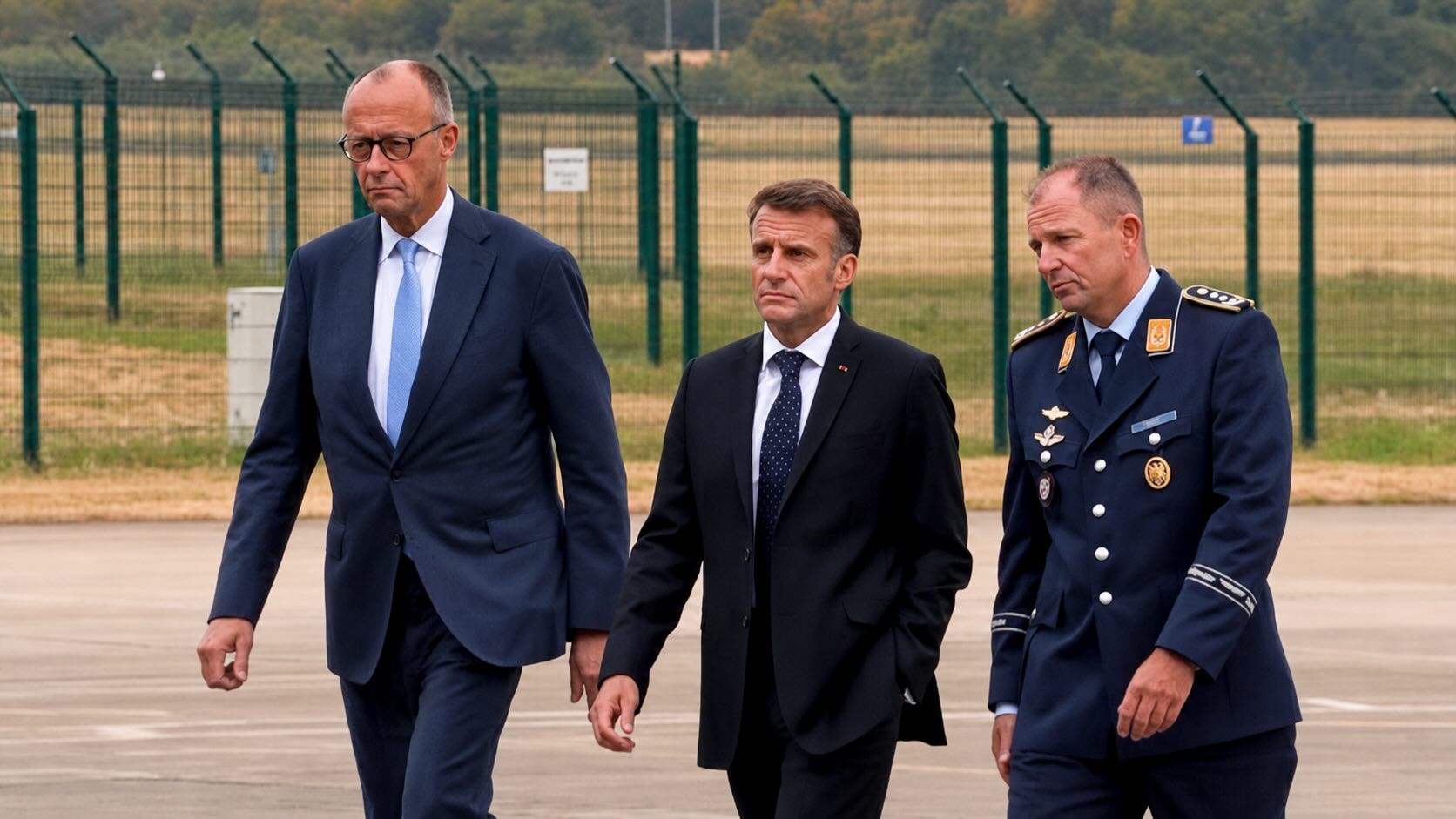
French President Emmanuel Macron and German Chancellor Friedrich Merz are trying to reset defence cooperation at a moment when Europe’s two largest military-industrial powers remain divided over some of the programmes meant to anchor strategic autonomy.
The leaders met as officials prepared discussions on nuclear deterrence, missile defence, long-range strike, military space and future air combat systems. The talks come after deep strain over the Future Combat Air System, the next-generation tank project, Eurodrone and wider industrial competition.
The difficulty is familiar. Paris and Berlin share the language of European defence, but not always the same industrial or operational priorities. France places a premium on strategic sovereignty, nuclear deterrence and preserving national design authority in key systems. Germany is increasing defence spending at scale but remains more open to US systems and to procurement choices driven by near-term Bundeswehr requirements.
The Future Combat Air System has become the clearest example. The programme was designed to produce a sixth-generation combat-air architecture, including aircraft, drones, sensors and a digital combat cloud. Industrial disagreements between Dassault Aviation and Airbus Defence and Space over leadership, workshare and technology control have repeatedly delayed progress. Political declarations have not removed the underlying question of who designs and controls the core combat platform.
The next-generation tank programme faces similar pressures. France and Germany agree that European land capability must modernise, but requirements differ. France has expeditionary needs and a smaller heavy-armour fleet; Germany has a larger central-European land role and a defence-industrial base with its own priorities. Aligning those requirements is harder than announcing a joint programme.
Eurodrone illustrates a third problem: timelines. European governments want unmanned systems that reduce dependence on US and Israeli platforms, yet procurement cycles remain slow. Defence Matters has repeatedly covered how Ukraine’s wartime drone sector is forcing NATO countries to rethink procurement speed, including through new drone partnerships that connect battlefield adaptation with industrial production.
The Franco-German dispute therefore matters beyond bilateral politics. If Europe’s two leading defence-industrial states cannot agree on flagship programmes, smaller countries will hedge. They may buy US systems, join narrower coalitions, or back national suppliers rather than wait for delayed multinational projects.
That fragmentation weakens Europe’s bargaining power. It also risks producing multiple expensive systems that cannot be fielded in sufficient numbers. Defence spending is rising, but money alone will not solve the problem if it is divided across incompatible designs, national protection and slow governance structures.
Macron and Merz can still salvage practical cooperation. Missile defence, long-range strike and military space may offer more immediate progress than a full reset of complex platform programmes. Shared standards, joint munitions production and common digital architectures could also deliver value without requiring every state to accept a single prime contractor.
The test is whether Franco-German defence cooperation can move from symbolism to programme discipline. Europe’s capability gap is no longer theoretical. The war in Ukraine, US pressure on European allies and the shortage of high-end systems have made delay strategically costly. Paris and Berlin can still lead, but only if they stop treating industrial workshare as an afterthought to political ambition.