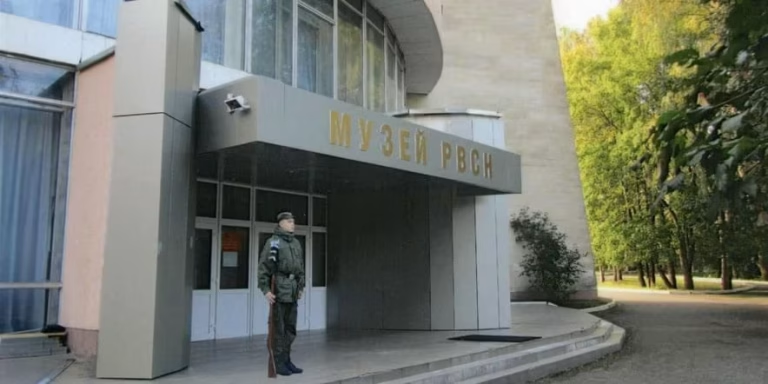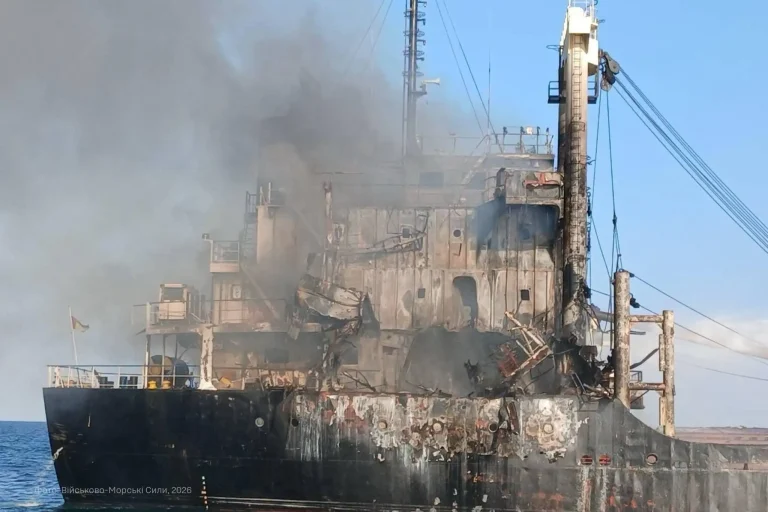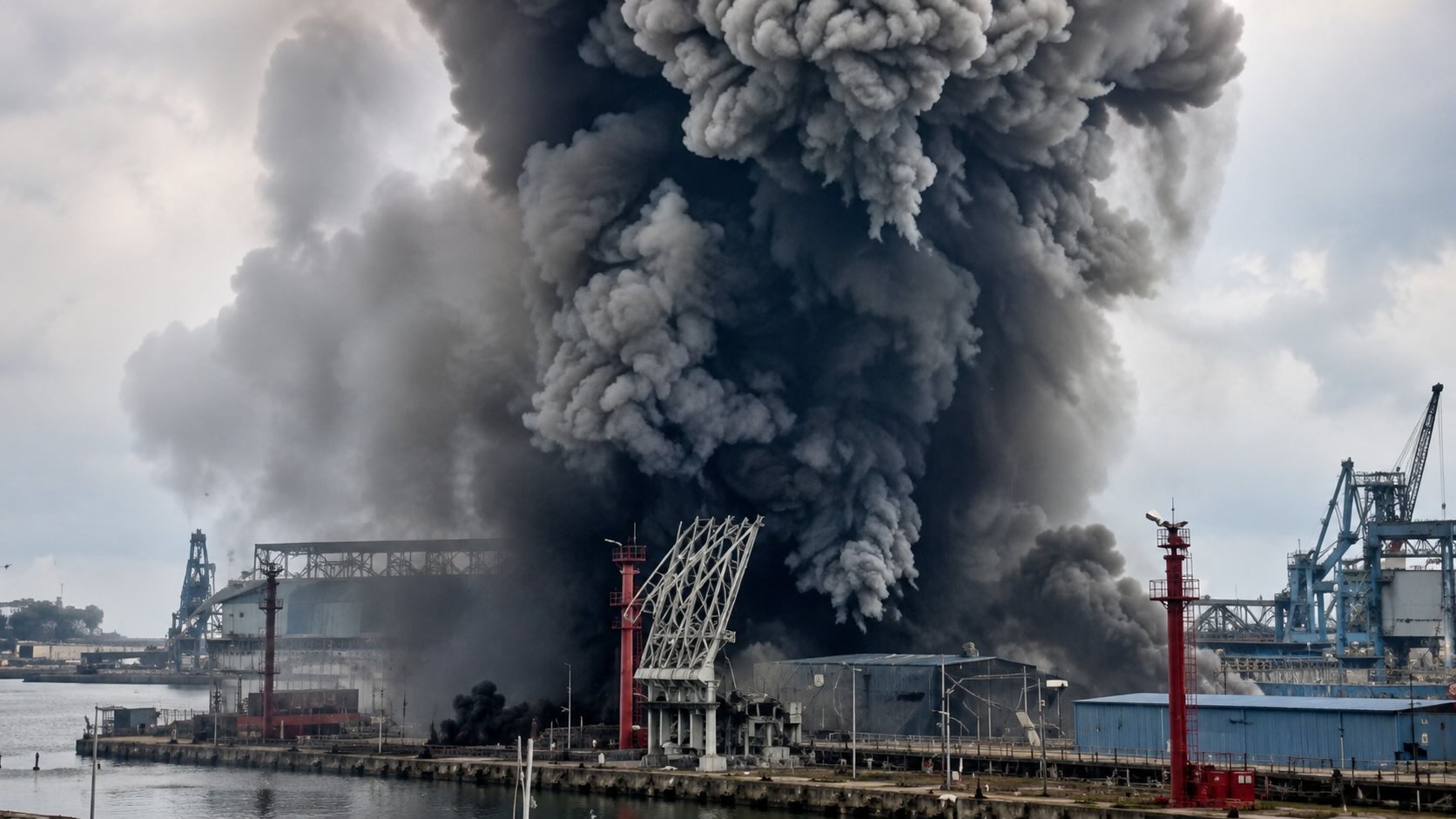
The object was discovered in the civil port area, near berths 77 and 78, close to the headquarters of the Romanian Agency for Saving Human Life at Sea. According to Romania’s defence authorities, the drone self-detonated at around 10.30am and caused no casualties. The area had already been secured by Romanian intelligence, coastguard and defence personnel before the explosion.
The Ministry of National Defence said the device was not part of the Romanian Army’s equipment and had not been involved in recent military exercises in the Black Sea. It described the object as being of a type used in the war in neighbouring Ukraine. The incident is now being examined by prosecutors attached to the Constanța Court of Appeal.
Emergency authorities activated the Red Intervention Plan and issued RO-Alert warnings advising people in parts of the coastal area to avoid the shore and follow official instructions. Emergency services deployed fire crews, medical teams, police, gendarmes, border police vessels, helicopters and specialist units to search for any further threats along the coast.
Raed Arafat, head of Romania’s Department for Emergency Situations, said the measures were preventive and that there was no reason for panic. He said helicopters had been sent to check the coastal area after the explosion, while residents were warned to keep away from the shore because of the possibility that other maritime drones might be present.
The alert was later extended to coastal communities, including Costinești, where local authorities warned residents and visitors not to approach the beach, the waterline or any suspicious objects washed ashore. A safety distance of one kilometre from the shore was advised while checks continued.
Romanian media, citing official sources, reported that several other explosive-laden maritime craft may have been detected in the coastal area. Authorities have not publicly confirmed all details. President Nicușor Dan said he had received information with “a certain degree of certainty” but would not disclose it while checks were still under way. He said the priority was to ensure public safety and protect port infrastructure.
Dan, who was travelling to Montenegro for an EU-Western Balkans summit when he was informed of the incident, said law enforcement and security services had acted promptly and had evacuated the area before the explosion. He added that if other devices were present, they had been located and would not be allowed to reach the shore.
The Russian embassy in Romania used the incident to accuse Ukraine of using unmanned maritime vehicles to create threats to civilian shipping in the Black Sea. Romanian officials have not publicly assigned responsibility for the device. Ukraine has used maritime drones extensively against Russian naval assets during the war, while Russia has repeatedly targeted Ukrainian ports and infrastructure, including along the Danube close to Romanian territory.
Ukraine’s Navy later said that one of its unmanned maritime vessels had lost control during operations in the Black Sea after being affected by Russian electronic warfare systems and had drifted towards the Romanian coast. The Ukrainian Navy said it had provided the necessary information to its Romanian counterparts in order to prevent civilian casualties. The statement appears to clarify how the vessel reached the Constanța area, while also placing the incident within the wider electronic-warfare environment of the Black Sea, where unmanned naval systems, jamming and countermeasures are now part of daily military operations.
The Constanța explosion follows a separate incident in Galați a week earlier, when a Russian drone struck a residential building and injured two people. The EU later condemned the violation of Romanian airspace and expressed solidarity with Romania. NATO Secretary General Mark Rutte also said the Alliance remained ready to defend allied territory, while Bucharest moved to close the Russian consulate in Constanța.
The two incidents have reinforced concerns in Bucharest that the war is increasingly affecting Romania’s immediate security environment. Romania shares a long border with Ukraine and has repeatedly reported Russian drone incursions or debris on its territory since Moscow intensified attacks on Ukrainian ports along the Danube.
Constanța is Romania’s largest port and one of the key maritime gateways on NATO’s eastern flank. Since the start of Russia’s full-scale invasion of Ukraine in 2022, it has also become an important regional logistics hub, including for Ukrainian exports and Black Sea trade flows.
European Commission President Ursula von der Leyen said after the Constanța incident that the threat to eastern border states required stronger European investment in anti-drone systems, air defence and early-warning capabilities. Her remarks linked the episode to wider EU defence financing efforts, including the SAFE programme, designed to support member states facing increased security pressure.
For Romania, the explosion raises practical questions over maritime surveillance, port security, coastal warning systems and the management of unidentified unmanned systems drifting beyond the immediate theatre of war. The Defence Ministry has underlined that responsibility for monitoring naval traffic in the Black Sea rests with the Romanian Naval Authority, while defence assets were deployed to supervise the area after the alert.
No casualties were reported, and the evacuation was described as precautionary. The broader issue, however, is that Romania is now facing recurring incidents involving drones, debris and maritime hazards linked to the war next door. For NATO and the EU, Constanța is no longer only a commercial port on the Black Sea. It is part of the exposed security perimeter created by the conflict in Ukraine.