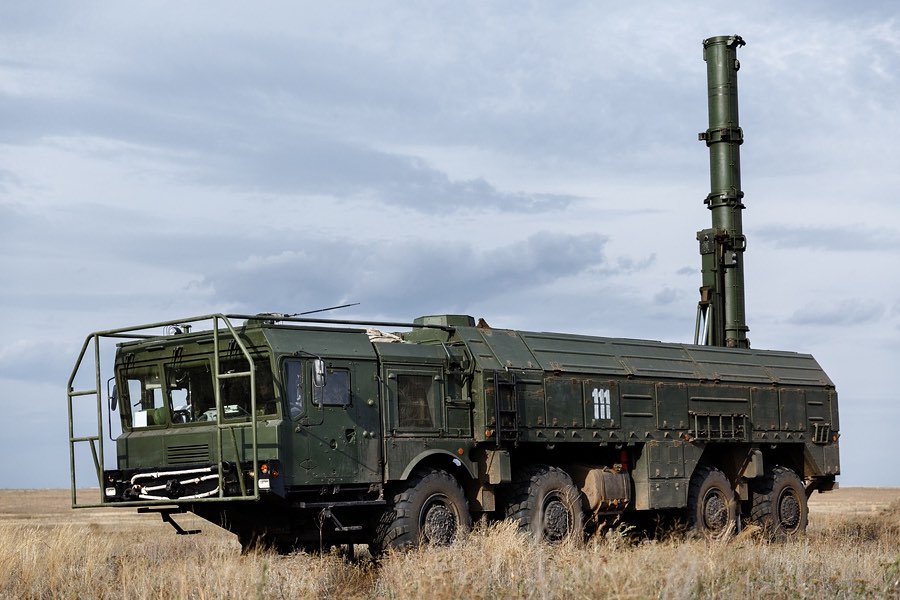
Russian claims and Ukrainian technical commentary about updated Iskander missiles should be assessed with caution. A new designation or reported modification does not automatically mean a step-change in battlefield capability. The practical question is whether the missile can reach targets it could not previously reach, defeat air defences more reliably, strike more accurately, carry a more useful warhead or be produced in larger numbers.
The baseline matters. The RUSI technical profile of Iskander-M and Iskander-K notes that the 9M723 series of quasi-ballistic missiles has gone through iterations and that range can vary with warhead weight and trajectory. Ukraine’s military-intelligence sanctions database lists the 9M723 Iskander-M with a range of 500km and warhead weights that vary by type. CSIS Missile Threat similarly describes Iskander as a road-mobile short-range ballistic missile system with a range up to 500km and payloads around 480-700kg depending on variant.
That means a reported range of around 480km is not automatically a breakthrough. It may indicate an export-style or treaty-conscious figure, a particular warhead configuration, or a modified missile whose claimed advantages lie elsewhere. Russia has previously presented the 9M729 cruise missile as having a 480km range, according to a TASS report from 2019, while Western governments disputed the broader INF context around that system. Range figures can therefore be politically loaded as well as technically uncertain.
The real trade-off may be warhead and internal volume. A lighter warhead can free mass for fuel, seekers, decoys, penetration aids or structural changes. A heavier warhead may improve destructive effect against hardened or large-area targets but reduce range or manoeuvre margins. If a new Iskander variant carries a lighter high-explosive warhead, the question is what Russia receives in return.
Penetration aids are especially important after Ukraine’s experience with Patriot. Ukrainian officials and analysts have reported Russian efforts to improve ballistic missile survivability through decoys, chaff, altered trajectories and terminal manoeuvres. Interfax-Ukraine reported in June that a Ukrainian defence institute described three modernisation directions for Iskander-M: resistance to modern air defence, increased range and scaled production under sanctions.
Accuracy is another possible area of change. A missile that can hit within a few metres is much more useful against aircraft shelters, command posts, bridges, radar sites and ammunition depots than one that can only strike a broad area. Guidance improvements may matter more than raw range if Russia is trying to destroy scarce Ukrainian systems such as air-defence launchers or aircraft on the ground.
Production rate may be the most consequential factor. A modestly improved missile produced in large numbers can be more strategically important than a more advanced missile produced slowly. Interfax-Ukraine, citing the Institute for the Study of War and Ukrainian data, reported that Russia had fired more ballistic missiles in July than it reportedly produces in a month, suggesting pressure on stockpiles even as production continues.
The target set also reveals capability. If updated Iskanders are used mainly against cities and fixed infrastructure, Russia may be relying on volume and terror effect rather than precision transformation. If they are used successfully against mobile air-defence systems, aircraft shelters or hardened command nodes, that would suggest a more meaningful improvement in guidance, intelligence integration or terminal performance.
Ukraine and its partners should avoid two analytical mistakes. The first is dismissing every Russian claim as propaganda. Russia has adapted many weapons during the war, including drones, glide bombs and missiles. The second is accepting every claimed new variant as a revolutionary system. Most wartime modifications are incremental: better electronics, different warhead, improved decoys, altered software, changed production methods.
For missile defence, incremental changes still matter. A small improvement in terminal manoeuvre or decoy deployment can force Patriot crews to adjust engagement doctrine. A new warhead can change damage patterns. A production increase can strain interceptor stocks even if each missile is not dramatically better.
The latest Iskander discussion should therefore be framed as a capability audit. What changed? Is range actually greater? Is warhead weight lower or higher? Are penetration aids improved? Can Russia produce it at scale? Is it being used against targets that require the claimed improvement? Until those questions are answered with debris, imagery and strike data, the safest conclusion is that Russia is iterating a dangerous missile family rather than unveiling a wholly new class of weapon.