Ukraine is reportedly experimenting with a new method of carrying drones deep into Russian territory by attaching them to weather balloons before releasing them into favourable air currents. The claims have circulated through Russian military-linked Telegram channels and were reported by Ukrainian outlet UNN, which said the alleged systems were being discussed by pro-war Russian sources as a possible means of delivering drones beyond the reach of electronic warfare.
Kyiv has not publicly confirmed the reported use of balloon-borne drones, and the claims should therefore be treated with caution. However, the concept itself is technically plausible and consistent with the broader pattern of the war, in which both Ukraine and Russia have adapted older technologies to new battlefield requirements. Earlier reporting by NV described Ukraine’s use of balloons for military purposes, including as decoys and possible carriers for small strike drones.
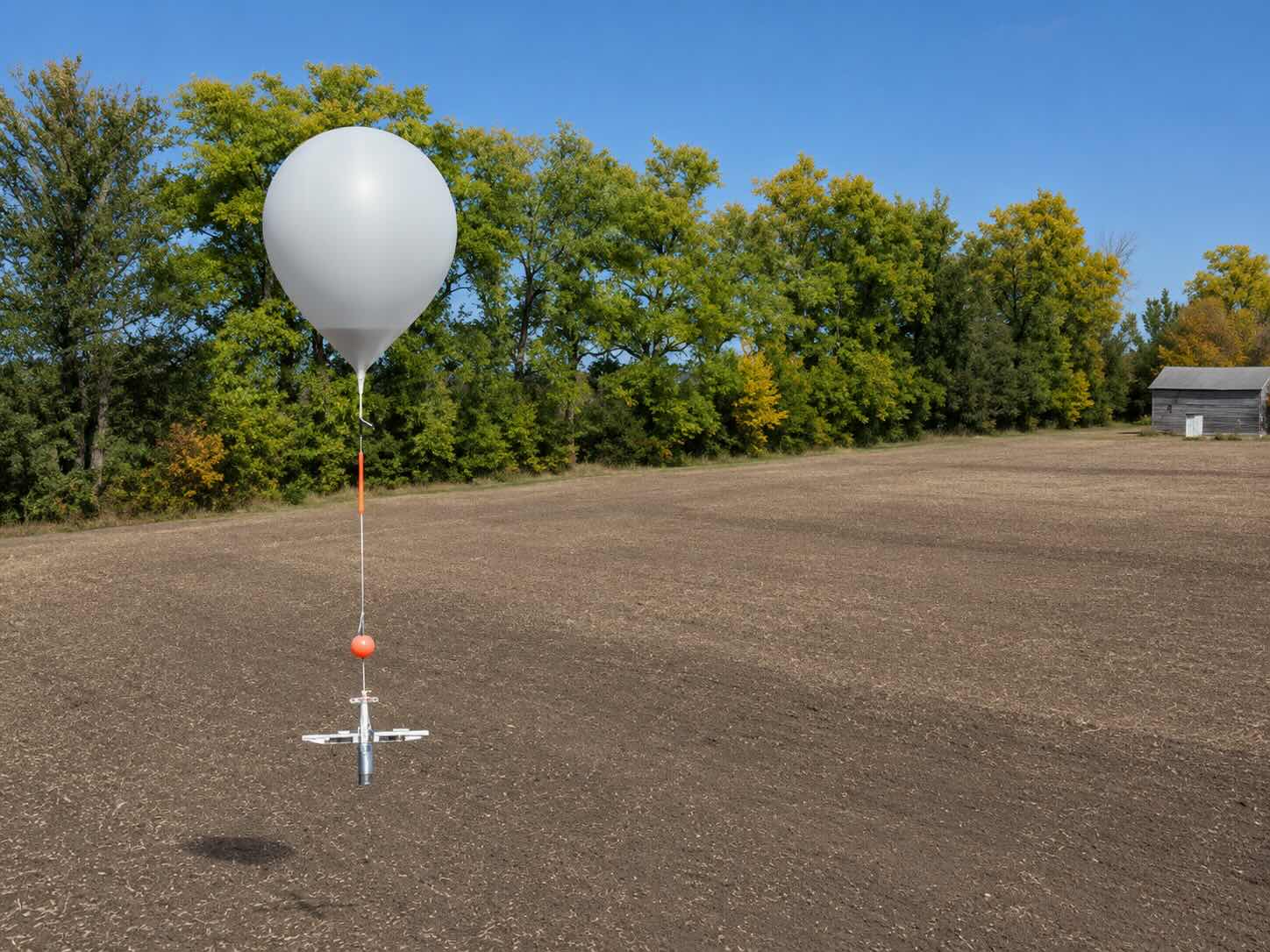
The operational logic is relatively straightforward. A balloon carries a small unmanned aerial vehicle at altitude and moves with prevailing winds rather than under radio control. Once it approaches a programmed area, the drone detaches and begins its own flight towards a pre-selected target. Depending on the sophistication of the system, the drone could use onboard sensors, visual navigation, satellite positioning, or pre-loaded data to identify its location and continue the final stage of the mission.
The reported advantage is that the carrier platform itself is difficult to suppress by electronic warfare. Radio jamming can interfere with a drone’s control link, satellite navigation or data transmission. It cannot alter the wind direction carrying a balloon. Until the drone separates and starts operating independently, there may be little for electronic warfare systems to disrupt.
That does not mean such systems are invulnerable. Balloons can be detected by radar, optical systems or airspace monitoring if the conditions are favourable. They can also be intercepted, although doing so may require disproportionate effort if the objects are cheap, numerous and difficult to classify. The challenge is made greater if a balloon has a weak radar signature, or if a small drone is suspended below a material that does not strongly reflect radio waves.
The limitations are equally clear. A balloon is not a precision delivery system. Its route depends heavily on meteorological conditions, particularly wind direction and speed at different altitudes. A shift in weather could send the payload far from its intended route. Accurate employment would therefore require detailed meteorological planning along the expected flight path, making the system useful only when weather conditions support the intended mission.
Even with those limits, the concept could have military value as part of a wider saturation strategy. A balloon-borne drone does not need to replace Ukraine’s longer-range strike drones or missiles. It could instead add another layer of uncertainty for Russian air defences, forcing them to monitor slow-moving airborne objects, distinguish threats from decoys, and allocate resources to targets that may be inexpensive but potentially dangerous.
The reported development comes as the drone war continues to evolve rapidly. Russia has been adapting its own one-way attack drones with electronic countermeasures, including systems intended to resist Ukrainian interceptors, according to Business Insider. Ukraine, meanwhile, has expanded the use of private and military air-defence initiatives to counter Russia’s mass drone attacks, including interceptor drones, radars and electronic warfare systems, as described in separate reporting on Ukraine’s private-sector air defence programme.
There is also a wider European security context. Lithuania has already faced repeated disruption from balloons launched from Belarus carrying contraband cigarettes. In October 2025, Vilnius airport had suspended traffic after helium balloons carrying cigarette consignments entered Lithuanian airspace. Reuters reporting recorded repeated closures of the airport and border restrictions linked to similar incidents.
Although those balloons were not armed, they showed how simple airborne objects can create significant disruption when they enter sensitive airspace. A later Reuters explainer noted that Vilnius airport had been closed for more than 60 hours because of the threat posed by smuggling balloons, affecting hundreds of flights and tens of thousands of passengers.
For NATO states bordering Russia and Belarus, the issue is no longer purely theoretical. Balloons, drones and improvised aerial systems blur the distinction between criminal smuggling, nuisance disruption, reconnaissance and hostile action. They are cheap to launch, difficult to attribute immediately, and capable of forcing a costly response from civil aviation and security authorities.
For Russia, if the reported Ukrainian system is genuine, balloon-borne drones would add another complication to an already congested defensive environment. Moscow has invested heavily in electronic warfare and layered air defence, but systems designed to jam drone control links are less useful against a drifting carrier platform. The drone becomes a conventional target only at the final stage, by which point it may already be close to its objective.
The military impact should not be overstated. Weather dependence, limited precision and detection risk all constrain the usefulness of balloon-carried drones. Yet the idea fits the central dynamic of the war: adaptation at speed, using cheap technology to impose cost and uncertainty on the other side.
Balloons are among the oldest tools in military aviation. In Ukraine’s war against Russia, they may now be returning in a new form — not as decisive weapons, but as part of a wider contest between innovation, air defence and electronic warfare.