

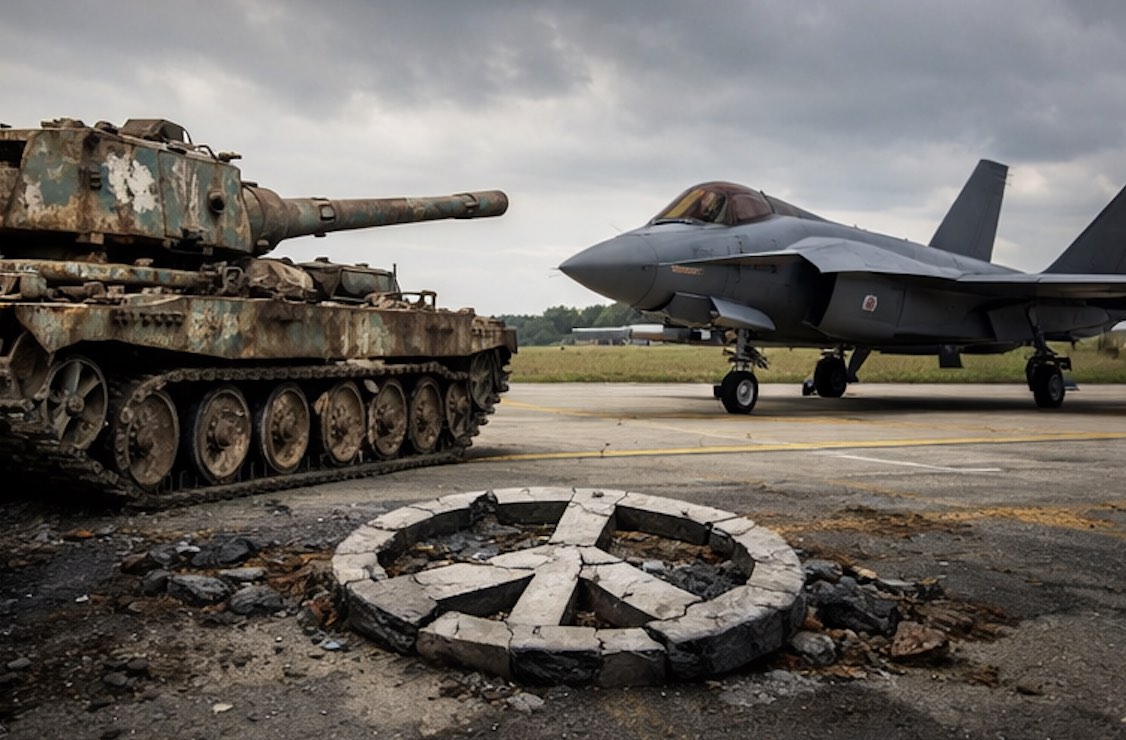
That illusion is now dissolving at speed. According to new research by the Stockholm International Peace Research Institute (SIPRI), Europe has become the world’s largest arms importer, a remarkable transformation driven by the war in Ukraine and a growing sense of geopolitical uncertainty.
Between 2021 and 2025, European countries more than tripled their arms imports compared with the previous five-year period. The continent now accounts for roughly a third of all global weapons imports—an extraordinary jump from just over a tenth previously.
The reason is not difficult to discern. Russia’s invasion of Ukraine in 2022 shattered the complacency that had defined European defence policy for decades. Governments that once argued over marginal increases to military budgets suddenly discovered the urgency of rebuilding armed forces hollowed out by years of neglect. Tanks, artillery, combat aircraft and air-defence systems—once considered relics of another era—have returned to the centre of strategic planning.
Yet Europe’s rearmament reveals a paradox. While the continent talks frequently about “strategic autonomy”, its weapons shopping list is dominated by American hardware. The United States remains by far the largest supplier of arms to European NATO states, accounting for roughly two-thirds of their imports in recent years.
In practical terms, this means European air forces are increasingly equipped with American aircraft, while missile defence systems and advanced sensors are often also sourced from across the Atlantic. The appeal is obvious: the United States produces the most advanced systems and delivers them in quantity. But the dependence is uncomfortable.
For decades European leaders have spoken about building a self-sufficient defence industry. Yet when urgency strikes, they turn to Washington. The result is a curious blend of ambition and reliance: Europe seeks autonomy while simultaneously deepening its dependence on American technology.
The war in Ukraine has also altered the geography of the global arms trade. Russian exports, once a significant pillar of the market, have collapsed sharply amid sanctions and the Kremlin’s own wartime needs. In their place, Western suppliers—particularly the United States and France—have strengthened their position.
Indeed, France has quietly consolidated its status as the world’s second-largest arms exporter, thanks in part to strong demand for its fighter aircraft and advanced military systems. Meanwhile, emerging suppliers such as South Korea and Israel are finding growing opportunities in Europe’s procurement programmes.
Yet the numbers tell a deeper story than simply the mechanics of arms markets. Europe’s surge in weapons purchases reflects a broader psychological shift. The assumption that peace was permanent has been replaced by a more sober assessment of the world.
The Baltic states, Poland and several Nordic countries have led the charge. Their governments, long wary of Russian intentions, have invested heavily in modernising their militaries. Germany, after years of hesitation, has also embarked on a substantial defence expansion, including large orders for advanced aircraft and air defence systems.
Such spending would have been politically unthinkable a decade ago. Today it is widely regarded as overdue.
At the same time, Europe faces a dilemma familiar throughout its history: how to balance collective defence with national industrial interests. Defence procurement remains fiercely political. Governments prefer to buy domestically whenever possible, both to sustain jobs and to preserve technological expertise. But domestic production is slower and often more expensive.
Hence the surge in imports. When urgency outweighs industrial policy, governments reach for whichever supplier can deliver the necessary equipment quickly.
Whether this transformation will produce a lasting European defence capability remains uncertain. The continent is spending more than at any time since the Cold War, yet its defence industries remain fragmented across dozens of national champions.
If Europe wishes truly to reduce its dependence on external suppliers, it will need to cooperate far more closely than it has in the past—pooling procurement, harmonising standards and investing collectively in next-generation technologies.
For now, however, the immediate priority is deterrence. Europe’s leaders are acutely aware that military weakness invites risk.
In that sense, the surge in arms imports is less a sign of aggression than of anxiety. It reflects a continent rediscovering an uncomfortable truth: peace, however cherished, has never been guaranteed.
And after decades spent dismantling its arsenals, Europe has discovered that rebuilding them is both expensive and urgent.
Why Europe Needs a Strong Polish Defence Industry, an Interview With Mehmet Göktürk İplikçioğlu

Britain’s Consistent Message on Ukraine Carries Growing Weight at the OSCE