The shift reflects both Turkey’s growing defence-industrial capacity and the changing strategic environment after Russia’s full-scale invasion of Ukraine. For Ankara, the rearmament of Europe has created a commercial and diplomatic opening. For European governments, Turkish industry offers a combination of production speed, lower costs and battlefield-tested systems, particularly in unmanned platforms.
According to a recent review of Turkish defence exports, Turkey’s defence and aerospace sales have expanded sharply in recent years, helped by two decades of state-backed investment and the visibility of Turkish-made drones in conflicts from Ukraine to the Caucasus and the Middle East.
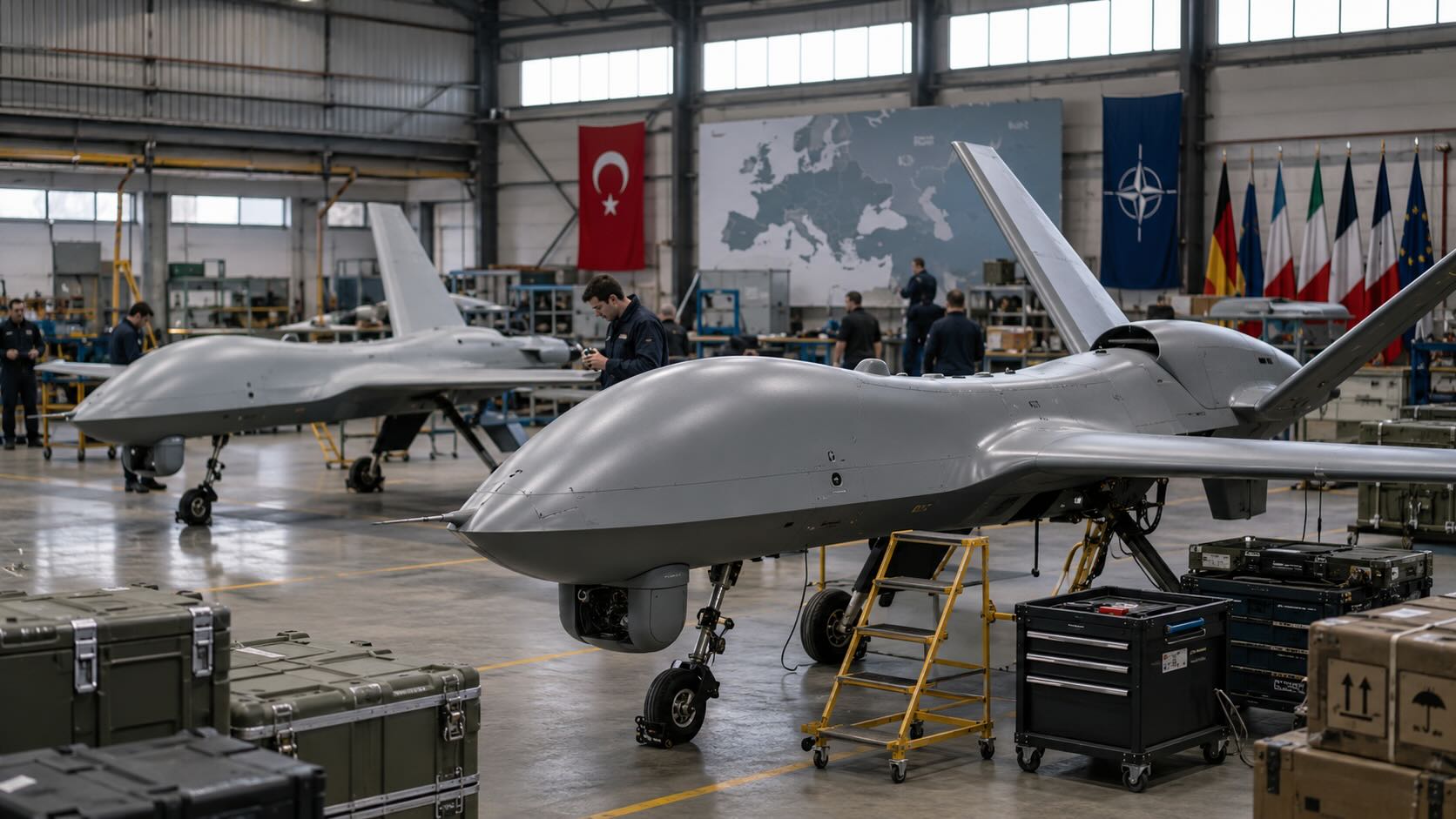
The best-known example is Baykar, maker of the Bayraktar TB2 drone, which became widely recognised after its use by Ukrainian forces in the early stages of Russia’s invasion. But Turkey’s defence industry is now broader than drones alone. It includes armoured vehicles, naval platforms, missiles, sensors, electronic warfare systems, helicopters and combat aircraft projects.
This matters for Europe because the continent’s defence problem is not only one of spending. It is also one of production capacity. European governments have announced higher defence budgets, but many face long delivery times for ammunition, air defence, drones, armoured vehicles and other equipment. The war in Ukraine has exposed limited stockpiles and slow industrial mobilisation across much of the continent.
Turkey is trying to position itself inside that gap. As a NATO member with a large standing military and an expanding domestic defence sector, it can argue that its companies are part of the wider allied industrial base. Turkish firms have also shown an ability to deliver systems at a pace that compares favourably with some European procurement cycles.
The growth is already visible in Europe. Turkish defence companies have supplied drones, armoured vehicles and naval systems to several European countries. A 2025 assessment by the International Institute for Strategic Studies noted that Turkish firms had been increasing their presence in European markets, including through naval and armoured vehicle contracts.
The most politically important area is unmanned systems. European militaries have spent years debating drone warfare, but the war in Ukraine has accelerated demand for reconnaissance drones, strike drones, loitering munitions and counter-drone systems. Turkish industry entered this market earlier than many European competitors and has built a reputation for practical, exportable systems.
That does not mean Turkey’s entry into Europe’s defence market will be politically straightforward. Ankara’s relations with the EU remain complicated by disputes over rule of law, migration, the Eastern Mediterranean and its wider foreign policy posture. Several EU governments also remain cautious about allowing non-EU suppliers too much access to European defence funding mechanisms.
This creates an awkward distinction. Turkey is inside NATO, but outside the European Union. In military terms, it is part of the alliance Europe relies on. In EU industrial-policy terms, it remains a third country. As Brussels builds instruments to support European defence production, including mechanisms designed to keep money inside the EU industrial base, Turkish access may become a contested issue.
For Ankara, that is one reason to pursue partnerships rather than only direct sales. The Baykar-Leonardo cooperation has shown how Turkish companies may seek a stronger position in Europe through joint ventures, co-development and NATO-compatible systems. Such arrangements could help reduce political resistance while giving European partners access to Turkish production experience.
The question for European governments is practical. If the priority is rapid capability, Turkish systems may be attractive. If the priority is EU industrial autonomy, reliance on Turkish suppliers may be seen as another dependency, even if Turkey is a NATO ally. The balance between capability, cost, speed and political control will shape how far Ankara can penetrate European markets.
Turkey’s position is also strengthened by the broader shift in US policy. European governments are under pressure to assume more responsibility for their own defence, regardless of who is in the White House. That pressure has made procurement speed more important and has created space for suppliers outside the traditional Franco-German, British, Italian and American defence ecosystems.
There are still limits. Some European countries will prefer domestic suppliers where possible. Others will prioritise EU-backed programmes to maintain jobs, technology and control inside the bloc. Export controls, interoperability standards and political trust will also affect procurement decisions.
Even so, Turkey’s defence industry has moved from the margins to the centre of the European security debate. Its offer is not only equipment, but speed, scale and combat experience. For a continent trying to rebuild its military capacity after years of underinvestment, those factors are difficult to ignore.
The result is likely to be a more complex European defence market. Turkey will not replace established European or American suppliers, but it may become a more important secondary source in areas where Europe lacks capacity or needs faster delivery. That would give Ankara both commercial gains and political leverage.
Europe’s rearmament is therefore not only changing defence budgets. It is also reshaping the map of suppliers, partnerships and dependencies. Turkey intends to be part of that shift.