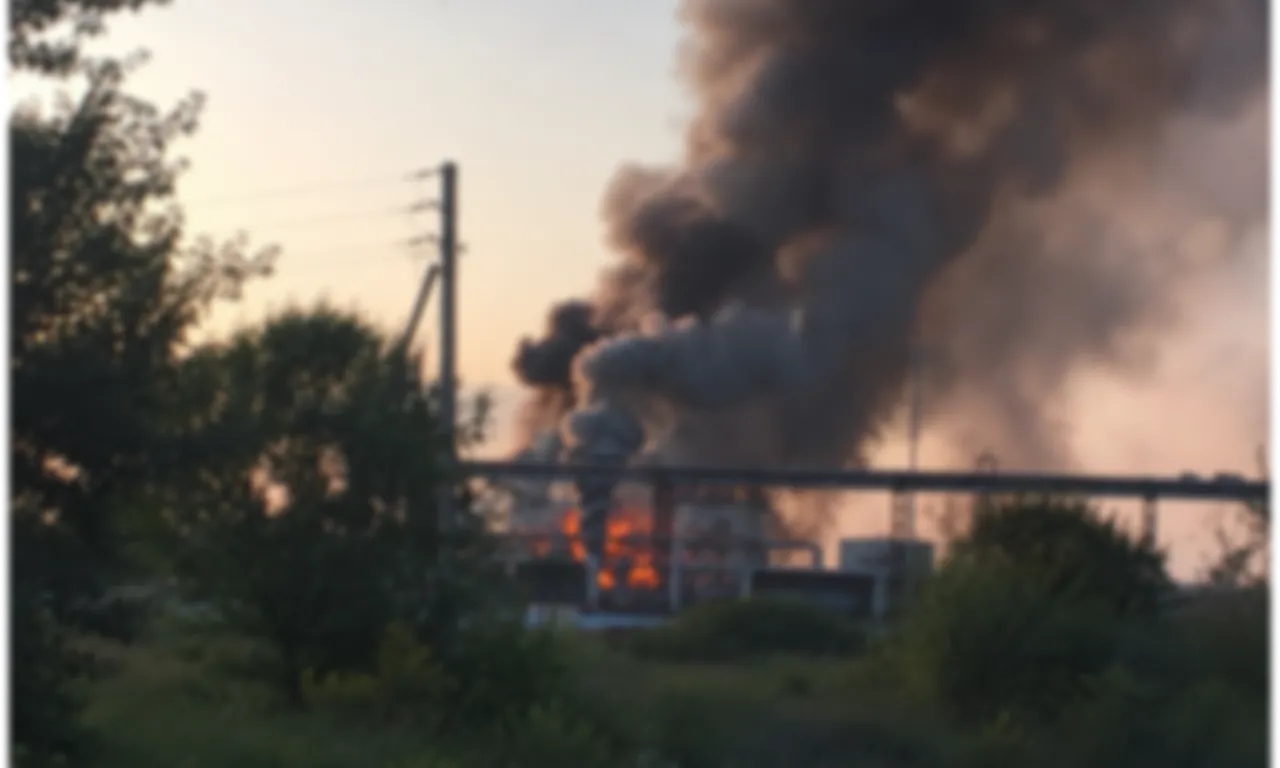
Russia has attacked Naftogaz gas-production facilities in the Kharkiv region for three consecutive days, damaging equipment, causing fires and temporarily reducing production. Naftogaz said on 21 July that one production asset caught fire after a Sunday strike, while another facility was hit on Monday morning and suffered extensive damage. Staff were sheltering during the attacks and no casualties were reported.
The operational detail is important because this looks less like a single strike and more like a deliberate sequence. Naftogaz’s acting chief executive, Sergii Fedorenko, said Russia was targeting facilities that supply the country with gas in order to disrupt winter preparations and create problems during the heating season. That is a strategic objective, not only a tactical one.
Ukraine’s energy infrastructure has been a military target throughout the war. Power plants, substations, transmission nodes, fuel depots and gas assets have all been struck at different stages. Recent Defence Matters analysis of Russia’s air campaign against Kyiv and other cities showed how air-defence shortages leave infrastructure exposed when missiles and drones are used in large packages.
Gas production occupies a specific place in that system. Domestic output reduces import requirements, supports storage, stabilises winter supply and limits the fiscal burden on the state. If production falls before winter, Ukraine may need more imports from European markets at precisely the point when prices can rise because of weather, storage pressure or wider geopolitical disruption.
That makes gas-production strikes a form of economic warfare. Russia does not need to destroy the entire Ukrainian gas system to create pressure. Damaging compressors, processing equipment, gathering systems or field infrastructure can reduce output, delay repairs and force Naftogaz to divert money and technical staff from preparation to emergency response.
The Kharkiv region is also close enough to the front and to Russian launch areas to remain exposed. Shorter flight times complicate air defence. Repeated strikes may also be intended to test which assets can be reached, how quickly repairs begin and whether Ukrainian protection measures improve after the first attack.
The winter dimension is central. Ukraine’s heating season is not only a civilian welfare issue. It affects morale, public finances, military logistics, industry and the credibility of the state. If homes, hospitals and municipal systems face shortages, the pressure on Kyiv increases even without a dramatic battlefield breakthrough.
Europe is part of the equation. Lower Ukrainian production would increase the importance of reverse-flow capacity, storage access, financing for imports and coordination with neighbouring states. It could also link Ukraine’s winter energy security more tightly to European gas prices. That is a problem at a time when Middle East conflict and LNG-route uncertainty are already moving through energy markets.
The attacks also show why air defence cannot be assessed only around major cities. Production facilities, pipelines, repair depots and energy-service sites may not be as visible as Kyiv apartment blocks, but they can be strategically decisive. A missile intercepted over a capital saves lives immediately. A drone intercepted over a gas facility may save winter production months later.
Naftogaz’s ability to restore output will depend on damage assessment, spare parts, safety checks and whether further strikes follow. The company has been attacked repeatedly this year, and cumulative damage can matter more than the effect of one event. Equipment may be repairable, but repeated emergency work consumes time and specialist capacity.
For Ukraine’s partners, the implication is that energy resilience should remain part of military assistance. Air-defence systems, generators, transformers, industrial spares, repair funding and gas-purchase financing are not separate from the war effort. They are the means by which Ukraine prevents Russia from converting battlefield pressure into social collapse.
The three-day campaign against Naftogaz production facilities should therefore be read as a warning before winter. Russia is not only attacking what Ukraine uses today. It is attacking the reserves and production capacity Kyiv will need when temperatures fall. That is why the target set matters: gas fields are becoming part of the front.
The repeated strikes also make repair protection as important as repair speed. If engineers restore damaged assets only for them to be hit again, Russia can turn Ukraine’s technical competence into a cycle of attrition. Hardening sites, dispersing equipment, improving local air warning and pre-positioning spare parts may therefore matter as much as headline reconstruction funding. Energy resilience is no longer a post-strike activity. It has to be built into the way production facilities operate under fire.