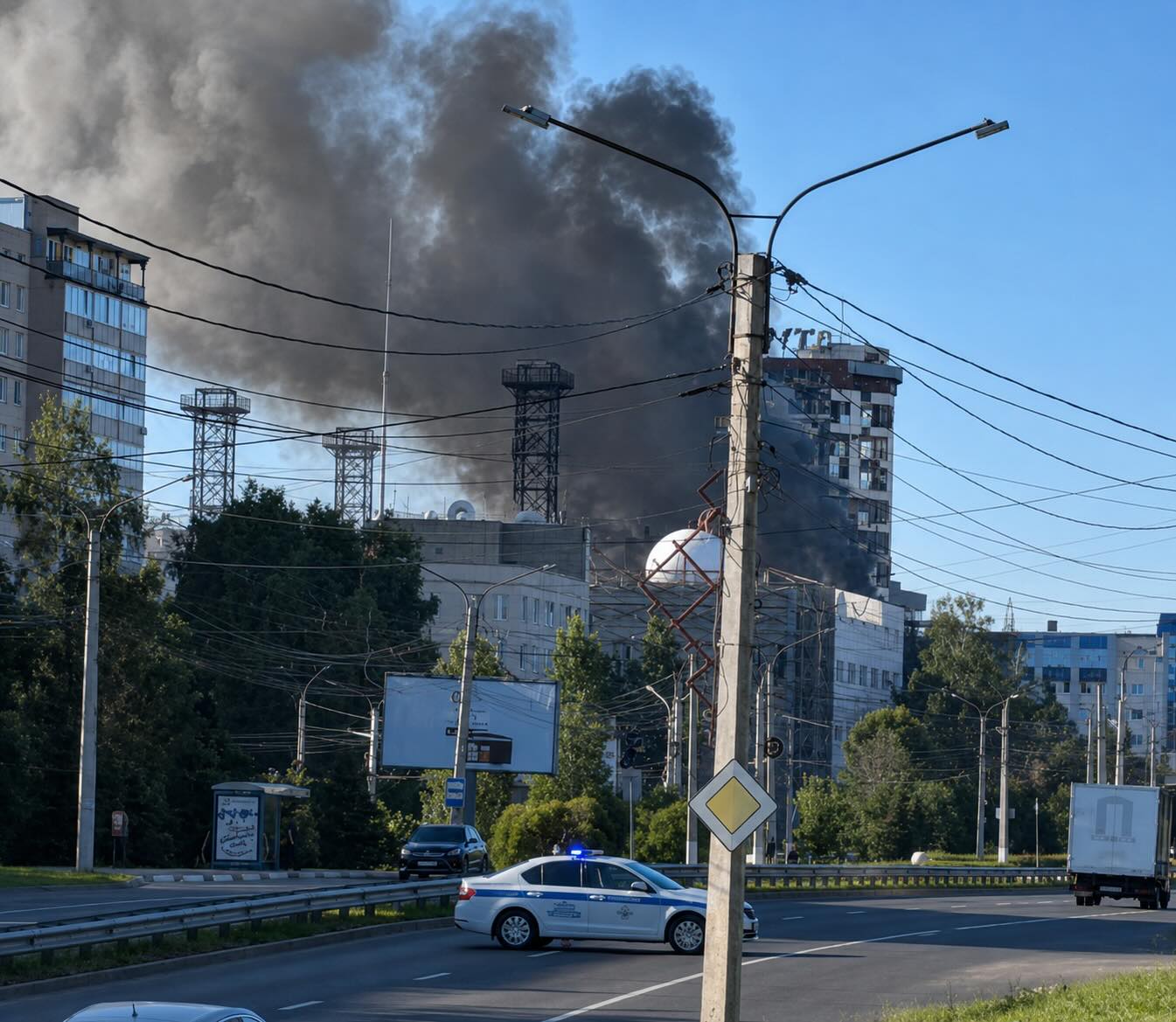
The plant, located in the capital of Russia’s Chuvash Republic, is not a conventional military depot or fuel storage site. It is a specialised electronics facility associated with systems used in Russian precision weapons. Ukraine’s sanctions database identifies VNIIR-Progress as a manufacturer of jamming-resistant Kometa navigation modules for Russian UAVs, cruise missiles and ballistic missiles.
That makes the target strategically important. Russia’s long-range strike campaign against Ukraine depends not only on missiles, aircraft and drones, but also on guidance, navigation and control systems. Components produced by facilities such as VNIIR-Progress help Russian weapons maintain accuracy despite Ukrainian electronic warfare. If such production is disrupted, the effect can extend across several categories of weapons rather than one individual platform.
The strike was linked by Ukrainian and open-source analysts to the FP-5 Flamingo, a domestically developed Ukrainian cruise missile. President Volodymyr Zelenskyy said Ukrainian-made Flamingo missiles had travelled more than 1,500 kilometres to hit military-industrial facilities in Cheboksary, describing the attack as part of Ukraine’s wider campaign of “long-range sanctions” against Russia’s war infrastructure.
The FP-5 Flamingo has been reported to have a range of up to 3,000 kilometres and a warhead of around 1,150 kilogrammes. The International Institute for Strategic Studies has described it as one of the largest and longest-range ground-launched cruise-missile systems, noting its claimed range and warhead size. Those figures, if confirmed, would place it well above the destructive capacity of many long-range drones used by Ukraine against Russian refineries, airfields and depots.
The practical significance of a weapon of this type is clear. A drone with a warhead of several dozen kilogrammes can damage exposed infrastructure, ignite fuel or destroy lightly protected equipment. A cruise missile carrying more than a tonne of explosive can penetrate or seriously damage industrial structures, especially if it detonates inside a production hall. For a defence electronics plant, the most serious losses may involve testing stands, precision machine tools, clean-room infrastructure, cable systems and imported specialist equipment rather than the outer structure of the building itself.
The Cheboksary strike was also reported to have hit a plant connected to navigation and guidance equipment used in Russian military systems. Open-source reporting said the VNIIR-Progress complex had been struck by Ukrainian FP-5 Flamingo cruise missiles on 10 June, with the facility still burning after the attack. As with many strikes inside Russia, the precise scale of damage remains difficult to verify independently.
The strike raises questions about Russia’s air defence coverage. Cheboksary lies far beyond the immediate border zone. Any missile reaching the city would have had to pass through or around Russian detection and interception systems over a long distance. Moscow cannot provide equal protection to every refinery, aircraft plant, ammunition site, naval base, command post and electronics facility across its territory. Ukraine’s growing ability to vary targets places additional strain on that system.
This vulnerability is now becoming a recurring feature of the war. Ukrainian strikes have repeatedly targeted oil refineries, fuel depots, arsenals, airfields and military-industrial sites. Zelenskyy has argued that Ukraine’s long-range strike campaign allows the country to bring the cost of Russia’s war back to the infrastructure that sustains it. His public remarks on Ukraine’s long-range sanctions framed such attacks as a response to continued Russian strikes on Ukrainian cities.
The Cheboksary attack fits that pattern. It does not by itself determine the course of the war, and the full extent of damage to VNIIR-Progress remains unverified. But it demonstrates that Ukraine is increasingly able to reach targets linked to the technical foundation of Russia’s missile and drone campaign.
For Moscow, the consequences are both operational and political. Russia has sought to present its strike capability as durable despite sanctions, component shortages and Ukrainian air defences. Strikes on electronics plants challenge that assumption by targeting the industrial base behind the weapons, not only the weapons after launch.
For Kyiv, the strike illustrates the growing importance of domestic long-range systems. Western-supplied weapons remain subject to political restrictions, while Ukrainian-built missiles and drones give the country more freedom to hit the infrastructure enabling attacks on its cities.
The central message of the Cheboksary strike is therefore not simply that Ukraine can hit distant Russian targets. It is that the factories, components and technical systems behind Russia’s long-range war are no longer beyond reach.