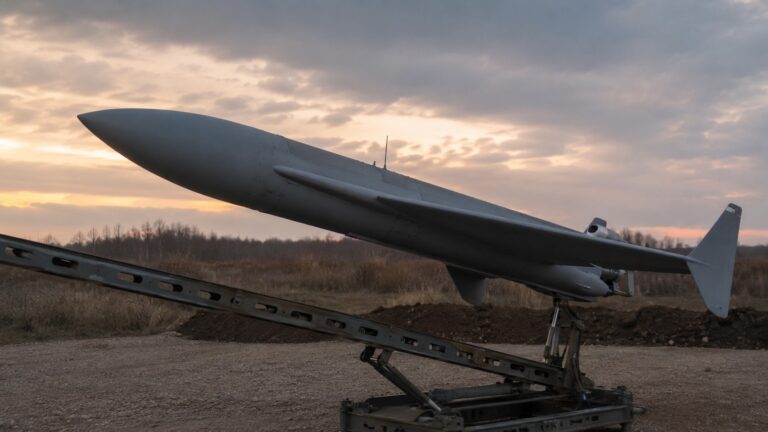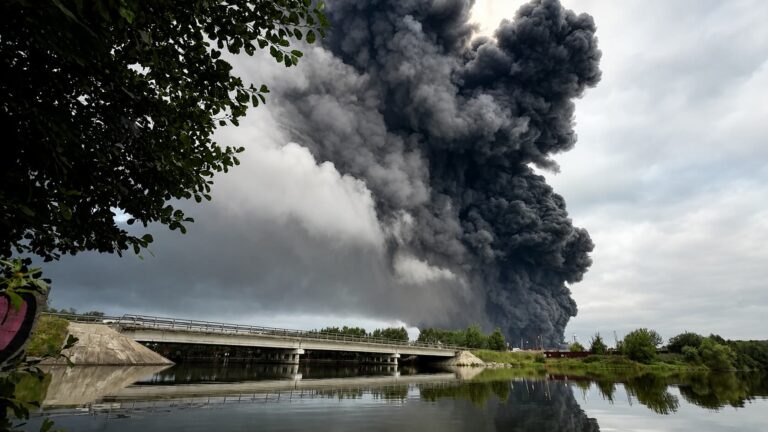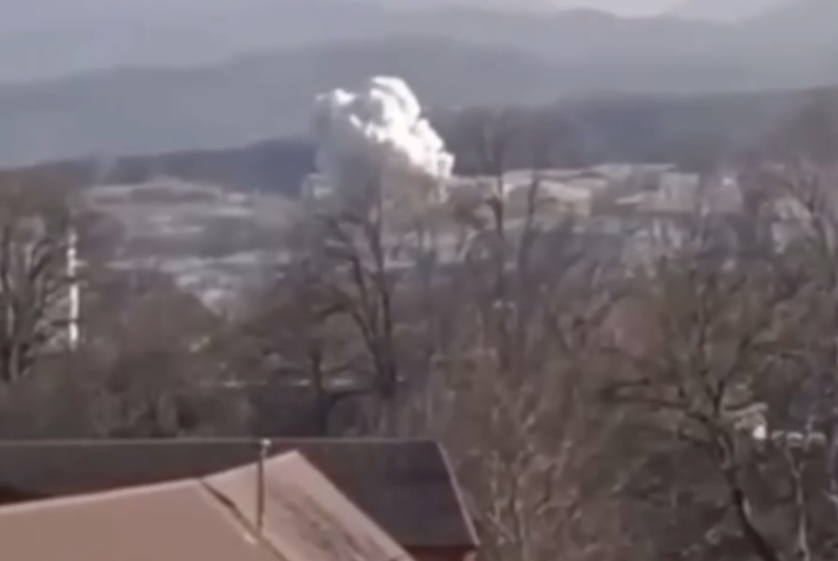
The incident occurred in daylight on 27 November in the Baysangurov district of Grozny. Video and photographs published on social media showed smoke rising from one of the buildings in a fenced compound. The images were subsequently geolocated by the Radio Free Europe/Radio Liberty project “Kavkaz.Realii” to a military town located on Akhmat Kadyrov Avenue.
According to Kavkaz.Realii, the structure hit is part of a complex where the 141st motorised regiment “Sever” (North) of the Russian National Guard, often referred to in Russian media as “Akhmat-Sever”, is based. In 2023 the head of Chechnya held an award ceremony for unit commanders at the same location, confirming the site’s continuing military use.
Russian and regional independent outlets reported that the impact caused the roof of a service building to collapse and triggered a fire, although there has been no official information on casualties. The Telegram-based outlet Astra, cited by Ukrainian and Russian-language media, stated that the strike hit a facility associated with military unit 65384 within the town.
The Chechen authorities have not commented publicly on the incident. Russia’s Ministry of Defence also made no specific reference to the strike on Grozny in its regular briefings, which did, however, claim the interception of more than a hundred Ukrainian drones over various regions of Russia during the same 24-hour period. Ukrainian military authorities had not issued any statement on the reported strike in Grozny at the time of writing.
The Chechen Telegram channel NIYSO, which is critical of the regional leadership, said the Grozny strike was part of a broader series of attacks on military sites in the republic. It reported that another drone targeted the base of the 291st motor rifle regiment in the settlement of Borzoi in the Shatoy district. Russian independent outlet Mediazona relayed these claims, stating that NIYSO based its information on images of the aftermath, though those images have not been made public.
Russia’s federal aviation agency, Rosaviatsiya, announced on the morning of 27 November that operations had been suspended at airports in Grozny, Makhachkala (Dagestan), Vladikavkaz (North Ossetia) and Magas (Ingushetia) “to ensure flight safety”. According to subsequent reporting, restrictions at Grozny and Makhachkala remained in place longer than at the other airports and were lifted only after the first reports of impacts in Chechnya.
The strike fits into a wider pattern of drone attacks reported against military and security infrastructure in Chechnya since Russia’s full-scale invasion of Ukraine in 2022. Kavkaz.Realii notes that in December last year barracks belonging to the second special police regiment of the Chechen Interior Ministry, named after Akhmat Kadyrov, were twice hit by what Ukrainian officials described as Ukrainian drones. In October of the same year, a drone raid caused a fire on the roof of the “Russian University of Special Forces” in Gudermes, a major training base for fighters deployed to Ukraine.
The same outlet also recalls that on 25 December an Azerbaijan Airlines passenger flight approaching Grozny crashed after being hit by a Russian air defence missile while air defences were responding to an incoming drone attack on the city. Thirty-eight of the 67 people on board were killed. Russian investigators later stated that the aircraft had been struck by friendly fire during efforts to repel the unmanned aircraft.
The 141st regiment “Sever”, whose base appears to have been affected in the latest incident, is one of the best-known Chechen formations within the National Guard. The unit has been repeatedly identified in Russian and Ukrainian reporting as taking part in operations on Ukrainian territory. Its personnel are often associated in Russian media with the broader group of Chechen forces informally described as “Kadyrovtsy”, loyal to the Chechen leadership.
While several Ukrainian and regional outlets attributed the latest Grozny incident to a long-range Ukrainian drone, they did so on the basis of earlier Russian claims about large-scale drone raids rather than on direct responsibility claims from Kyiv. As with many recent attacks on military and energy infrastructure deep inside Russian territory, key details – including the type of unmanned aircraft used, the launch point and the full extent of the damage – remain unconfirmed and may become clearer as further verifiable information emerges.
Ukrainian strike reportedly destroys rare Russian laser aircraft at Taganrog