The announcement marks a clear signal: Europe is rearming its skies with serious ambition and technological muscle.
The system is not just another radar-and-rocket package. Rather, Michelangelo Dome is conceived as a comprehensive architecture — integrating land, sea, air, space sensors, cyber-defence, command-and-control networks and AI-driven strike coordination. In effect, Leonardo proposes a dynamic “security dome” that watches — and defends — across multiple domains simultaneously.
Leonardo’s Chief Executive, Roberto Cingolani, described the project at a presentation in Rome as evidence that, in a world where “defending costs more than attacking,” defence companies must innovate pre-emptively rather than reactively.
At its core, Michelangelo Dome is about threat detection and interception — but in a far broader sense than traditional missile-defence systems. The architecture is designed to:
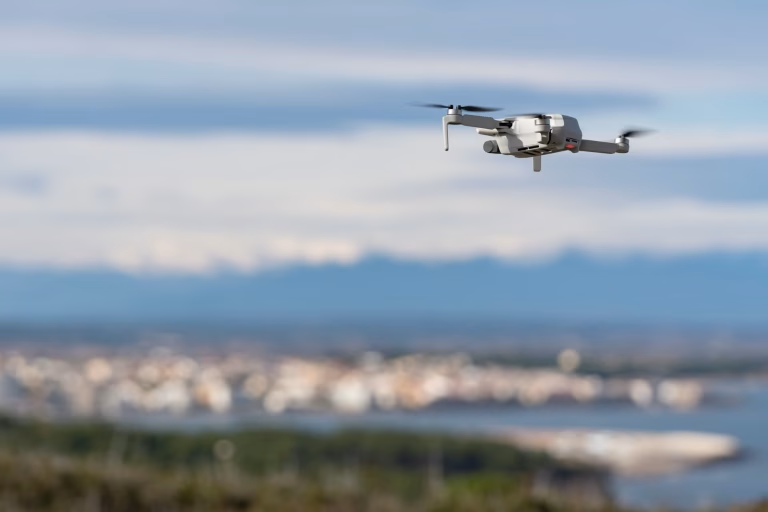
Detect and track a wide spectrum of airborne threats — from rockets and ballistic missiles to hypersonics, drone swarms and even low-flying unmanned aerial systems.
Integrate data from multiple platforms — ground radars, naval sensors, satellite and space-based detectors, airborne early-warning assets — fusing them with AI and predictive algorithms for rapid, coordinated responses.
Provide a coordinated, multi-layered defence: anti-air, anti-missile, anti-drone — and even capabilities to respond to surface or subsurface threats at sea, or asymmetric ground-based attacks.
Offer modularity and interoperability. Michelangelo is designed as an open architecture, compatible with NATO standards — meaning different European nations can plug in their existing military hardware rather than purchasing wholly new systems.
In short: this is not just Italy building a better shield for itself — it’s a blueprint for a pan-European defensive dome.
The decision to unveil Michelangelo Dome comes at a moment of profound uncertainty and rising threats across Europe. From drone-swarm attacks on infrastructure to looming missile and hypersonic risks, the nature of war is evolving faster than existing defence postures. Traditional systems, designed for Cold-War threats, are increasingly inadequate — and fragmented, national defences leave dangerous gaps.
Michelangelo represents a much-needed strategic reset. As Leonardo’s leadership makes clear, the cost of defending cities, energy grids, ports, airports — and by extension, civilian life — now outweighs the cost of investing in cutting-edge defence systems.
It also marks a shift in mindset: from reactive to proactive; from siloed national programmes to integrated, shared European security. The fact the system is built on open, interoperable architecture — rather than a national lockdown — suggests Leonardo sees Michelangelo Dome as a cornerstone for EU-wide or NATO-wide deployment.
For Italy, the benefit is obvious: a home-grown defence solution that enhances sovereignty, protects vital infrastructure and positions Rome as a leader in the European defence industry. For smaller European nations, Michelangelo offers a path to modern air-defence without the massive investment normally needed for a bespoke system.
Of course, the road from blueprint to operational dome is long — and the challenge formidable. Leonardo estimates the system could be fully operational by 2028, still leaving much work in integration, testing, and deployment.
Then there’s cost. While modular and interoperable, the system will likely require substantial investment, not just in hardware but in maintenance, training, logistics and command infrastructure. Member states must commit budgets — a tall order in a Europe still navigating debt, inflation and competing spending priorities.
Political will is another hurdle. While Italy’s government has backed the project, convincing a coalition of European states — each with different threat perceptions and defence priorities — that they need to commit to a shared dome is a task far beyond any corporate presentation.
Finally, integration with existing national or NATO air-defence networks poses technical and bureaucratic challenges. Achieving coordination across land, sea, air, space and cyber domains — with different languages, platforms and doctrines — is a formidable task. Failure to do so could reduce Michelangelo Dome to yet another addon rather than a truly integrated shield.
But even with these challenges, Michelangelo Dome’s unveiling should be viewed not simply as an Italian ambition — but as a wake-up call for Europe. If states continue to rely on outdated Cold-War systems, fragmented defences, and national silos, they risk being unprepared for the threats that define this new era: drones, missiles, asymmetric attacks, and hybrid warfare.
What Leonardo has proposed is more than hardware. It’s a strategic vision — one that acknowledges Europe may need to defend not only borders, but territory, infrastructure, cities and citizens in a world where threats are fast, unpredictable and multidimensional.
For those European capitals that worry about cost or sovereignty, Michelangelo offers another benefit: interoperability. Because it is built on open architecture and NATO standards — not proprietary, national lock-ins — the system can be adapted to existing arsenals. That reduces both cost and political resistance.
If European countries seize this opportunity — coordinate procurement, share data, commit to joint defence — Michelangelo Dome could become the backbone of a European shield: stronger, smarter, and far more resilient than anything seen before.
If they don’t — if Michelangelo remains an Italian toy, or a half-built concept — the cost may come in blood and rubble sooner than anyone wants to admit.
Brussels Votes to Arm Europe: Parliament Green-Lights €1.5bn Defence Industry Push