The ship is assessed to have sustained damage severe enough to prevent it from carrying out its cruise-missile role in the near term, though the scale of the wider damage across the harbour has not been independently confirmed.
The reported hit follows an overnight drone attack on Novorossiysk on 1–2 March, an area that has become central to Russia’s Black Sea basing as Ukrainian strikes have made operations from occupied Crimea increasingly risky. Ukrainska Pravda cited the OSINT community CyberBoroshno as saying satellite imagery showed a strike on the frigate’s midship superstructure, with secondary explosions consistent with the detonation of decoy-launcher ammunition.
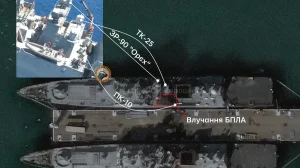
CyberBoroshno’s assessment focused on the ship’s countermeasure and sensor suite rather than its missile launchers. Analysts said the impact point appeared to have triggered the detonation of PK-10 launchers, which are used to deploy passive decoys such as chaff and flares. They also reported damage to the TK-25 electronic warfare system, used for detecting hostile emissions and generating active jamming, and to fire-control radars associated with the ship’s air-defence system. Debris was further assessed as likely having struck the ship’s main Fregat-M2M radar, a key component for long-range detection and tracking.
If accurate, that pattern of damage would be significant for two reasons. First, it would degrade the frigate’s ability to protect itself and nearby vessels against air and drone threats, raising the cost of operating it in contested waters. Secondly, it would complicate any attempt to return the ship rapidly to a strike posture even if its missile cells were physically intact, because modern naval cruise-missile employment relies on a functioning combat system, sensors, and defensive suite to survive in port and at sea.
A source in Ukraine’s Security Service (SBU) told Kyiv Post that the frigate is a carrier of eight Kalibr cruise missiles and that the damage prevents it from launching them. The same report said the vessel was hit during the 2 March attack and is “out of action”, while acknowledging that the status of other warships allegedly affected in the same operation remains unclear.
Separate reporting by the Kyiv Independent, also citing an SBU source, described broader effects from the same operation against Russian naval assets in the area. Those claims included damage to multiple vessels and casualties, though they have not been corroborated by independent imagery in the same level of detail as the assessments published about Admiral Essen.
The OSINT reporting did not suggest Admiral Essen was sunk. Instead, it characterised the strike as a disabling hit to the superstructure and electronic systems. Ukrainska Pravda published satellite images and said Russian monitoring channels claimed that around 200 drones may have been involved in the overnight attack, although the figure is not independently verified.
CyberBoroshno also reported a separate strike on the stern of a Project 1241 Molniya-class missile boat in the same port area. The group said the impacted section houses engines, generators and other propulsion-related systems, as well as close-in weapons mounts, implying a hit intended to immobilise the craft rather than cause magazine detonation.
The Russian Ministry of Defence has not, in the cited reports, provided a detailed public account confirming damage to Admiral Essen. In the absence of Russian acknowledgement and on-site imagery, many of the operational conclusions remain provisional. However, the availability of commercial satellite imagery has increasingly allowed outside analysts to validate at least some strike effects on fixed targets and ships in port when cloud cover and resolution permit.
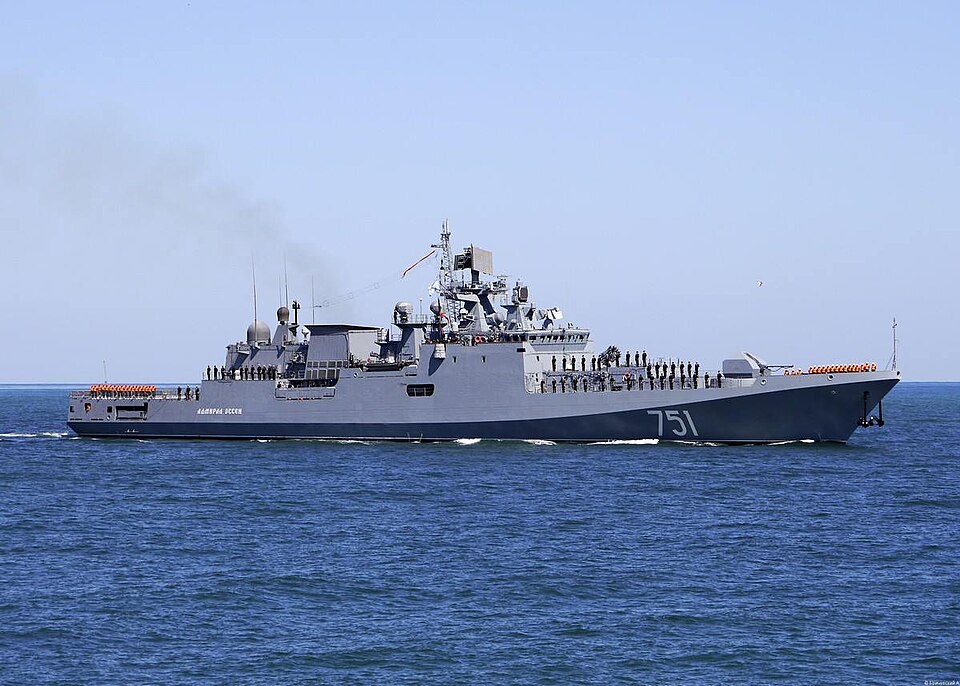
Admiral Essen is a Project 11356R (Admiral Grigorovich-class) frigate launched in 2014 and assigned to the Black Sea Fleet. Ukrainian reporting notes that it has been used in cruise-missile strikes since 2022 and is equipped with Kalibr missiles alongside an air-defence system and naval gun armament.
For Ukraine, operations against ships in Novorossiysk would underline a shift towards striking targets previously regarded as sheltered by distance and layered air defences. For Russia, repeated disruption at rear-area ports would add pressure to repair capacity, fleet readiness, and the security burden around critical naval and energy infrastructure along the Black Sea coast.