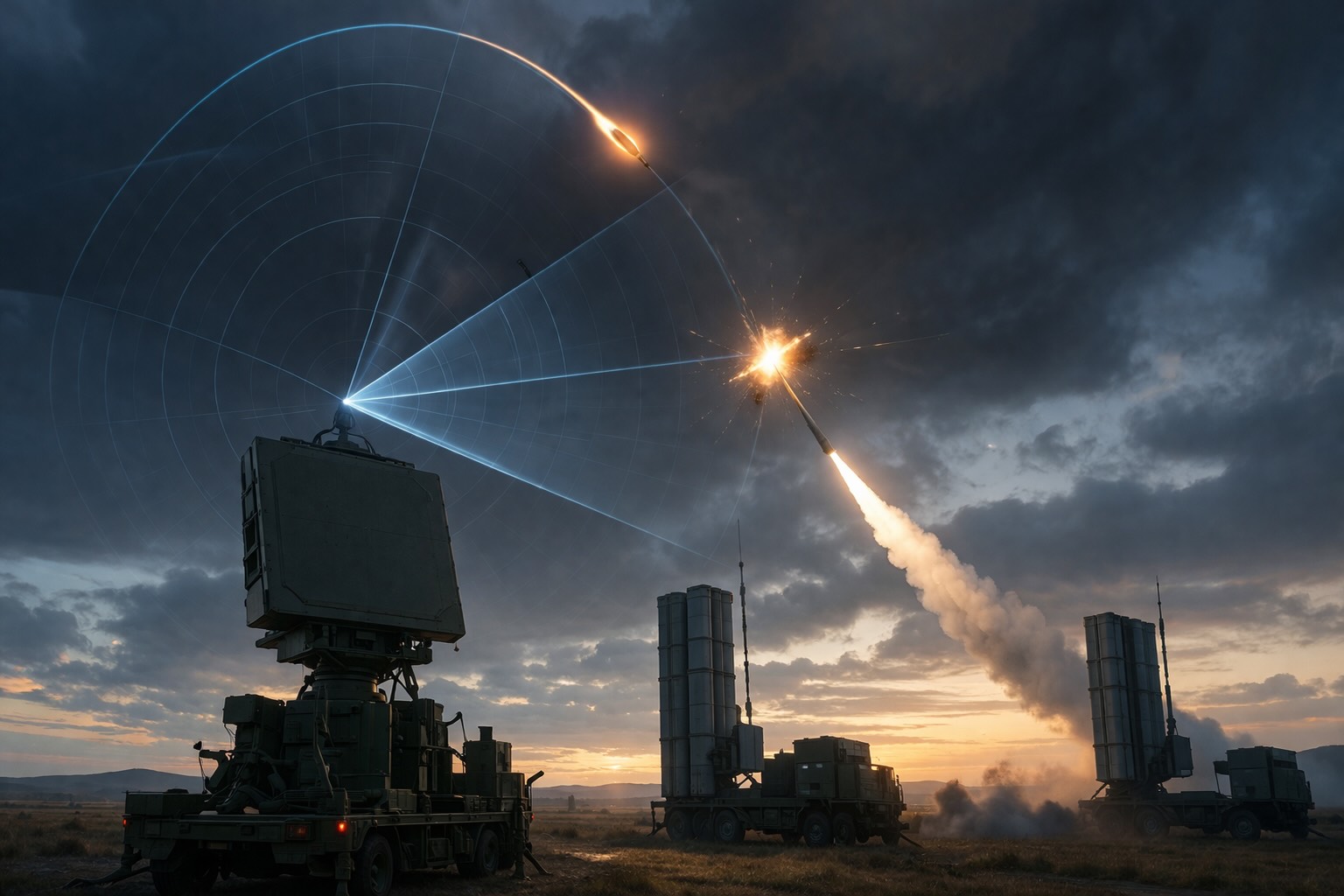
The project was outlined on 6 April by Fire Point, the maker of the Flamingo cruise missile, which said it aims to field the system by 2027 and reduce the cost of a ballistic interception to below $1 million.
That figure is central to the proposal. Existing high-end missile-defence systems such as Patriot remain highly effective, but they are expensive, limited in number and difficult to replace quickly. For Ukraine, the issue is not only performance but sustainability. Repeated large-scale Russian strikes force defenders to think in terms of magazine depth, replacement speed and the cost of each engagement. Fire Point’s pitch is that a lower-cost interceptor layer could make it easier to absorb prolonged pressure without relying entirely on scarce Western systems.
The company said it is in discussions with several European defence firms on the main enabling components, including radar, communications and targeting technologies. That matters because the project is not being presented as a purely Ukrainian stand-alone design. Instead, it appears to be taking shape as a collaborative model in which Ukraine provides battlefield experience, missile development and operational urgency, while European partners contribute the sensor and command elements needed to turn a missile into a functioning air-defence architecture.
The timing is not accidental. Demand for Patriot-class capability has risen sharply across several theatres, and Ukraine is not the only country competing for a limited pool of interceptors and launchers. In that environment, any credible attempt to create a lower-cost ballistic-defence option will attract attention, even if it remains at an early stage. The company’s target date of 2027 also underlines the fact that this is not an immediate battlefield fix. It is a medium-term industrial and capability proposition aimed at addressing a shortage that is now plainly structural rather than temporary.
Fire Point is not a theoretical entrant. The company is already known for the Flamingo long-range strike missile and says it is also developing two supersonic ballistic missiles, the FP-7 and FP-9. According to the company’s outline on 6 April, those programmes form part of a broader expansion of missile and drone production. That gives the air-defence project a clearer industrial context: the same company is trying to scale both offensive and defensive systems, using wartime demand to move from a narrow manufacturer into a larger weapons developer.
For Europe, the more important question is whether this kind of partnership can become a serious part of the continent’s wider defence-industrial response. A cheaper interceptor does not replace Patriot and would not eliminate the need for top-tier Western systems against the most demanding threats. But European governments are increasingly focused on layered air defence, stockpile resilience and lower-cost ways to protect cities, infrastructure and military sites over time. In that context, a Ukrainian-led programme with European technical inputs fits a broader trend: practical wartime collaboration turning into joint industrial development.
That wider pattern is already visible elsewhere. On 1 April, Romania said it was advancing talks with Ukraine on joint drone production using European funding under the EU’s new rearmament framework. The proposed project concerns drones rather than air defence, but it reflects the same strategic logic: Ukraine brings real operational knowledge and tested systems, while EU and NATO states provide finance, industrial depth and production space closer to the European market. The Fire Point proposal appears to sit within that same emerging model of wartime co-development.
There are, however, clear limits to what can be claimed at this stage. The company has set an ambitious timeline, but no completed system has yet been presented publicly, and there is no basis for assuming that technical integration, testing and financing will proceed smoothly. Air-defence programmes are demanding even under peacetime conditions. They require the reliable fusion of sensors, software, command networks and interceptors, and they must prove they can operate under stress. A promise to reduce costs below $1 million per interception is strategically attractive, but it remains a target rather than a demonstrated outcome.
Even so, the proposal deserves attention because it addresses a real capability gap rather than a hypothetical one. Ukraine continues to face a long war in which the economics of air defence matter almost as much as the engineering. The more often Russia can force defenders to spend scarce, high-cost interceptors, the more pressure it places on Ukraine and its partners. A credible lower-cost ballistic-defence layer would not solve that problem on its own, but it could change the arithmetic.
For now, the project is best understood as a serious industrial signal rather than a finished military answer. A Ukrainian manufacturer has publicly set out a plan, tied it to a clear timeline, and said it is seeking European collaboration to make it viable. If that effort matures, it could become one of the more significant examples of how Ukraine’s wartime defence innovation is beginning to shape the next phase of European capability development.