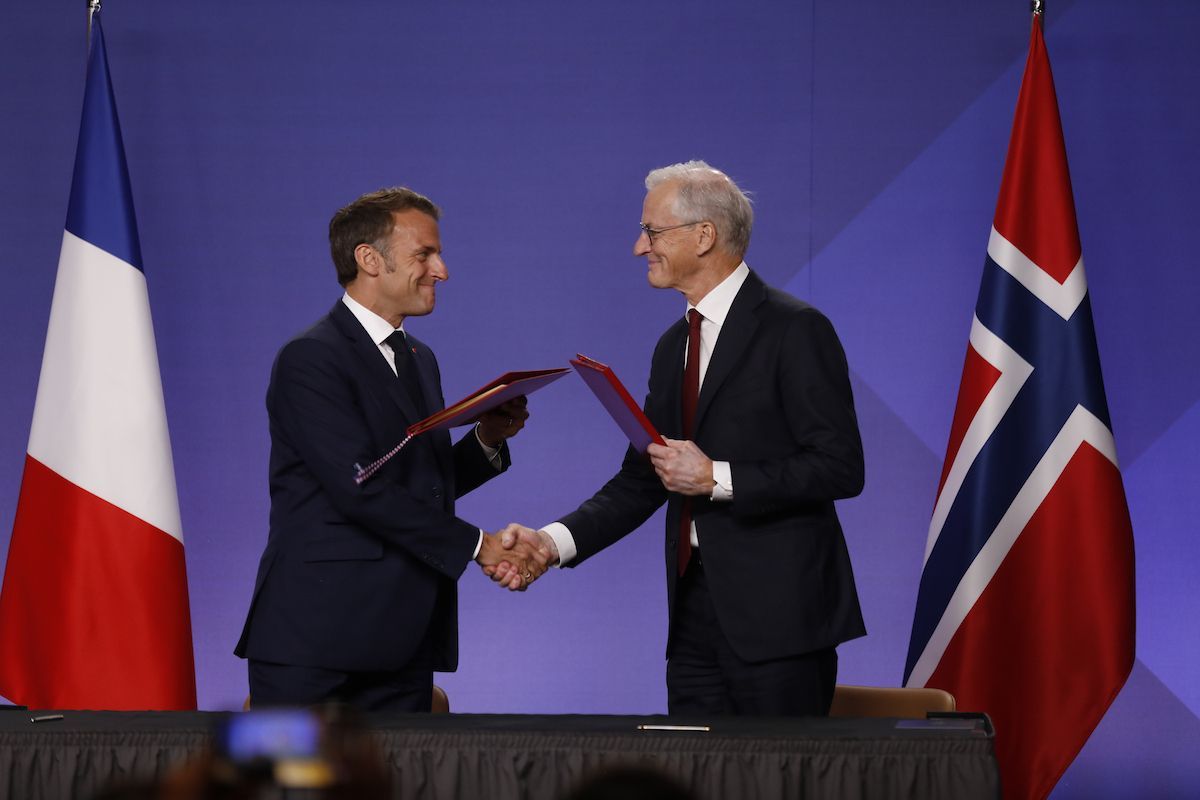
Norway is to come under France’s nuclear umbrella after Prime Minister Jonas Gahr Støre travelled to Paris to meet President Emmanuel Macron and sign a new defence agreement. According to Reuters, the arrangement will bring Norway into a French-led nuclear protection initiative, adding another element to Europe’s evolving debate over deterrence and strategic autonomy.
Støre said the decision was taken in light of the security situation in Europe, including Russia’s large-scale rearmament, its nuclear capabilities, and its full-scale war against Ukraine. Norway is not a member of the European Union, but it is a NATO ally and shares a border with Russia in the Arctic, making the issue of deterrence a direct national security concern.
The Norwegian prime minister also emphasised that nuclear weapons would not be deployed on Norwegian territory in peacetime. That position is consistent with Oslo’s long-standing approach of relying on NATO’s nuclear deterrent while maintaining restrictions on the stationing of nuclear weapons in Norway.
The agreement follows Macron’s earlier proposal to open a European discussion on extending France’s nuclear deterrent to other states. In February, he set out his intention to update France’s nuclear doctrine while maintaining national control over French nuclear forces, as reported by Reuters.
France is one of Europe’s two nuclear-armed powers, alongside the United Kingdom. Its nuclear doctrine has traditionally been based on national sovereignty and independent decision-making, in contrast to the wider European reliance on the United States’ nuclear umbrella through NATO.
The French initiative has gained attention as European governments assess the future reliability and structure of deterrence on the continent. NATO Secretary General Mark Rutte has backed Macron’s nuclear policy shift, while making clear that the United States’ nuclear umbrella remains the ultimate guarantee for European security, according to Reuters.
Norway’s decision should therefore be seen as an additional layer of security rather than a replacement for NATO. It does not alter the central role of Article 5 or the American nuclear guarantee, but it does indicate that European allies are increasingly prepared to discuss complementary deterrence arrangements.
The move also reflects a wider strengthening of defence ties between Oslo and Paris. In February, the Norwegian government announced a separate agreement with France to provide Ukraine with capabilities including surveillance, situational awareness and aerial bombs.
For Norway, the French nuclear framework comes at a time of heightened concern over the Arctic and North Atlantic security environment. Russia’s military posture, its war against Ukraine, and its nuclear signalling have made deterrence a more prominent issue for Nordic defence planning.
The agreement also strengthens Macron’s argument that France’s nuclear forces can contribute to wider European security. Paris has insisted that any such framework would remain under French national control, but the political message is clear: France is offering its deterrent as part of a broader European response to a deteriorating strategic environment.
Several European states have already shown interest in France’s initiative. Germany has argued that any European nuclear umbrella should complement the existing American shield, not replace it. That distinction is important for NATO allies which remain dependent on the United States for the core of their nuclear deterrence.
The practical details of the French-led arrangement remain to be clarified. France has a much smaller nuclear arsenal than the United States or Russia, and its deterrent was not originally designed as an alliance-wide system. The question for European governments is therefore not only political, but also operational: how such protection would be defined, communicated and integrated with NATO planning.
Norway’s participation nevertheless marks a significant step. As a NATO member on Europe’s northern flank, with direct exposure to Russian military activity, its decision gives the French initiative additional weight. It also confirms that Europe’s nuclear debate is moving beyond abstract discussion and into concrete defence policy.