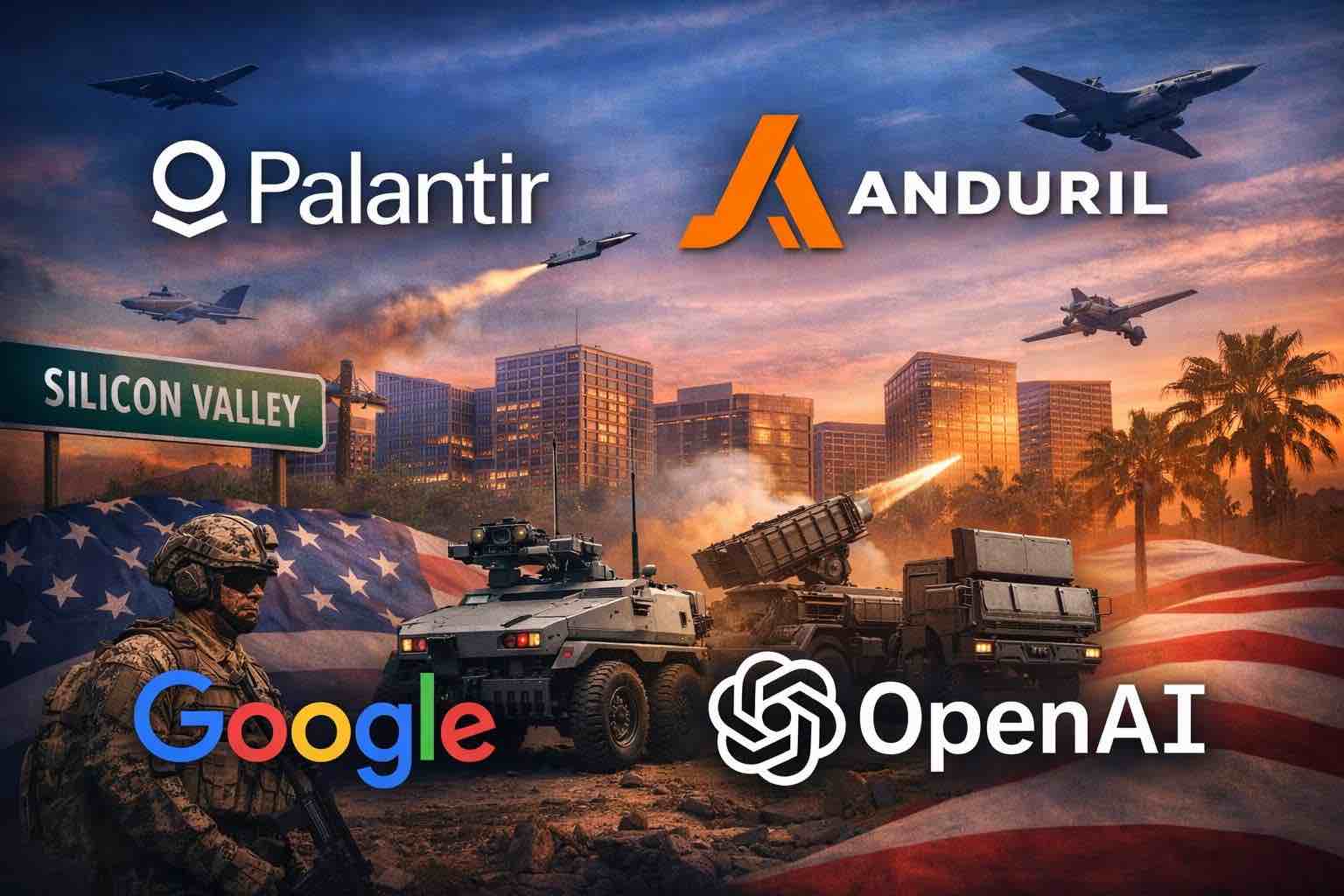
President Donald Trump’s administration has proposed a defence budget of about $1.5 trillion for fiscal 2027, up from roughly $1 trillion in fiscal 2026. That would mark one of the sharpest increases in modern US defence spending and would create a far larger pool of contracts for software, data, autonomous systems and artificial intelligence providers.
For years, the Pentagon’s contracting system has been led by the established giants of the US defence industry. Reuters reported in December 2025, citing Govini data, that large prime contractors including Boeing, Lockheed Martin, RTX and Northrop Grumman still accounted for 92% of Pentagon contracts, while venture-backed defence firms had lifted their share only to 1.3%, from 0.6% a year earlier. That means the old order remains intact, but the direction of travel is becoming clearer.
Among the companies benefiting most visibly is Palantir. Reuters reported in early April that the Pentagon was moving to adopt Palantir’s Maven Smart System more deeply across the US military, following earlier contract awards and an increase in the contract ceiling to $1.3 billion in 2025. Maven began as a drone-imagery analysis project, but it has evolved into a broader military data and decision-support platform.
Palantir’s own 2025 results show why investors have focused on the company. The firm reported US government revenue of $1.855 billion for 2025, up 55% year on year, while Reuters said the group expects total 2026 revenue of just over $7.18 billion. That places Palantir at the centre of the current defence-tech shift: a company whose growth is increasingly tied to federal demand, but whose valuation is being driven by public equity markets rather than by the traditional defence-industrial model.
Anduril is following a different, but parallel, route. In March, the US Army awarded the company a 10-year enterprise contract with a ceiling of up to $20 billion. The Army said the agreement would consolidate more than 120 separate procurement actions into a single framework for Anduril’s technologies, with the stated aim of reducing administrative costs and accelerating the deployment of software, hardware and data infrastructure. Reuters also reported that Anduril has been seeking fresh funding at sharply higher valuations as investors bet on the expansion of military demand.
OpenAI and Google are also moving further into the national security market. Reuters reported in February that OpenAI reached a deal allowing the Pentagon to use its tools on an unclassified network rolled out to more than 3 million Defence Department employees. Later reporting said the Pentagon had signed agreements worth up to $200 million each with OpenAI, Anthropic and Google during the past year, while OpenAI separately said it had reached an agreement with the Pentagon for deployments in classified environments, subject to specific restrictions.
That expansion is not without political and legal friction. Reuters reported in March that the Pentagon had designated Anthropic a “supply-chain risk”, barring its tools from defence contracts after a dispute over safeguards governing military use of its models. A further Reuters report this week said Anthropic remains in talks with the Trump administration over its latest model despite that clash. The episode illustrates that the Pentagon’s embrace of AI suppliers is not uniform, even as demand for such tools grows.
The investment case is therefore not simply about rising military budgets. It is about which companies can convert Washington access into scalable products, recurring contracts and, in some cases, public market value. Reuters reported in March that OpenAI’s annualised revenue had passed $25 billion, while Anduril has been linked to new fundraising at valuations above $60 billion. Those figures show how closely defence demand, enterprise AI and capital markets are starting to intersect.
For European observers and investors, the significance lies in the fact that the US defence market is no longer only a contest between legacy weapons manufacturers. It is increasingly also a contest between software platforms, AI labs and autonomous-systems firms, many of them backed by venture capital and some likely to seek stock market listings. The established primes are still dominant, but the budget surge now under discussion in Washington is giving Silicon Valley’s defence challengers a far larger opening than they have previously enjoyed.