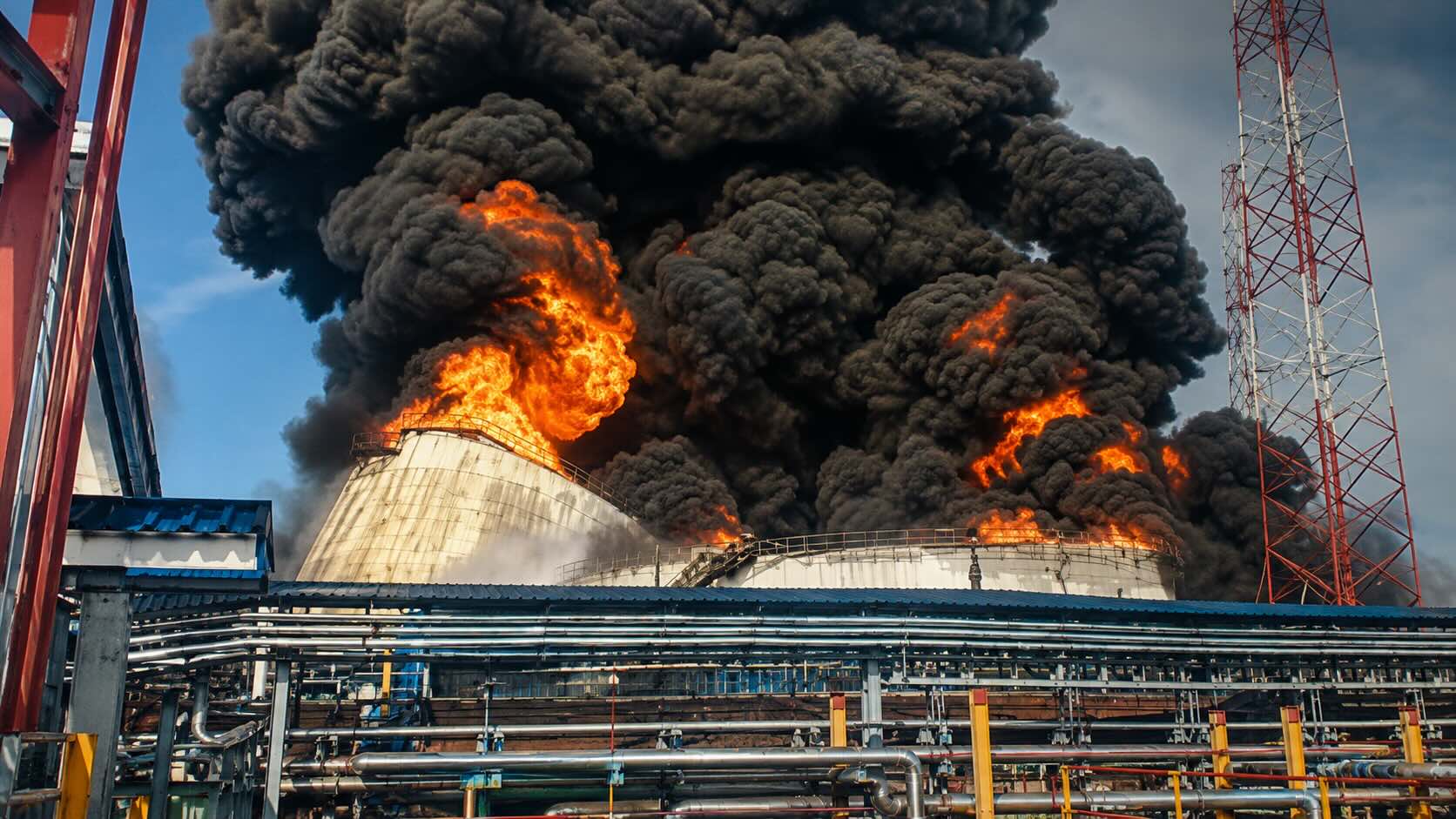
Ukraine’s reported strike on the Lazarevo oil pumping station in Russia’s Kirov region marks a significant development in Kyiv’s campaign against the infrastructure that supports Moscow’s war economy.
The attack, carried out during the night of 30–31 May, targeted a facility deep inside Russian territory, far from the front line and beyond the range that would once have been considered routine for Ukrainian strike systems. According to Ukrainian military reporting, drones operated by Ukraine’s Special Operations Forces struck a major oil pipeline control station in Kirov region.
Russian officials did not identify the facility by name. Kirov governor Alexander Sokolov said that drones had attacked an enterprise in the Urzhum district, causing a fire but no reported casualties. He also reminded residents that local rules prohibit the publication of images or information showing drone strikes and their consequences. Despite those restrictions, videos showing a large fire circulated online, making the incident difficult to minimise publicly.
The reported target, Lazarevo, matters because it is not simply a local industrial facility. It is a linear production and dispatch station, or LPDS, within Russia’s trunk oil pipeline system. Such stations help maintain pressure, regulate flows, monitor transit and support the movement of crude across long-distance pipeline routes. In practical terms, they keep oil moving through the system between production regions, refining centres, export terminals and onward pipeline connections.
Ukrainian sources described Lazarevo as a key point on the Surgut–Polotsk pipeline, while other reporting has referred to the Surgut–Gorky–Polotsk main pipeline network. The route is significant because it links oil-producing areas in Western Siberia and northern Russia with the western part of the country. From there, crude can be moved towards Belarus and towards the Baltic export ports of Primorsk and Ust-Luga.
This gives Lazarevo a role in both domestic oil logistics and export-oriented flows. Russia’s oil business depends not only on wells, refineries and tankers, but also on the pipeline network that connects them. Crude extracted in Siberia must be transported over very long distances before it reaches refineries, export terminals or cross-border pipeline systems. Pumping stations such as Lazarevo are therefore part of the operational backbone of the Russian oil industry.
The station’s reported connection to the wider Druzhba-linked system adds to its significance. Ukraine’s Special Operations Forces said Lazarevo allows oil to be moved between two of the largest pipeline systems in the European part of Russia. That matters because flexibility is central to Russia’s oil business. When one route is disrupted, operators seek to reroute flows through another. A facility that helps move oil between major pipeline arteries therefore has value beyond its immediate location.
For Russia, this kind of infrastructure supports several objectives at once. It helps deliver crude to refineries serving the domestic economy. It enables supplies to move towards Belarus. It also supports exports through Baltic ports, which remain central to Russia’s ability to sell crude and generate state revenue. Even when sanctions, price caps and shipping restrictions complicate trade, Russia’s capacity to move oil physically from production regions to export outlets remains essential.
That is why the Lazarevo strike differs from an attack on a border-region fuel depot. A depot can affect local storage and distribution. A refinery can affect the production of usable fuel. A pumping and dispatch station affects the movement of crude through the wider system. Damage to such a node can create pressure on scheduling, maintenance, rerouting and throughput, even if the broader pipeline network continues to function.
The exact impact of the strike remains unclear. Open-source images of fire do not by themselves establish the scale of structural damage or the duration of any disruption. Russian authorities have released little detail, and Ukrainian sources have an interest in emphasising operational success. However, the fact that Lazarevo was selected as a target is itself revealing. Ukraine is not only striking sites that produce or store fuel. It is also targeting the transport architecture that allows Russia’s oil business to operate as a national and export system.
The economic context is central. Oil remains one of the main sources of revenue for the Russian state. Export income helps finance the federal budget, while domestic petroleum logistics support both civilian consumption and military requirements. A sustained campaign against oil infrastructure therefore has a dual purpose: to complicate military logistics and to impose costs on the revenue base that supports Russia’s war.
The distance is also important. Lazarevo is located roughly 1,200 kilometres from Ukraine. A successful strike at that range indicates that Ukrainian long-range drone capabilities continue to expand, both in reach and in target selection. The issue for Russia is not only that one facility was hit, but that other pipeline nodes, refineries and export-related assets previously regarded as safely distant may now require additional protection.
That presents Moscow with a growing air-defence problem. Russia must decide whether to prioritise front-line military assets, airfields, refineries, depots, ports, command facilities or pipeline infrastructure spread across a vast territory. Each new successful Ukrainian strike increases the number of sites that Russian planners must regard as vulnerable.
The Kirov strike also fits a broader pattern. Ukraine has increasingly targeted Russian oil and fuel infrastructure as part of a long-range campaign aimed at weakening the economic and logistical foundations of Russia’s invasion. Recent reporting has noted that such attacks have become a recurring feature of the war, as Kyiv uses domestically developed long-range drones against facilities linked to Russia’s energy revenues and military supply chains.
For Ukraine, the logic is both economic and strategic. Russia continues to attack Ukrainian cities, energy facilities and civilian infrastructure with missiles and drones. Kyiv is now demonstrating that Russian industrial and energy assets far from the battlefield are also exposed. The purpose is not simply retaliation, but pressure on the systems that help sustain Russia’s military campaign.
The Lazarevo strike is therefore important less because of the fire itself than because of what the target represents. It is a point within the infrastructure that moves Russian crude from the interior towards western routes and export outlets. It connects production, transit, refining and export interests. It is part of the machinery through which oil becomes budget revenue, fuel supply and strategic leverage.
Even limited disruption at such a site can force additional operational work, consume repair resources and raise uncertainty across the network. Repeated strikes on similar nodes would increase those pressures. Russia’s oil pipeline system was built for scale, distance and continuity. Ukraine is now testing its resilience under conditions of war.
The strike on Lazarevo therefore carries a message beyond Kirov region. Russia’s oil infrastructure is extensive, valuable and difficult to defend in full. Ukraine’s long-range drones are increasingly being used to exploit that vulnerability. As the war continues, pumping stations and pipeline junctions may become as important to Kyiv’s target list as refineries, fuel depots and military airfields.