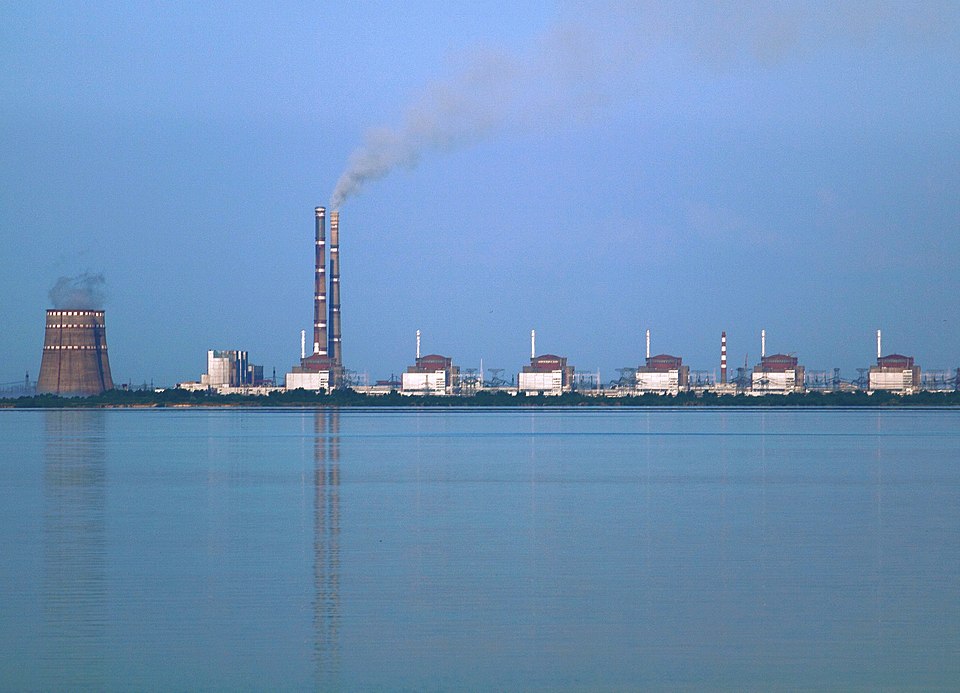
Russia’s claim that a Ukrainian drone struck the Zaporizhzhia nuclear power plant has reopened one of the most sensitive questions of the war: how to verify military incidents at a nuclear facility controlled by one belligerent, contested by the other, and watched by international inspectors with limited access.
Russia’s state nuclear company Rosatom said on Saturday that a Ukrainian drone had hit the turbine hall building of Unit 6 at the Russian-controlled plant, causing an explosion and leaving a hole in the wall. According to Reuters, Rosatom chief Alexei Likhachev said the incident had caused no damage to the plant’s primary equipment, but described it as deliberate.
Ukraine’s military rejected the allegation, calling it another Russian propaganda claim. It said Ukrainian forces had not struck Unit 6 and that no active fighting or use of weapons had taken place in the relevant section of the front at the time. Kyiv also said its forces were aware of the consequences of any action targeting nuclear facilities and operated within international humanitarian law.
The competing claims cannot be treated as equivalent proof. The site is under Russian occupation, access is restricted, and independent verification remains difficult. That is why the role of the International Atomic Energy Agency has become central. The UN nuclear watchdog has maintained experts at the plant and, according to AP, IAEA Director General Rafael Grossi expressed serious concern after the reported incident and sought direct verification of the damage.
The Zaporizhzhia plant is Europe’s largest nuclear power station. Russian forces seized it in March 2022, in the early weeks of the full-scale invasion, and it remains close to the frontline in south-eastern Ukraine. Although its reactors have not been operating in the same way as before the war, the facility still requires stable power, cooling, staff access, physical security and reliable safety systems. A nuclear plant does not cease to be a risk simply because electricity generation has been reduced or halted.
The military significance of the latest allegation is less important than the verification problem it exposes. In an ordinary battlefield incident, claims and counterclaims may shape public perception, but the consequences are limited to the military and political sphere. At a nuclear facility, unverified claims can affect international risk assessments, diplomatic pressure and public anxiety across Europe.
Russia has repeatedly accused Ukraine of threatening the plant. Ukraine has accused Russia of militarising the site and using the facility as a shield. Both sides have used Zaporizhzhia in diplomatic messaging, but the physical reality is that the plant remains in an abnormal and hazardous condition because it is located inside a war zone and under the control of an occupying force.
This is where the information war becomes directly connected to nuclear safety. A drone allegation may be true, false, exaggerated or misattributed. Each possibility carries different implications. If the plant was deliberately targeted, that would raise grave safety and legal concerns. If the allegation is false, it would amount to the use of nuclear-risk messaging for political effect. If the incident was caused by debris, malfunction, misidentification or another source, premature attribution would still distort the international response.
For that reason, publication and policy responses should be cautious. The immediate question is not who can issue the stronger statement, but whether inspectors can examine the reported damage, assess the safety implications and report what they find without political pressure. Without that process, the plant remains vulnerable not only to military incidents but to competing narratives about them.
The incident also comes amid a broader escalation in the drone war. Ukraine has been striking Russian energy and industrial infrastructure, while Russia continues large-scale drone and missile attacks against Ukrainian cities and energy sites. The growth of long-range unmanned warfare increases the risk that critical infrastructure near or behind the front will be drawn into the conflict, whether deliberately or accidentally.
Zaporizhzhia is in a category of its own. An oil depot, refinery or rail node can be a military and economic target. A nuclear power plant cannot be treated in the same way. The legal, environmental and political consequences of damage to nuclear safety systems would extend far beyond the battlefield. That is why the IAEA has repeatedly warned about drones, explosives and military activity near the plant.
The latest claim also illustrates a wider European vulnerability. Nuclear safety in wartime depends not only on engineering standards, but on command discipline, access for inspectors, reliable communications and restraint by military forces operating near the site. When any of those elements becomes uncertain, risk rises even if no immediate radiological release occurs.
For European governments, the case is a reminder that Zaporizhzhia should not be treated as a background feature of the war. The plant remains a live security issue, requiring continued diplomatic attention, technical monitoring and pressure for unfettered inspection access. It is also a test of how international institutions operate when a nuclear facility is held by an occupying power during an active war.
The strongest conclusion that can be drawn at this stage is limited but important. Russia has made a serious allegation. Ukraine has denied it. The IAEA needs direct access to verify what happened. Until that verification is available, the incident should be reported with caution.
What is already clear is that the danger around Zaporizhzhia is not only the possibility of physical damage. It is also the use of nuclear-risk claims as part of the war’s political and informational battlefield. That combination makes the site one of the most dangerous unresolved issues in Europe’s security environment.