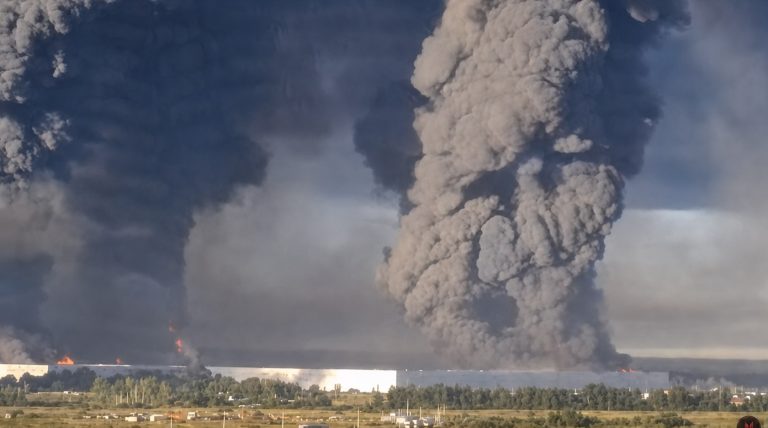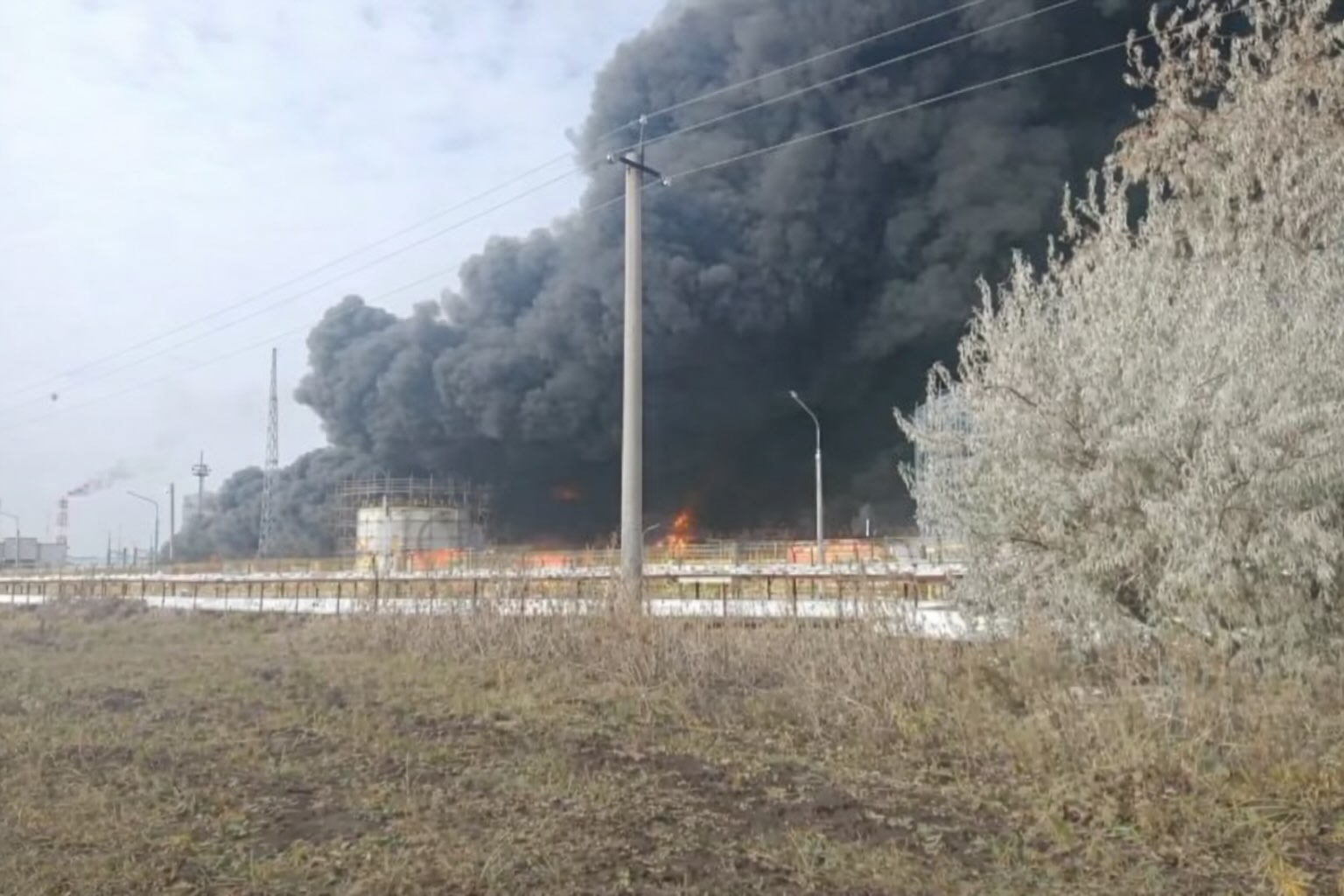
Ukraine appeared to widen its long-range drone campaign against Russian energy and export infrastructure overnight into 18 April 2026, with reported strikes on refineries, oil depots and a Baltic port terminal stretching from the Volga region to the Black Sea and the Gulf of Finland. Industrial sites in Syzran and Novokuibyshevsk in Samara region were hit, while a fire was also reported at Vysotsk port in Leningrad region. Fires linked to drone attacks were likewise reported at an oil depot in Tikhoretsk and an oil terminal in Tuapse, in Krasnodar region.
The pattern of targets matters. Novokuibyshevsk and Syzran both host important refining capacity in the Samara industrial belt, while Vysotsk is one of Russia’s Baltic export nodes for fuel products. Reuters said the fire at Vysotsk was extinguished at a port hosting a Lukoil-operated terminal used for exporting products including diesel, fuel oil and naphtha. That places the attack not simply in the category of tactical harassment, but within Ukraine’s broader effort to disrupt the infrastructure through which Russia processes, stores and moves petroleum products.
Russian officials have tended to frame such incidents in localised terms, usually stressing that air defences were activated and that emergency crews had contained the damage. Yet the geographical spread of the latest wave suggests a co-ordinated attempt to pressure multiple links in the same chain at once: refining in the Volga region, storage in southern Russia, and export capacity on both the Black Sea and Baltic routes. Reuters noted that the same overnight wave also affected Tikhoretsk and Tuapse, underlining the extent of the operation.
There were also reports from Ukrainian and Russian media of a strike in occupied Sevastopol, where an oil storage site was said to have caught fire after an attack lasting more than two hours. Those reports were not part of Reuters’ initial account of the overnight strikes, but they fit the wider pattern of Ukraine targeting fuel infrastructure in occupied Crimea as well as inside Russia proper.
The timing is also significant. The latest Ukrainian strikes came only two days after Russia’s deadliest attack of the year on Ukraine, when overnight missile and drone strikes on 16 April 2026 killed at least 17 people across several cities, including Kyiv, Odesa and Dnipro. Ukrainian officials have repeatedly argued that attacks on Russian fuel and military-related infrastructure are intended to reduce Moscow’s ability to sustain its air campaign and battlefield operations.
Odesa strike sharpens pressure on Europe over Ukraine’s air-defence gap
That argument has become more central as both sides have expanded the range and frequency of deep strikes. What was once seen as a largely symbolic use of drones against distant targets has developed into a sustained campaign against Russia’s energy system. In recent weeks Ukraine has also targeted other major oil export and refining sites, including the Novorossiysk and Tuapse area. Reuters reported on 13 April 2026 that damage to the Sheskharis terminal at Novorossiysk had already forced Rosneft to divert crude supplies and adjust refinery operations, showing that repeated attacks can have operational and commercial consequences beyond the immediate fire damage.
From Kyiv’s perspective, the latest strikes may therefore serve several purposes at once. They impose costs on Russian logistics, force the diversion of air defence resources, and create uncertainty around fuel processing and export routes. By hitting refineries, depots and port terminals rather than residential districts, Ukraine is also seeking to frame these operations as attacks on war-supporting infrastructure rather than on civilian population centres. That distinction is politically important for Kyiv as it continues to answer Russian strikes that have repeatedly hit housing and urban infrastructure in Ukrainian cities. The scale of the Russian attack on 16 April gives that context particular weight.
Whether these strikes will alter Russian military decision-making is harder to judge. Russia has shown an ability to repair damaged facilities, reroute flows, and absorb repeated disruption. Even so, sustained attacks on refineries and terminals increase costs, complicate logistics, and expose vulnerabilities in sites once thought safely beyond the frontline. The overnight strikes on Novokuibyshevsk, Syzran, Tikhoretsk, Sevastopol and Vysotsk indicate that Ukraine is continuing to push that strategy across a broad arc of Russia’s energy geography. At minimum, they are a reminder that the war’s economic and industrial dimension is becoming ever more prominent, and that the battle over fuel infrastructure is now an established part of the war.